
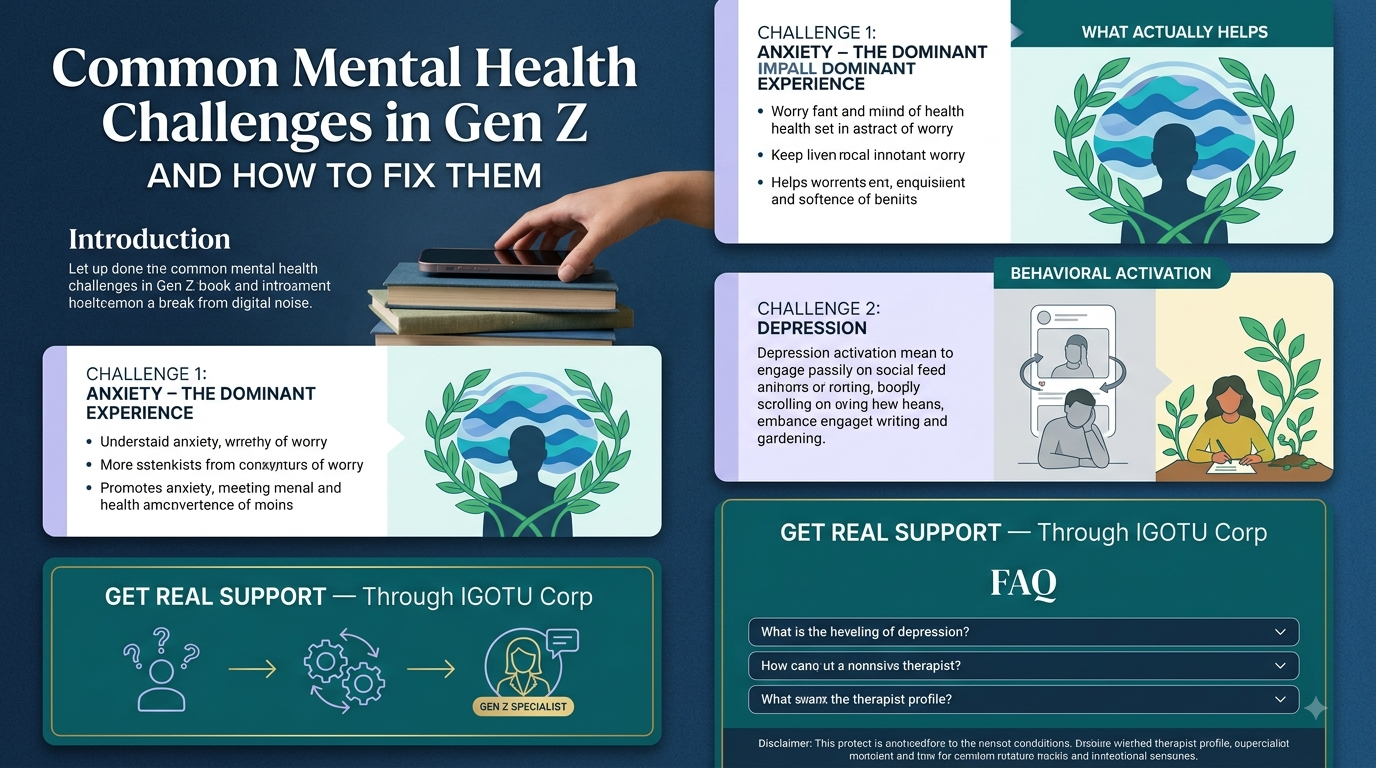
Common Mental Health Challenges in Gen Z and How to Fix Them
Mental Health Challenges in Gen Z shaped by social media, economic anxiety, identity pressure, and a world that changed fundamentally during their formative years. Here is what is actually happening and what genuinely helps.
Every generation has its struggles. But the data on Gen Z mental health is not simply a continuation of a trend that has always existed — it represents a measurable, significant departure from previous generational patterns that demands honest examination rather than dismissal as millennial-style oversharing or generational softness.
According to the American Psychological Association, Gen Z — broadly defined as people born between 1997 and 2012 — reports the highest rates of mental health conditions of any living generation. They are more likely than any other age group to report a diagnosed mental health condition. They are more likely to seek therapy — and simultaneously more likely to report unmet mental health needs. They are, by multiple measures, struggling in ways that their parents and grandparents did not at the same age — and the reasons are specific, structural, and worth understanding clearly.
This is not softness. It is not fragility. It is the predictable psychological consequence of a specific set of circumstances that no previous generation navigated — and understanding those circumstances is the foundation of addressing them effectively.
This article names the most significant mental health challenges Gen Z faces, explains their specific origins, and describes what the evidence shows actually helps — not generic wellness advice, but targeted interventions that address what is actually wrong.
What Cause Mental Health Challenges in Gen Z
Before naming the specific challenges, it is worth establishing the context that makes Gen Z’s mental health situation distinct — because the challenges cannot be addressed without understanding what produced them.
They are the first generation to grow up entirely inside social media. The oldest Gen Z members were in middle school when social media became mainstream. The youngest have never experienced adolescence without it. The psychological consequences of growing up with constant peer comparison, public performance of identity, cyberbullying, doomscrolling, and algorithmic amplification of the most emotionally activating content during the most neurologically vulnerable developmental period in human life are not yet fully understood — but what is understood is significant and concerning.
They came of age during a period of compounding collective trauma. School shootings, climate anxiety, a global pandemic that closed schools and severed social connections at critical developmental stages, economic instability, and a political environment characterized by crisis and polarization — Gen Z has processed an unusual concentration of large-scale threatening events during their formative years.
They entered adulthood into economic conditions that make traditional markers of stability feel inaccessible. Housing costs, student debt, job market volatility, and the erosion of the economic structures that gave previous generations a sense of forward trajectory have created a specific form of existential anxiety about the future that is not irrational but is genuinely debilitating.
They are, paradoxically, the most connected and most isolated generation simultaneously. They have more tools for social connection than any previous generation — and they are lonelier. The distinction between online connection and embodied connection matters psychologically in ways that have become increasingly clear.
Challenge 1: Anxiety — The Dominant Experience of Gen Z Mental Health
Anxiety is the defining mental health experience of Gen Z. Research consistently finds that anxiety disorders are more prevalent in this generation than in previous ones at the same age — and that subclinical anxiety is nearly universal.
The anxiety Gen Z experiences is not uniform. It clusters into several specific forms:
Social anxiety amplified by social media. The constant availability of peer comparison, the public documentation of social inclusion and exclusion, the permanent record of social performance, and the quantification of social worth through likes and followers — all of these have created conditions uniquely hostile to healthy adolescent social development. Normal social anxiety, which has always been a feature of adolescence, has been amplified by a technology environment that makes social evaluation continuous, public, and permanent.
Climate anxiety. The American Psychological Association recognizes eco-anxiety as a legitimate clinical concern — and Gen Z experiences it at rates significantly higher than older generations. They have grown up with the explicit knowledge that the planet is in crisis, that previous generations contributed to that crisis, and that the consequences will fall disproportionately on them. This is not irrational fear — it is an accurate response to real information, which makes it particularly difficult to address through ordinary cognitive restructuring techniques that require challenging the accuracy of the feared thought.
Anticipatory anxiety about the future. Economic instability, job market uncertainty, housing inaccessibility, and the general sense that the pathways that worked for previous generations are no longer reliably available have produced a specific form of future-oriented anxiety that functions differently from classic anxiety disorders — it is partially grounded in real circumstances rather than distorted appraisal, which changes the therapeutic approach required.
What actually helps: CBT remains the gold standard for anxiety disorders in Gen Z — with specific adaptations that account for the social media dimension. Exposure-based work for social anxiety must grapple with the digital dimension of social fear, not only the in-person one. For climate anxiety specifically, ACT’s values-based approach is particularly well-suited — helping young people engage with what they can actually influence rather than being paralyzed by what they cannot.
Challenge 2: Depression — Quiet, Chronic, and Frequently Missed
Depression rates in Gen Z have risen sharply over the past decade — with particularly dramatic increases in adolescent girls, among whom rates of persistent feelings of sadness and hopelessness have roughly doubled since 2011.
What makes Gen Z depression clinically distinctive is its frequent functional depression— the depression that does not collapse functioning but quietly makes everything harder, flatter, and less worth doing. Gen Z has normalized a kind of ambient low-grade depression — sometimes called “languishing” in popular discourse — that is pervasive enough to feel like personality rather than symptom.
The social media connection to depression operates through several mechanisms: passive consumption of carefully curated content that makes ordinary life feel inadequate, social comparison that is continuous and involuntary, the dopaminergic conditioning of likes and engagement that makes ordinary experience feel insufficiently stimulating, and the displacement of the activities — sleep, exercise, face-to-face social interaction — that most reliably protect against depression.
Cyberbullying represents a specific and significant depression driver — with research consistently showing that victims of cyberbullying are significantly more likely to develop depression than those who experience in-person bullying alone, partly because the harassment is omnipresent (it follows you home), permanent (it is documented), and public (it happens in front of a visible audience).
What actually helps: Behavioral Activation is particularly well-matched to Gen Z depression — because the motivational deficit and anhedonia that characterize depression in this generation are directly addressed by systematically re-engaging with activities that provide genuine reward rather than algorithmic stimulation. Reducing social media consumption — particularly passive scrolling — has shown consistent benefit in depression research. Human connection, exercise, and sleep are not clichés in this context; they are the behavioral interventions with the strongest evidence base for depression, and Gen Z is systemically deprived of all three.
Challenge 3: Loneliness — Pandemic-Amplified and Structurally Maintained
Gen Z is the loneliest generation on record — a finding that is both intuitive given their social media saturation and paradoxical given the connectivity those platforms represent.
The COVID-19 pandemic was particularly devastating to Gen Z’s social development. Many members of this generation lost critical social developmental windows — the high school years, the first year of university, the early years of independent adulthood — to lockdowns, remote learning, and the severing of in-person social contact at precisely the ages when social bonding is neurologically most significant.
The loneliness that resulted was not simply situational. It was developmental — the connections that should have been formed during those years, the social skills that should have been practiced, the independence that should have been built — all of these were disrupted in ways that continue to affect Gen Z social functioning years after restrictions lifted.
The structural loneliness of Gen Z also reflects something about how social life has changed. The third places — cafes, community centers, clubs, places of worship, neighborhood gathering spaces — that provided previous generations with ambient social connection have declined. The algorithmic social world that replaced them provides stimulation without the depth of social contact that human neurobiological systems actually require.
What actually helps: Research on loneliness consistently shows that quality of connection matters more than quantity. For Gen Z, this means prioritizing the development of a small number of genuinely deep friendships over the accumulation of online social contacts — a reorientation that is psychologically counterintuitive given their social conditioning but neurobiologically necessary. Therapy specifically helps with the social anxiety and relational patterns that prevent the depth of connection that resolves loneliness.
Challenge 4: Identity Pressure and the Performance of Self
Gen Z has grown up in a social environment that both expands identity possibilities and demands their constant public performance in ways that create a specific form of psychological pressure that previous generations did not face.
The expansion of identity categories — around gender, sexuality, politics, values, aesthetics, dietary choices, and more — is in many ways positive. It creates space for more authentic self-definition than previous generations had access to. But it also creates a demand for premature identity consolidation — the pressure to know and publicly declare who you are before the developmental work of figuring that out has had adequate time.
Social media amplifies this pressure in specific ways. Identities that are performed publicly — shared, documented, and presented to an audience — carry the added burden of audience response. The identity that garners approval is reinforced; the identity that does not is discouraged. The result is a generation that has learned to form identity partly through the feedback mechanism of public performance — which creates a fragile, audience-dependent sense of self that is particularly vulnerable to the instability that characterizes adolescence and early adulthood.
What actually helps: Psychotherapy — particularly approaches that emphasize values clarification and identity development, such as ACT and narrative therapy — helps Gen Z clients develop a more internally grounded sense of self that is less dependent on external validation. Building identity through direct experience, skill development, and committed action rather than through social media performance produces more stable and more durable self-concept.
Challenge 5: Burnout at an Age It Was Not Supposed to Arrive
Burnout has historically been associated with mid-career adults — people who have been giving everything to their work for fifteen or twenty years and have finally run out. Gen Z is experiencing burnout at 22.
The specific form of Gen Z burnout reflects the specific pressures this generation navigates: the academic pressure that begins in elementary school and does not relent, the extracurricular performance required for university admission, the expectation of internships and portfolio-building during the years that used to be available for exploration and rest, and the entry into a job market that demands perpetual availability and personal branding alongside actual work performance.
The pandemic added a specific burnout dimension — the fatigue of sustained collective crisis, of online learning that removed the embodied social context that makes learning meaningful, of managing pandemic anxiety while maintaining academic performance.
Gen Z burnout is also partly a burnout of hope — the exhaustion of sustained effort toward goals that do not reliably deliver the promised outcomes. The generation that was told education was the pathway to stability, only to graduate into a job market that does not reliably reward that investment, carries a specific grief about the gap between what they were promised and what they are living.
What actually helps: Burnout treatment requires both immediate symptom management and structural change — the same conditions that produced the burnout will reproduce it unless something changes. Therapy for Gen Z burnout helps identify which demands are genuinely non-negotiable and which are internalized standards that can be revised. Genuine rest — not productive leisure, not self-improvement activities — is a clinical intervention, not a reward. Permission to rest, given by a professional in the context of a clinical assessment, is sometimes the most practically significant thing a therapist can provide.
Challenge 6: Trauma and the Generation That Grew Up in Crisis
Gen Z has experienced an unusual concentration of collective trauma — school shootings, a global pandemic, climate disasters, social upheaval — during their formative developmental years. The neurobiological consequences of growing up with these experiences as background context are significant.
The specific feature of Gen Z trauma that distinguishes it from previous generational trauma is its ambient quality — it is not the trauma of a single event with a clear before and after, but the cumulative effect of sustained exposure to threatening information, uncertain safety, and the persistent awareness that catastrophic events can happen anywhere, at any time, without warning.
This ambient trauma produces a specific hypervigilance — a nervous system calibrated to a higher baseline threat level — that functions like PTSD without a single identifiable trauma event. It is diffuse, chronic, and difficult to address with trauma therapies designed for discrete event processing.
What actually helps: Somatic approaches that address the nervous system’s baseline activation level — rather than processing specific traumatic memories — are particularly relevant for Gen Z’s ambient trauma experience. Mindfulness-based approaches, body-based regulation practices, and therapies that address the nervous system’s overall calibration rather than specific events complement the cognitive and behavioral work of more traditional trauma treatment.
Get Real Mental Health Support Designed for What Gen Z Is Actually Facing — Through IGOTU Corp
Gen Z is the generation that destigmatized therapy. They are more likely than any previous generation to recognize mental health struggles, use mental health language accurately, and believe that seeking help is a sign of self-awareness rather than weakness.
What they need now is not more awareness — it is more access to clinical support that understands the specific landscape they are navigating. Not a therapist who treats their social media use as a character flaw, or their climate anxiety as catastrophizing, or their identity exploration as confusion to be resolved. A therapist who understands the specific structural, technological, and developmental circumstances that have produced Gen Z’s mental health challenges and is equipped to address them with approaches calibrated to this generation’s actual experience.
IGOTU Corp connects Gen Z clients with licensed mental health professionals who specialize in the specific challenges this generation faces — anxiety, depression, loneliness, burnout, identity, and trauma, understood in the context of the world Gen Z is actually living in rather than the world previous generations navigated.
Their therapists are not only licensed and vetted — they are matched to you based on the specific nature of what you are dealing with, so you are not explaining the social media dimension of your social anxiety to someone who does not understand it or justifying your climate anxiety to someone who thinks you are catastrophizing.
If you are a Gen Z person who has been carrying something and has not yet found the right support — or a parent watching a young person struggle and wanting to find them real help — visit IGOTU Corp today and take their free mental health assessment. Because the generation that destigmatized therapy deserves access to therapy that actually meets them where they are.
Frequently Asked Questions (FAQs) | Mental Health Challenges in Gen Z
Q: Why is Gen Z so much more anxious and depressed than previous generations? The research points to several converging factors: the introduction of smartphones and social media during critical developmental periods, economic instability that makes traditional pathways to security feel inaccessible, a concentration of collective trauma events during formative years, and the disruption of social development by the COVID-19 pandemic. These are structural causes, not generational weakness.
Q: Does social media cause Gen Z mental health problems? Research consistently shows associations between heavy social media use — particularly passive consumption — and depression and anxiety in adolescents and young adults. The relationship is particularly strong for adolescent girls. Causality is complex and bidirectional — social media worsens mental health, and worse mental health increases social media use. The most consistent protective finding: reducing passive social media consumption and increasing in-person social connection improves mental health outcomes.
Q: Is Gen Z more likely to seek therapy than previous generations? Yes — significantly. Gen Z has the highest therapy utilization rate of any generation and the lowest mental health stigma. They are also, paradoxically, more likely to report unmet mental health needs — reflecting a demand-supply gap in mental health care rather than a reluctance to seek it.
Q: What mental health issues are most common in Gen Z? Anxiety disorders are the most prevalent, followed by depression, loneliness and social isolation, ADHD (increasingly diagnosed in this generation), eating disorders, and trauma-related conditions. Many Gen Z individuals have multiple co-occurring conditions — reflecting both genuine comorbidity and the interconnected nature of the social, technological, and economic stressors affecting this generation.
Q: Can Gen Z mental health challenges be treated effectively? Yes — with treatment that is calibrated to their specific presentation. CBT, ACT, DBT, EMDR, and other evidence-based approaches are effective for Gen Z mental health conditions when delivered by therapists who understand the specific context this generation is navigating. The evidence for treatment effectiveness is not generation-specific — effective treatments work across age groups, with appropriate adaptation.
Q: Is climate anxiety a real mental health condition? The American Psychological Association recognizes eco-anxiety as a legitimate psychological response to climate-related threats. It is not classified as a standalone disorder in the DSM-5 but is clinically significant when it impairs functioning. Therapeutic approaches that address eco-anxiety focus on moving from paralysis to agency — identifying specific, meaningful action rather than helpless rumination — which is different from cognitive restructuring approaches designed for anxiety based on distorted threat appraisal.
Q: How do I find a therapist who understands Gen Z mental health specifically? Look for therapists who explicitly acknowledge familiarity with social media’s psychological impact, who do not pathologize identity exploration, and who understand the specific stressors of this generation’s economic and social context. IGOTU Corp’s matching process specifically connects Gen Z clients with therapists who understand their generation’s unique challenges — removing the burden of explaining the context before you can get to the help. Visit IGOTU Corp today to get matched.
The Bottom Line: Gen Z Deserves Treatment That Understands Their World
The mental health challenges in Gen Z faces are not imaginary, not exaggerated, and not the product of generational weakness. They are the predictable and measurable psychological consequence of growing up inside a specific set of technological, economic, social, and developmental circumstances that no previous generation navigated.
Addressing them requires more than generic mental health advice repackaged for a younger audience. It requires clinical support that understands the specific mechanisms — how social media shapes anxiety and identity, how ambient collective trauma differs from event-based trauma, how loneliness operates differently in a digitally saturated social world, how burnout arrives at 22 rather than 42 when the conditions are right.
That understanding exists. Therapists who possess it exist. The treatment approaches that work for Gen Z’s specific presentations exist and are well-evidenced.
What remains is access — and the willingness to pursue it with the same commitment that Gen Z has already shown in destigmatizing the conversation about mental health in the first place.
IGOTU Corp is ready to connect you with the right licensed professional for what you are specifically dealing with. Take the free assessment today — and let the generation that changed the conversation about mental health be the one that also leads the way in actually getting help.
Recent Posts
Related Posts

What to Expect During Your First 7 Days at a Depression Center
The night before you start treatment can feel strange. Part of you is relieved that help is finally coming. Another...

How to Protect Your Mental Health Without Sacrificing Your Career
It is Sunday evening and your stomach is already tight. You are replying to emails you will see again in...

How to Find a Licensed Male Therapist in California
Plenty of people know the moment they decide they want therapy. Fewer people know what to type into the search...

How to Do the 5-4-3-2-1 Technique Silently in Class
Learn how to manage anxiety discreetly during class using the simple and effective 5-4-3-2-1 grounding technique in this article. Exclusive...
How to Set Boundaries Without Guilt: Stop People Pleasing
You said yes again. You knew while the words were leaving your mouth that you did not want to say...