
What Is the 54321 Grounding Technique? How Does It Actually Work?
If you have ever looked up what to do during a panic attack, an anxiety spiral, or a moment of acute overwhelm, there is a good chance you encountered the 54321 grounding technique. It gets recommended constantly; by therapists, by mental health apps, by well-meaning friends who read about it somewhere.
And the advice usually goes something like this: name five things you can see, four things you can touch, three things you can hear, two things you can smell, one thing you can taste. Focus on your senses. It helps with anxiety.
Which is true. It does help with anxiety. But “focus on your senses” without any explanation of why focusing on your senses does anything is the kind of incomplete guidance that makes people try it once during a panic attack, find it harder than expected in the middle of acute fear, assume it did not work, and abandon one of the genuinely most effective in-the-moment anxiety interventions available.
This article goes further than the standard explanation. It tells you what is actually happening neurologically when you use this technique, why it works when it works, what makes it fail when it fails, and how to use it in a way that produces the maximum benefit in the moment when you actually need it.
What Is the 54321 Grounding Technique?
The 54321 grounding technique — also written as the 5-4-3-2-1 technique or called the five senses grounding exercise — is a structured sensory awareness practice used to interrupt anxiety, panic, dissociation, and acute emotional overwhelm by redirecting attention from internal distress to the immediate sensory environment.
The structure is simple:
5 — Name five things you can currently see. Not from memory. Not imagined. Actually present in your immediate visual field right now.
4 — Name four things you can currently touch or feel physically. The texture of your clothing. The temperature of the air. The pressure of your feet on the floor. The surface beneath your hands.
3 — Name three things you can currently hear. Background sounds that were there before you started listening for them. Your own breathing. Something outside the window.
2 — Name two things you can currently smell. If nothing is immediately obvious, notice the neutral smell of the air or move toward something with a scent.
1 — Name one thing you can currently taste. The residual taste in your mouth. A piece of gum. A sip of water.
The counting structure — decreasing from five to one — is not arbitrary. It provides a cognitive scaffold that gives the anxious mind something to follow even when executive function is compromised by acute distress. The decreasing numbers create a mild sense of completion and forward movement that helps sustain engagement with the technique through to the end.
Where Did the 54321 Technique Come From?
The 54321 grounding technique has roots in several clinical traditions simultaneously — which explains why it appears in so many different therapeutic contexts.
It draws most directly from grounding techniques developed in trauma therapy — specifically from the work of trauma therapists who recognized that clients experiencing flashbacks, dissociation, or acute trauma responses needed tools to reorient to the present moment and to the safety of the current environment. The sensory focus of grounding techniques was specifically designed to interrupt the time-distortion of trauma — the way traumatic re-experiencing pulls consciousness out of the present and into the past.
It also reflects principles from mindfulness-based interventions — particularly the mindfulness practice of deliberate sensory awareness as a way of anchoring attention in present-moment experience rather than in cognitive content. The overlap between grounding and mindfulness is significant and intentional.
Elements of it appear in Dialectical Behavior Therapy (DBT) — specifically in the distress tolerance skill set that teaches specific techniques for surviving acute emotional crises without making them worse.
The specific 54321 counting structure appears to have emerged from clinical practice and been refined through use rather than arising from a single published protocol — which is why it appears across so many different therapeutic traditions without a single definitive origin point.
The Neuroscience: What Is Actually Happening in Your Brain
This is the part that most explanations skip — and it is the part that makes the technique genuinely understandable rather than just a thing you were told to try.
The Amygdala Is Running the Show During Acute Anxiety
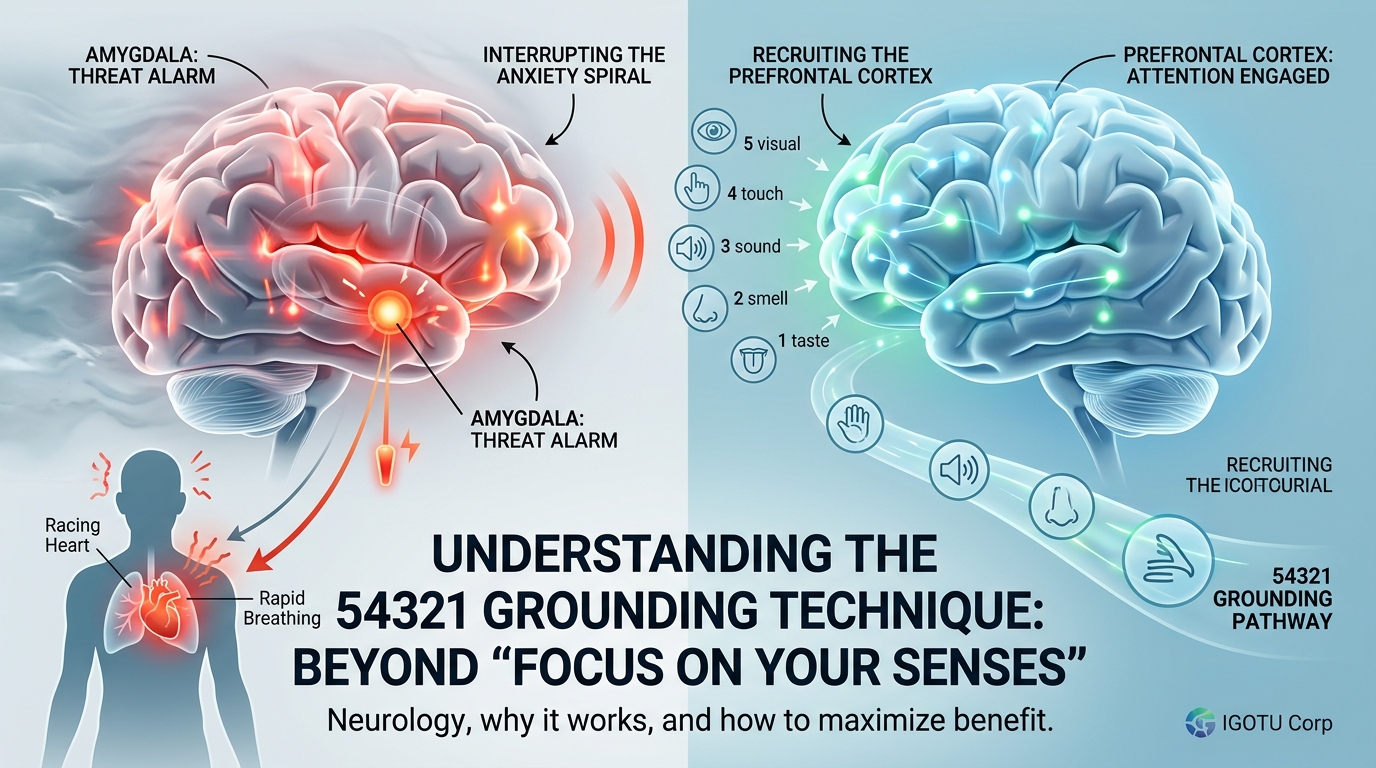
During acute anxiety or panic attack, the amygdala — the brain’s threat-detection center — has essentially taken over the bus. It has fired an alarm that floods the body with adrenaline and cortisol, activated the full sympathetic nervous system stress response, and redirected cognitive resources toward scanning for threat.
In this state, the prefrontal cortex — the brain region responsible for rational thought, perspective-taking, planning, and the recognition that you are not actually in danger — is significantly less accessible. This is not a failure of intelligence or willpower. It is a designed feature of the stress response: when your ancestor was being chased by a predator, the time it takes to rationally evaluate the situation was not a survival asset.
The problem is that this same system fires during panic attacks and anxiety spirals — situations where the threat is not external and physical but internal and psychological. The amygdala cannot distinguish. It fires the same alarm either way.
Sensory Engagement Recruits the Prefrontal Cortex Back Online
Here is what the sensory focus of the 54321 technique actually does neurologically: it recruits the prefrontal cortex.
When you direct deliberate attention to specific sensory details of your immediate environment — naming what you see, describing the texture of what you touch — you are engaging the prefrontal cortex in a task. Not a threatening task. Not an anxiety-generating task. A concrete, present-moment, perceptual task that requires attention and description.
This engagement has a measurable effect on the amygdala’s activity. The prefrontal cortex and the amygdala have an inhibitory relationship — increased prefrontal activity modulates amygdala reactivity. By giving the prefrontal cortex something concrete and non-threatening to engage with, sensory grounding exercises shift the neurological balance away from pure amygdala dominance toward a more regulated state.
This is not the same as thinking your way out of anxiety. Rational argument with an activated amygdala is largely ineffective — the amygdala does not respond to logic in the moment. But sensory engagement is different from rational argument. It is bottom-up as much as top-down — it works through attentional redirection and perceptual engagement rather than through cognitive reasoning about whether the anxiety is justified.
Affect Labeling: Why Naming Things Matters
The naming component of the 54321 technique — actually saying or thinking words to describe what you observe — activates a specific neurological mechanism that researchers call affect labeling.
Research by Matthew Lieberman at UCLA has consistently shown that putting experience into words — naming emotions, describing sensations — measurably reduces amygdala activation. The act of naming something is processed differently in the brain than simply perceiving it. It requires a different kind of attention and engages language regions that are associated with the more regulatory, cortically-mediated processing that anxiety suppresses.
In the 54321 technique, you are not just noticing the blue chair in the corner. You are naming it: “I see a blue chair.” That naming step — which seems almost redundant — is doing specific neurological work that pure observation does not.
Sensory Grounding Interrupts the Internal Focus of Anxiety
Anxiety is predominantly an internal experience. The racing thoughts are about the future — catastrophic predictions, worst-case scenarios, rumination about what might go wrong. The physical symptoms are in your body. The attention is directed inward and forward in time.
The 54321 technique forcibly redirects attention outward and into the present moment. Not through willpower — through task engagement. When you are genuinely looking for five specific things you can see right now, your attention is occupying itself with the external, present-moment environment rather than with the internal, future-oriented content of anxiety.
This redirection is not a cure. The anxiety content does not disappear. But the attentional occupation of the task creates what is sometimes called a cognitive interruption — a disruption of the anxiety cycle that creates space between the anxious stimulus and the anxious response.
That space — even a small one — is where regulation becomes possible.
Why It Works Better for Some Situations Than Others
The 54321 technique is not equally effective in all anxiety situations, and understanding the conditions where it works best helps you use it strategically rather than as a blunt instrument for all distress.
It Works Best For
Panic attacks and acute anxiety episodes. The sudden, physically overwhelming quality of panic attacks is precisely what sensory grounding is designed to interrupt. The technique gives the amygdala-dominated mind something specific and concrete to engage with rather than spiraling further into catastrophic interpretation of physical symptoms.
Dissociation and trauma responses. The technique was originally developed for trauma therapy precisely because it anchors consciousness in present-moment sensory experience — counteracting the time-distortion of trauma re-experiencing that pulls awareness out of the present and into the traumatic past.
Pre-event anxiety with a specific physical context. Sitting in a waiting room before an anxiety-provoking appointment. Sitting in a car before a difficult conversation. The technique grounds you in the specific sensory reality of where you are right now rather than in the catastrophic narrative of what is about to happen.
Anxiety in the middle of the night. Lying awake with racing thoughts about tomorrow or beyond — the technique redirects attention to the immediate sensory environment of the bed, the room, the physical present, interrupting the future-oriented cognitive content of nighttime anxiety.
It Works Less Well For
Chronic, low-grade anxiety that is not acutely activated. The 54321 technique is an acute intervention — designed for moments of elevated distress rather than for the management of ongoing anxiety that has not reached an acute activation point. For chronic anxiety, the cognitive and behavioral work of CBT is more appropriate.
Anxiety that is primarily cognitive rather than physically activated. If the anxiety is primarily a thought spiral without significant physiological activation, purely cognitive techniques — thought challenging, worry postponement — may be more directly targeted to the mechanism.
When used too mechanically without genuine sensory engagement. The technique fails when it becomes a rote checklist completed without genuine perceptual attention. If you are naming five things you can see while your mind remains fully occupied with anxious thought content, the neurological mechanism — attentional redirection, prefrontal engagement — is not being activated.
How to Actually Use the 54321 Technique Effectively
Knowing the technique is different from being able to use it well in the middle of acute anxiety. Here is what genuinely effective use looks like.
Practice When You Are Not Anxious
This is the most important practical advice most explanations omit: practice the technique when you do not need it. When you are calm. When anxiety is not disrupting your executive function.
The reason is neurological. The 54321 technique requires deliberate attentional direction — a cognitive capacity that is significantly compromised during acute anxiety. Practicing the technique when calm builds the neurological pathway so that activating it during anxiety requires less executive effort. You are not learning the technique in the moment of need. You are retrieving a practiced skill.
Think of it the way athletes think about skill practice under non-pressure conditions so that the skill is accessible under pressure conditions. The practice is not the same as the performance — but without the practice, the performance is significantly harder.
Go Slowly and Genuinely
In the middle of anxiety, the temptation is to rush through the technique — to check the boxes quickly and see if it worked. This bypasses the mechanism.
The technique works through genuine sensory engagement — actually looking at, actually touching, actually listening to the things you are naming. Give each sensory item a moment of real attention. Notice specific details — not just “a chair” but “a wooden chair with a slight scratch on the left armrest.” The specificity is not pedantry. It is what deepens the perceptual engagement that drives the neurological effect.
Say Things Out Loud When Possible
Saying your observations out loud — even quietly — adds the motor component of speech to the neurological engagement, deepening the prefrontal recruitment. It also adds an additional sensory channel — you hear your own voice, which itself adds to the present-moment sensory grounding.
When speaking is not possible — in a meeting, in public — thinking the words rather than just perceiving the things still activates the affect-labeling mechanism, just with less added effect than vocalization.
Do Not Fight the Anxiety While You Do It
One of the most common mistakes: using the technique while simultaneously trying to suppress or fight the anxiety. This creates two competing cognitive tasks — sensory engagement and anxiety suppression — which divides the attentional resources that sensory engagement needs to work.
The technique is most effective when used with an attitude of observation rather than combat. You are not trying to make the anxiety stop by doing this. You are giving your attention somewhere else to be while the anxiety does what it will do. The reduction in anxiety is a consequence of the attentional shift — not a goal to pursue while doing the technique.
Combine With Breath
The physiological sigh — a double inhale through the nose followed by a long exhale — activates the parasympathetic nervous system directly and is well-supported as the fastest physiological route to reducing acute arousal. Combining one or two physiological sighs with the 54321 technique addresses both the neurological and physiological dimensions of acute anxiety simultaneously.
Begin with a breath. Then move into the sensory inventory. The breath reduction in physiological arousal makes the attentional work of the technique slightly more accessible.
The 54321 Technique in Clinical Context
The 54321 technique is a tool, not a treatment. This distinction matters and is frequently blurred in the wellness space that has widely adopted the technique.
As a tool, it does something real and useful: it interrupts acute anxiety episodes, provides a practiced response to panic that reduces the fear-of-fear amplification, and builds a sense of agency in moments that otherwise feel entirely out of control. These are genuine clinical benefits.
As a treatment for anxiety disorders — GAD, panic disorder, social anxiety, PTSD — it is not sufficient. These conditions have maintaining mechanisms — cognitive distortions, behavioral avoidance, interoceptive sensitivity, trauma-rooted neural patterns — that grounding techniques do not address directly. The 54321 technique manages anxiety in the moment. Evidence-based therapy changes the patterns that produce anxiety.
The most effective use of the 54321 technique is as part of a broader therapeutic approach — a skill that complements the cognitive and behavioral work of CBT, the trauma processing of EMDR, the values-based engagement of ACT — rather than as a standalone management strategy that substitutes for professional treatment.
Get Professional Support That Goes Beyond the Tools — Through IGOTU Corp
The 54321 technique is genuinely worth knowing. It works, it is free, it is always available, and it can be the difference between a panic attack that escalates and one that you navigate with some sense of agency and skill.
But if you are reaching for grounding techniques regularly — if anxiety or panic is a consistent enough presence in your life that you need in-the-moment tools on a regular basis — that frequency is a signal worth taking seriously. It is telling you that the anxiety generating these episodes has not been adequately addressed at the level that produces lasting change.
IGOTU Corp connects you with licensed mental health professionals who work with anxiety, panic disorder, trauma, and the conditions that make grounding techniques necessary in the first place. Their therapists do not just teach tools — they address the underlying conditions that make the tools so frequently needed, through evidence-based treatment that produces the kind of change that reduces the frequency and intensity of episodes rather than only managing them when they arrive.
If you are ready to move from managing anxiety to genuinely treating it, IGOTU Corp is where that process starts. Take their free mental health assessment today and get matched with a licensed therapist who can build a comprehensive approach around what you are actually experiencing — with the 54321 technique in your toolkit alongside the clinical work that addresses what drives the anxiety in the first place.
Frequently Asked Questions (FAQs) About the 54321 Grounding Technique
Q: Does the 54321 technique work for everyone?
It works for most people who practice it genuinely — but the degree of benefit varies by presentation. People with panic disorder and acute anxiety episodes typically find it most immediately useful. People whose anxiety is primarily cognitive rather than physiologically activated may find purely cognitive techniques more directly helpful. Practice matters significantly — people who have practiced the technique when calm find it more accessible during acute episodes than those trying it for the first time in the middle of distress.
Q: Can I do the 54321 technique in public without anyone noticing?
Yes. The technique can be done entirely internally — thinking the observations rather than saying them aloud — and requires no visible behavior beyond looking around attentively, which is entirely unremarkable in most social contexts. The slightly reduced effectiveness of the internal versus spoken version is generally outweighed by the practical accessibility of a technique that can be used anywhere.
Q: How long does it take for the 54321 technique to reduce anxiety?
Most people notice some shift in their physiological anxiety state within two to five minutes of genuinely engaging with the technique. Full resolution of an acute episode depends on the intensity of the episode and individual factors. The technique is most useful as an interruption that creates a window for anxiety to begin resolving naturally — not as a magic switch that immediately eliminates anxiety.
Q: Is the 54321 technique evidence-based?
The specific 54321 structure is a clinical tool rather than a formally studied intervention in its own right. The neurobiological mechanisms it relies on — attentional redirection, affect labeling, present-moment sensory engagement, prefrontal recruitment — are all individually well-supported in peer-reviewed research. Grounding techniques more broadly are endorsed within DBT, trauma therapy, and mindfulness-based interventions, all of which have strong evidence bases.
Q: Can children use the 54321 grounding technique?
Yes — with developmentally appropriate adaptations. Children generally engage well with sensory grounding exercises. The language can be simplified and the counting structure can be retained as a child-friendly scaffold. For younger children, the technique is often most effective when initially practiced with a caregiver present rather than used independently during distress.
Q: What if I cannot smell or taste anything during the technique?
The smell and taste components are often the most difficult in context-dependent ways. If you cannot identify a smell, notice the neutral quality of the air or imagine a familiar smell — the attentional engagement is more important than identifying a strong smell. For taste, a sip of water or awareness of the current state of your mouth is sufficient. Some people modify the technique by replacing smell and taste with two additional touch sensations, which is a reasonable adaptation.
Q: Should I use the 54321 technique instead of therapy?
No — but not because the technique is not useful. Because the technique addresses acute episodes while therapy addresses the underlying conditions that generate those episodes. The most effective approach uses both — the technique for in-the-moment management, therapy for the lasting change that reduces how often you need the technique.
Q: How can IGOTU Corp help me beyond grounding techniques?
IGOTU Corp connects you with licensed therapists who provide evidence-based treatment for anxiety, panic disorder, trauma, and the conditions that make grounding techniques a regular necessity. Their clinicians work with the whole picture — not just the acute moments but the patterns, history, and maintaining mechanisms that produce them. Visit IGOTU Corp today to take the free assessment and get matched with the right therapist for your specific situation.
The Bottom Line: 54321 grounding technique
The 54321 grounding technique is not a gimmick. It is not placebo comfort that works only because you believe it will. It is a structured sensory attention practice that works through specific, documented neurobiological mechanisms, prefrontal recruitment, affect labeling, attentional redirection from internal threat content to external present-moment sensory data that produce measurable effects on the anxiety state.
It is also not magic. It does not eliminate anxiety. It does not treat anxiety disorders. It interrupts acute episodes, builds a practiced response to panic that reduces its power, and creates the attentional window in which the nervous system can begin to regulate.
Used correctly, practiced when calm, deployed with genuine sensory engagement rather than rote checklist completion, combined with breath work, used without fighting the anxiety it is meant to manage; it is one of the most reliably helpful in-the-moment tools available for anxiety and panic.
And it works best as part of something larger, a therapeutic approach that addresses what drives the anxiety in the first place, delivered by a licensed professional who can build a comprehensive plan around your specific experience.
IGOTU Corp is ready to help you build that larger approach. Visit IGOTU Corp today — take the free assessment, get matched with a licensed anxiety specialist, and find out what it looks like when in-the-moment tools are part of a treatment plan that actually changes the underlying patterns.
Recent Posts
Related Posts

How to Protect Your Mental Health Without Sacrificing Your Career
It is Sunday evening and your stomach is already tight. You are replying to emails you will see again in...

How to Find a Licensed Male Therapist in California
Plenty of people know the moment they decide they want therapy. Fewer people know what to type into the search...

How to Do the 5-4-3-2-1 Technique Silently in Class
Learn how to manage anxiety discreetly during class using the simple and effective 5-4-3-2-1 grounding technique in this article. Exclusive...
How to Set Boundaries Without Guilt: Stop People Pleasing
You said yes again. You knew while the words were leaving your mouth that you did not want to say...
When to Seek Professional Help for Anxiety: Signs, Timelines, and First Steps
Anxiety (anxious distress) is the body's alarm response to a perceived threat, marked by worry, muscle tension, and a faster...