
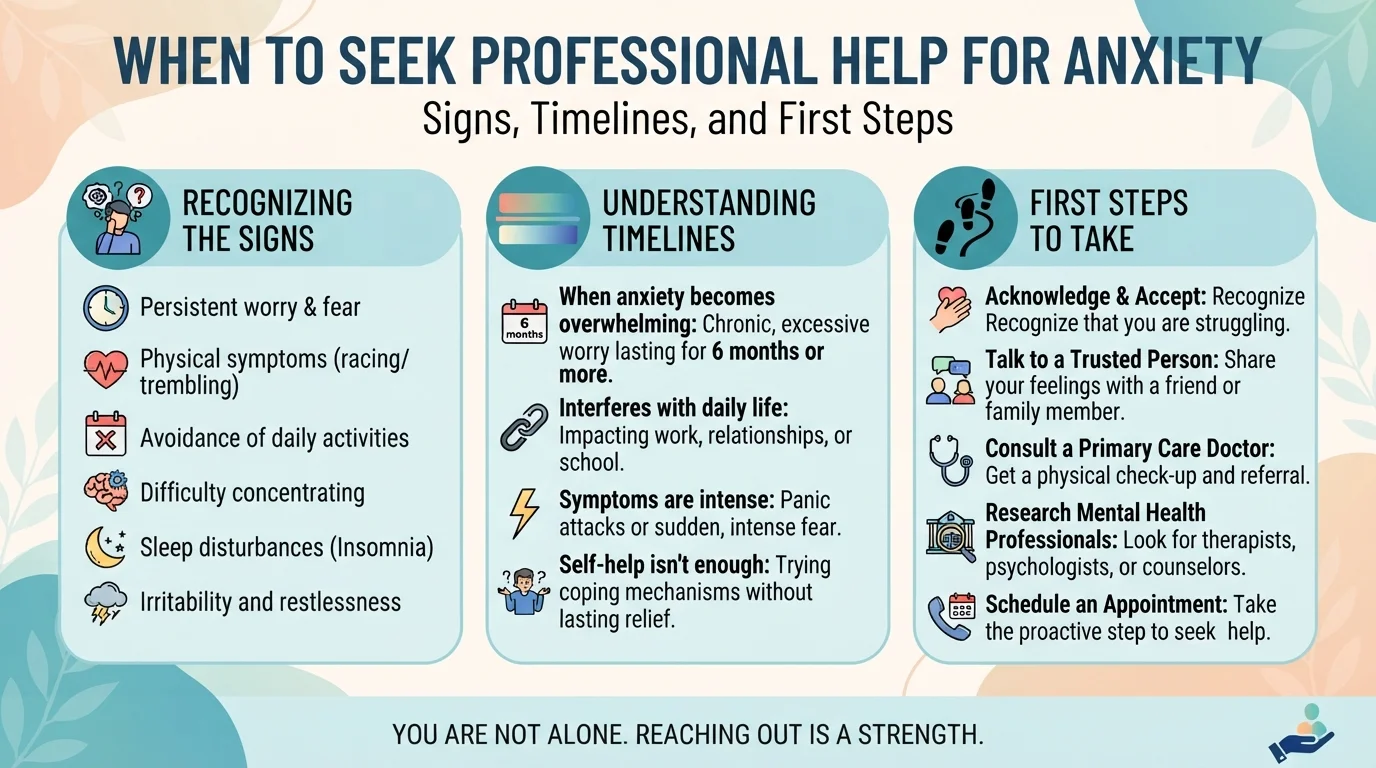
When to Seek Professional Help for Anxiety: Signs, Timelines, and First Steps
Anxiety (anxious distress) is the body’s alarm response to a perceived threat, marked by worry, muscle tension, and a faster heartbeat. The National Institute of Mental Health (NIMH) estimates that 19% of U.S. adults have an anxiety disorder in a given year and 31% at some point in their lives. The Anxiety and Depression Association of America (ADAA) reports that only about 37% of those affected receive treatment.
Ordinary worry becomes a disorder along three lines: duration, intensity, and interference. The DSM-5, published by the American Psychiatric Association, sets the benchmark for generalized anxiety disorder (GAD) at excessive worry on most days for six months or more. Panic disorder, social anxiety disorder, and specific phobias follow different patterns, but they share one test. Does fear shrink your daily life?
Insomnia, a pounding heart, avoidance, and heavy drinking are the warning signs that most often send people to a primary care physician, psychologist, or psychiatrist. This guide explains when to seek professional help for anxiety: how to tell normal anxiety from a disorder, which symptoms justify a call, which need a medical check first, whom to book, what the first appointment involves, and when anxiety turns into an emergency.
Each section builds on the last, and the checklist under warning signs works as a quick self-screen. For the full range of therapy and medication choices, see our complete guide to anxiety treatment.
Normal Anxiety vs an Anxiety Disorder
Normal anxiety comes with a trigger and leaves with it. A job interview, a lab result, or a cross-country move can spike worry for a few days, and then the feeling settles. An anxiety disorder behaves differently. The worry outlasts the trigger, grows out of proportion to it, or arrives with no trigger at all.
Three tests separate the two. Duration asks how long symptoms have lasted: weeks and months point toward a disorder, days point toward stress. Intensity asks whether the fear matches the real risk. Interference asks whether work, school, relationships, or self-care have started to slip. A rough month can trip one test. But when all three show up together, an evaluation makes sense.
Those tests decide when to seek professional help for anxiety, and they show up in daily life as concrete warning signs.
When to Seek Professional Help for Anxiety: The Warning Signs
Warning signs fall into emotional, physical, and behavioral groups. Any of the following, repeated across several weeks, deserves a professional opinion:
- Worrying about worst-case outcomes on most days, even when the evidence says otherwise.
- Sleeping badly: trouble falling asleep, waking at 3 a.m., or rising exhausted.
- Avoiding places, people, or tasks until your routine keeps shrinking.
- Missing work or school, or struggling with basics like showering, shopping, and driving.
- Having panic attacks: sudden terror that peaks within minutes, with a pounding heart, sweating, or breathlessness.
- Drinking, using drugs, or overusing prescription pills to take the edge off.
- Feeling restless, irritable, or unable to concentrate, and snapping at people close to you.
Substance use deserves extra attention. Alcohol quiets nerves for an hour, then rebound anxiety often hits the next day, and the cycle tightens. A clinician treats the anxiety and the drinking together.
Waiting carries a cost, and that cost grows with time.
What Delay Costs You
Delay compounds over time. Anxiety disorders frequently occur alongside depression, and untreated anxiety raises the odds of chronic sleep loss, substance misuse, and missed work or school. Avoidance compounds the problem: every canceled plan teaches the brain that the feared situation was dangerous, so the next one feels worse. Knowing when to seek professional help for anxiety lets you interrupt that loop while the habits are still young.
The body takes part of that toll as well, and body symptoms can mislead.
Physical Symptoms That Need a Medical Check First
Physical symptoms often bring people to a clinic before the worry does. Chest tightness, a racing pulse, dizziness, nausea, and shortness of breath all occur in anxiety. They also occur in heart rhythm disorders, an overactive thyroid, asthma, and anemia. Caffeine, decongestants, and stimulant medications can produce the same picture.
A primary care physician can order blood work, check thyroid function, and review your medications. Get new chest pain evaluated the same day, because only testing separates a panic attack from a cardiac event. So once medical causes are ruled out, the question becomes which professional fits your symptoms.
Which Professional to See
Choosing among providers depends on what you need: an evaluation, therapy, medication, or all three.
- Primary care physician: screens symptoms, orders lab tests, and prescribes some anxiety medications.
- Psychologist (PhD or PsyD): diagnoses anxiety disorders and delivers psychotherapy such as cognitive behavioral therapy (CBT).
- Licensed clinical social worker (LCSW) or licensed professional counselor (LPC): provides talk therapy and coping-skills training.
- Psychiatrist (MD or DO): diagnoses conditions and manages medication.
- Psychiatric nurse practitioner: evaluates symptoms and prescribes medication, and some also offer therapy.
Therapy usually comes first for mild to moderate symptoms. Severe symptoms, or symptoms that stall after several months of sessions, often bring in a medication review. Our breakdown of how anxiety treatment works compares each path in detail. Once you’ve picked a provider type, a few questions narrow the choice to one clinician.
Questions to Ask Before Booking
Fit matters as much as credentials, and a short call answers most of it. Cover five points:
- Licensure: confirm the clinician holds a current license in your state.
- Specialty: ask how many clients with anxiety disorders they treat, and which methods they use.
- Timeline: ask how many sessions to expect before symptoms ease.
- Cost: ask about insurance, sliding-scale fees, and cancellation rules.
- Format: ask whether video or in-person sessions are available.
A mismatch in session one doesn’t mean therapy fails. Switching clinicians is common, and it costs little compared with staying in a poor fit. The first appointment follows a predictable format.
What Happens at a First Appointment
Appointments like this usually run 45 to 60 minutes and work as an intake interview. The clinician asks when symptoms began, how often they occur, what sets them off, and how they affect sleep, work, and relationships. Expect questions about medical history, medications, caffeine, alcohol, family history, and past trauma. Nothing you say needs polish, since clinicians hear about panic, intrusive thoughts, and avoidance every day.
Many clinicians hand over the GAD-7, a seven-question screening form scored from 0 to 21. A score of 10 or higher suggests moderate anxiety. The form screens; it doesn’t diagnose.
By the end, most clinicians outline a working diagnosis and a proposed anxiety treatment plan with goals and session frequency. Bring a medication list, a rough log of sleep and panic episodes, and the three worries that trouble you most. Those goals lead straight into treatment itself.
What Treatment Involves
Treatment splits into psychotherapy and medication. CBT is the most studied psychotherapy for anxiety. It teaches you to catch catastrophic thoughts and test them, and it uses graded exposure to reverse avoidance. Courses commonly run 12 to 20 weekly sessions. Selective serotonin reuptake inhibitors (SSRIs) and serotonin-norepinephrine reuptake inhibitors (SNRIs) are the first-line medications, and they typically take 4 to 6 weeks to reach full effect.
Comparisons, side effects, and timelines for each option sit in our guide to evidence-based anxiety treatment options. Waitlists add a gap before any of it starts.
Self-Help Steps While You Wait for an Appointment
Waitlists for therapists often stretch for weeks. Self-help steps cover that gap, though they support treatment rather than replace it. Aim for 150 minutes of moderate exercise weekly, the minimum in federal physical activity guidelines. Keep a fixed wake-up time to steady your sleep. Practice slow breathing: inhale for four counts, exhale for six, and repeat for five minutes. Write worries down at a set hour each day so they stop leaking into the rest of it.
If symptoms spike while you wait, know the emergency options.
When Anxiety Becomes an Emergency
Emergencies need same-day help. Call or text 988 (the Suicide & Crisis Lifeline) for thoughts of suicide or self-harm. Call 911 for chest pain that spreads to the arm or jaw, fainting, or breathing trouble that doesn’t ease. The SAMHSA National Helpline offers free treatment referrals around the clock.
Frequently Asked Questions
Can anxiety go away on its own?
Mild, situational anxiety often fades on its own once the stressor passes. Anxiety disorders tend to persist without treatment, and avoidance can deepen them over time.
Do I need a diagnosis before I see a therapist?
No. Therapists treat symptoms, and a diagnosis isn’t a prerequisite for a first session. Insurance claims usually require a diagnosis code, which the clinician assigns after the intake.
Is one panic attack a sign of panic disorder?
No. A single attack doesn’t establish the disorder. Panic disorder involves repeated, unexpected attacks plus at least one month of worry about the next one, or behavior changes made to avoid attacks.
How long should I wait before getting help?
Book an evaluation once symptoms last several weeks and disrupt daily life. The six-month benchmark applies to a GAD diagnosis, and it doesn’t set the rule for when to seek professional help for anxiety.
What is the difference between a psychologist and a psychiatrist?
A psychologist treats anxiety with psychotherapy, and a psychiatrist treats it mainly with medication. Many people see both, and the two clinicians coordinate care.
Which is better for anxiety, therapy or medication?
Neither wins in every case. CBT and SSRIs each reduce symptoms in controlled trials, and many clinicians combine them when one alone stalls.
Does online therapy work as well as in-person sessions?
Yes, for most anxiety disorders. Studies of video-based CBT report results comparable to in-person care, and it cuts travel time.
Ordinary worry has a trigger and an end point. A disorder shows up as duration, intensity, and interference, and it leaves warning signs in your sleep, behavior, and body. Physical symptoms deserve a medical check with a primary care physician before anyone labels them anxiety. From there, a psychologist, counselor, psychiatrist, or nurse practitioner can take over, starting with a first appointment built around intake questions and a GAD-7 score. Treatment then combines CBT, medication, or both, and emergencies go to 988 or 911.
If you’re still unsure when to seek professional help for anxiety, several of these warning signs lasting a few weeks is your cue: book that evaluation this week. Read our complete guide to anxiety treatment to see what comes after it.
This article offers general information and doesn’t replace an evaluation by a licensed clinician.
Recent Posts
Related Posts

How to Protect Your Mental Health Without Sacrificing Your Career
It is Sunday evening and your stomach is already tight. You are replying to emails you will see again in...

How to Find a Licensed Male Therapist in California
Plenty of people know the moment they decide they want therapy. Fewer people know what to type into the search...

How to Do the 5-4-3-2-1 Technique Silently in Class
Learn how to manage anxiety discreetly during class using the simple and effective 5-4-3-2-1 grounding technique in this article. Exclusive...
How to Set Boundaries Without Guilt: Stop People Pleasing
You said yes again. You knew while the words were leaving your mouth that you did not want to say...
When to Seek Professional Help for Anxiety: Signs, Timelines, and First Steps
Anxiety (anxious distress) is the body's alarm response to a perceived threat, marked by worry, muscle tension, and a faster...