

Why You Feel Invisible & How to Be Seen Again; Trauma Therapists’ Take
What Does It Mean to Feel Invisible?
There is a particular kind of pain that doesn’t have a bruise. It doesn’t show up on a blood test. It doesn’t make you visibly sick. But it hollows you out from the inside just as effectively as anything that does.
It’s the feeling of being in a room full of people and believing — deeply, physically, convincingly — that not one of them truly sees you.
It’s finishing a sentence and watching the conversation move on as if you hadn’t spoken. It’s showing up, trying, contributing — and feeling like a ghost in your own life. It’s the exhausting performance of being present while feeling completely absent.
Feeling invisible is one of the most searched emotional experiences on the internet — and one of the least talked about out loud. People search for it at 2 a.m., alone, because the very nature of the feeling makes it hard to say to another human being: I feel like I don’t exist to the people around me.
This article is for those people. It takes the experience seriously, explains what’s really behind it — psychologically, neurologically, and socially — and offers a genuine, research-backed path toward being seen again.
Why Do I Feel Invisible? The Real Reasons Behind the Feeling
Feeling invisible is rarely just about one thing. It is almost always a layered experience — part circumstance, part psychology, part history. Here are the most common and clinically significant reasons people feel invisible:
You Were Not Truly Seen in Childhood | Dig into your Childhood Trauma
This is the deepest root for many people, and it is worth naming plainly.
Children have a fundamental developmental need to be seen, attuned to, and emotionally mirrored by their caregivers. When a parent consistently misses a child’s emotional cues — not necessarily through cruelty, but through distraction, emotional unavailability, depression, substance use, or simple emotional illiteracy — the child learns something devastating: my inner world does not register with the people who matter most.
That learning doesn’t stay in childhood. It becomes a template — a subconscious expectation about how relationships work and what you can expect from other people. You stop signaling your needs because experience has taught you that signaling doesn’t work. You make yourself small. You stop expecting to be noticed. And then, in adulthood, you find yourself surrounded by people who don’t notice you — partly because you’ve unconsciously chosen or created environments that confirm what you already believe.
Psychologists call this attachment wounding, and it is extraordinarily common and extraordinarily treatable.
You’ve Been in a Relationship That Erased You
Romantic relationships, friendships, and family dynamics can all produce invisibility — slowly, subtly, and sometimes without any obvious abuse or cruelty.
A partner who consistently dominates conversation. A family that centers one person’s needs above all others. A friendship group where you are always the listener, never the heard. A workplace where your contributions are absorbed without attribution.
Over time, these dynamics don’t just make you feel unseen in those relationships — they erode your sense of self more broadly. You begin to question whether you have anything worth saying. Whether your perspective matters. Whether you are, in some fundamental way, less real than the people around you.
You’re Struggling With Depression
Emotional invisibility is one of the signature experiences of depression — and it runs in two directions simultaneously.
Depression makes you withdraw — speak less, share less, ask for less, expect less. And then, as the people in your life receive fewer signals from you, they naturally engage less. Which confirms the depressive belief that you don’t matter, that no one cares, that you are alone.
The cruelty of depression is that it creates the very isolation it then uses as evidence of your worthlessness. Feeling invisible when depressed is not a reflection of your actual relationships — it is a symptom distorting your perception of them.
You’re Highly Sensitive or Introverted in an Extrovert-Rewarding World
Many people who feel chronically invisible are not actually ignored — they are operating in environments and social structures that systematically reward certain communication styles over others.
Extroversion is culturally prized. Loudness, confidence, quick talking, social assertiveness — these traits tend to get noticed, remembered, and promoted. People who are highly sensitive, introverted, quiet, or thoughtful often find that their contributions — which may be deeper, more considered, and more carefully offered — are consistently overlooked in favor of faster, louder, more dominant voices.
This is not a personal failure. It is a structural mismatch. But it produces a very real experience of invisibility.
You’ve Lost Your Sense of Identity
Sometimes feeling invisible is not primarily about other people at all. It is about losing contact with yourself.
Major life transitions — the end of a relationship, retirement, the children leaving home, a career change, immigration, serious illness — can strip away the roles and identities that gave you a sense of who you are. When those scaffolding structures collapse, many people experience a profound sense of unreality about themselves. If I’m not a wife, a worker, a parent, a resident of this place I’ve always lived — then who am I? And if I don’t know who I am, how can anyone else see me?
This identity dissolution is its own form of invisibility — and it requires a different kind of healing than the relational forms.
Social Anxiety Has Made You Small
Social anxiety doesn’t just make social situations uncomfortable. Over time, it makes people actively minimize themselves — speaking quietly to avoid attention, agreeing rather than asserting to avoid conflict, deflecting compliments, shrinking physically in group settings.
The painful paradox is that the more social anxiety causes you to minimize yourself, the more invisible you become — which then increases anxiety about social interactions, which increases self-minimization. It is a tightening spiral that, without intervention, tends to narrow your world progressively.
You’re Experiencing Burnout
Burnout — the state of chronic depletion from sustained overextension — produces a particular kind of invisibility. You are physically present everywhere you’re supposed to be, but emotionally and cognitively absent. The lights are on, but nobody’s home.
People around you interact with your functioning self — the part that shows up, completes tasks, says the right things — while your actual self retreats further and further behind a wall of exhaustion. You feel invisible because, in a meaningful sense, you are not fully there. And nobody seems to notice that the person they’re talking to is a shell of someone who used to be fully present.
What Feeling Invisible Does to Your Mental Health Over Time
Feeling invisible is not just an uncomfortable emotional experience. When it persists without being addressed, it has measurable, serious consequences for mental and physical health.
It deepens depression. The perceived absence of social connection — even when objective connection exists — activates the same neural pain pathways as physical pain. Chronic invisibility is neurologically painful.
It erodes self-worth. Over time, being unseen confirms and calcifies negative beliefs about yourself. The inner narrative shifts from I feel invisible to I am invisible to I am not worth seeing — a progression that requires active therapeutic intervention to reverse.
It increases anxiety. When you feel invisible, social situations become fraught with the anticipation of further non-recognition. You monitor yourself and others constantly. This hypervigilance is exhausting and anxiety-producing.
It produces physical health consequences. Chronic social isolation and the stress of perceived invisibility elevate cortisol, suppress immune function, disrupt sleep, and increase systemic inflammation. The research on loneliness and health outcomes is unambiguous — feeling unseen is not a soft problem. It is a health problem.
It can lead to dangerous silence. People who feel invisible don’t just withdraw from parties. They withdraw from asking for help when they need it. They suffer longer. They reach out less. They are, statistically, at higher risk for depression, anxiety disorders, and in severe cases, suicidal ideation — precisely because the very symptom of their condition prevents them from seeking relief.
The Neuroscience of Being Seen: Why Recognition Is a Biological Need
Here’s something important to understand: the desire to be seen is not vanity, neediness, or weakness. It is a fundamental biological drive hardwired into the human nervous system.
The brain’s default mode network — the neural system active when we’re thinking about ourselves and others — is deeply involved in social cognition and the processing of being recognized. When we are acknowledged, validated, and genuinely seen by others, this system registers it as reward. When we are consistently overlooked or ignored, the same regions that process physical pain activate.
Ostracism research by psychologist Kipling Williams at Purdue University has consistently shown that even brief, mild social exclusion — being left out of an online ball-tossing game by strangers — produces measurable distress, lowered mood, reduced sense of meaning, and decreased sense of control. These effects occur even when people know intellectually that the exclusion is trivial and meaningless.
That’s how deep the need to be seen goes. It is not optional. It is not a preference. It is baked into your neurobiology as surely as hunger or thirst.
Understanding this reframes feeling invisible not as a personal weakness to be overcome, but as a legitimate unmet need to be addressed — with the same seriousness you would give any other fundamental human need going unmet.
How to Be Seen Again: Evidence-Based Pathways Back to Connection
This is the section that matters most — because understanding why you feel invisible is only useful if it leads somewhere. Here is what the research and clinical experience show actually works.
Start With Being Seen by Yourself
This sounds like a cliché until you understand the psychology behind it.
Many people who feel invisible have spent years — sometimes decades — directing all their attention outward, monitoring how others perceive them, trying to figure out what they need to do or say or be in order to finally be noticed. The exhausting paradox is that this outward focus makes genuine self-expression less likely, not more.
Being seen begins with knowing yourself well enough to show yourself. This means developing a practice of turning inward — journaling, therapy, mindfulness, or simply sitting with the question: what do I actually think, feel, want, and need right now? Not what you think you should think or feel. Not what would be acceptable. What is actually true for you.
You cannot show people who you are if you’ve lost track of who that is.
Speak First, Speak Specifically
One of the behavioral patterns that maintains invisibility is waiting to be invited in — waiting for someone to ask the right question, waiting for the perfect opening, waiting to be acknowledged before you offer yourself.
The research on social connection is clear: disclosure drives intimacy, not the other way around. People don’t become close and then share — they share and then become close. Waiting to feel safe enough to be real keeps you permanently on the outside.
This doesn’t mean oversharing. It means practicing the small, specific disclosures that make you real to other people — saying what you actually think about something, naming how you actually feel, sharing something true rather than something safe.
Ask to Be Heard Directly
This is uncomfortable for most people who feel invisible, because it feels vulnerable to the point of humiliation. But it is one of the most powerful things you can do.
Telling a friend, partner, or family member: I’ve been feeling like I’m not really being heard lately, and it matters to me — is not weakness. It is the kind of direct communication that changes relationships. Most people who are making you feel invisible are not doing it deliberately. They don’t know. Telling them gives them the chance to change something they didn’t know needed changing.
Find Environments Where Your Particular Voice Is Valued
Not every environment is equally hospitable to every communication style. If you are quiet, thoughtful, and introverted in a loud, fast-paced, extrovert-dominated environment — you will feel invisible there, regardless of your inherent worth.
This is not about accepting invisibility. It is about being strategic. Seek out communities, friendships, workplaces, and social contexts where your particular way of being in the world is genuinely valued — not just tolerated. They exist. Finding them changes everything.
Reconnect With Something That Makes You Feel Real
Before you can be seen by others, you often need to reactivate the sense that you are someone worth seeing. This is not about building confidence through achievement. It is about re-engaging with the specific activities, relationships, and experiences that make you feel most like yourself.
For some people, this is creative work — writing, making music, painting. For others, it is physical — sport, dance, movement. For others, it is intellectual — learning something genuinely new. For others, it is service — helping someone else, which has the profound side effect of making you feel real and present in the world.
What gives you a sense of this is me matters. Make space for it even when — especially when — you feel most invisible.
Therapy: The Dedicated Space for Being Truly Seen
There is something specific and irreplaceable that happens in good therapy that directly addresses the experience of invisibility: you are given the sustained, attentive presence of another human being whose entire professional focus is on accurately understanding you.
For people who have rarely or never experienced being truly seen, this is not just useful — it is, in itself, a corrective emotional experience. It begins to shift the internal template from I am not worth noticing to I can be known by another person and that knowing is safe.
CBT helps challenge the thought patterns that maintain invisibility. Psychodynamic therapy addresses the deeper attachment roots. ACT (Acceptance and Commitment Therapy) helps you reconnect with your values and re-engage with your life. All roads, in different ways, lead back to the same destination: being more fully yourself, more consistently present, more genuinely connected.
Get Professional Support for Feeling Invisible — IGOTU Corp’s Certified Therapists Are Here
Feeling invisible is not a personality flaw. It is not something to simply push through. It is a real, painful, and treatable psychological experience — and you deserve support that takes it seriously.
IGOTU Corp connects you with certified, licensed therapists who specialize in emotional disconnection, identity, attachment, depression, anxiety, and the complex experience of feeling unseen. Their clinicians don’t just offer a space to talk — they offer a structured, evidence-based path toward genuine reconnection with yourself and the people around you.
Whether your invisibility has roots in childhood attachment wounds, a relationship that erased you, depression, social anxiety, or something harder to name — IGOTU Corp’s certified therapist network has the expertise to meet you exactly where you are.
Visit IGOTU Corp today, take their free mental health assessment, and get matched with a certified therapist who will make sure you are genuinely, professionally, and consistently seen.
Feeling Invisible in Relationships: What’s Really Happening
Relationships are where invisibility is felt most sharply — and where it does the most damage. Here are the most common relational patterns that produce chronic invisibility:
The Asymmetric Relationship
This is the friendship or partnership where one person consistently holds the emotional floor — their problems, their stories, their needs structuring most interactions — while the other person listens, supports, accommodates, and slowly disappears.
These relationships often feel good to the invisible person at first, because being needed feels like connection. But over time, the asymmetry becomes suffocating. You realize that your inner world has no place in this dynamic. That you are valued for your function — your listening, your support, your reliability — but not for yourself.
Emotional Unavailability in a Partner
A partner who is physically present but emotionally closed off creates a uniquely painful form of invisibility. You are right there — in the same house, the same bed, the same life — and yet profoundly alone. The loneliness of an emotionally unavailable relationship is often harder to bear than physical solitude, because the proximity makes the distance feel like a judgment.
Being the Responsible One in a Family
In many families, one person — often the eldest child, the most capable sibling, or the one who coped best during family crisis — becomes the functional anchor around whom everyone else orbits. They are relied upon, leaned on, depended on. But they are rarely asked how they are doing. Rarely seen beneath their competence.
The reliable, capable person in a family system often grows up invisible inside their own usefulness.
The Workplace That Takes Without Acknowledging
A job where your contributions are absorbed without credit, where your ideas are used without attribution, where your effort is expected but your presence is unremarkable — this is a specific and corrosive form of professional invisibility that grinds down self-worth with the efficiency of daily repetition.
Feeling Invisible as a Parent, Partner, or Caregiver
Caregiving roles — parenting young children, caring for aging parents, supporting a partner through illness — are invisibility risks that rarely get discussed honestly.
When you are defined entirely by your function in someone else’s life, your own selfhood can quietly erode. The parent who hasn’t had a conversation about themselves in months. The caregiver who has become so thoroughly oriented toward another person’s needs that they have lost track of their own. The partner whose identity has been subsumed into the couple until the individual is barely discernible.
This form of invisibility is not selfish to name. It is not ingratitude. It is a legitimate psychological need — the need to be seen as a person, not just as a role — that does not disappear because your role is important and loving.
Naming it is the beginning of addressing it.
Can Social Media Make You Feel More Invisible?
Yes. And the research backs this up thoroughly.
Social media creates a specific paradox: it offers the appearance of connection and visibility — you are posting, sharing, existing publicly — while simultaneously producing the conditions for intense invisibility.
Here’s why. Social media recognition is quantified, public, and comparative. When a post receives few likes, the brain doesn’t interpret this neutrally. It interprets it as evidence of low social worth — processed in the same neural regions as physical rejection. The comparison with others who receive more engagement is automatic and relentless.
More insidiously, social media trains us to present a curated self rather than a real one. When you receive recognition on social media, you receive it for the performance, not for yourself. This creates the deeply unsatisfying experience of being seen while still feeling invisible — because the part of you that was recognized wasn’t really you.
Studies consistently link heavy social media use with increased loneliness, decreased sense of belonging, and heightened feelings of social exclusion — precisely the components of feeling invisible.
Frequently Asked Questions (FAQs) About Feeling Invisible
Q: Is feeling invisible a mental health condition? Feeling invisible is not a standalone diagnosis, but it is a significant symptom of several mental health conditions including depression, social anxiety disorder, attachment disorders, and identity disturbances. It is also a common experience during major life transitions and in response to relational and environmental factors. It warrants professional attention when it is persistent, distressing, or affecting your quality of life.
Q: Why do I feel invisible even around people who love me? Feeling invisible around people who love you is one of the most confusing and painful forms of this experience. It usually reflects one of a few dynamics: a disconnect between how you present yourself and how you actually feel inside; attachment patterns from early life that make genuine connection feel unfamiliar or unsafe; depression distorting your perception of how others see you; or a genuine communication gap in the relationship that needs to be addressed directly.
Q: Is feeling invisible the same as loneliness? They are closely related but distinct. Loneliness is the absence of connection. Feeling invisible is the presence of people combined with the absence of being genuinely known. You can feel invisible in a crowd, at a party, in a marriage. In some ways, feeling invisible is more painful than loneliness because the people are there — the connection is just not reaching you.
Q: Can therapy really help with feeling invisible? Yes — and for many people it is the most transformative intervention available. Therapy provides both a direct experience of being genuinely seen (which is itself healing) and a structured process for understanding and changing the patterns — internal and relational — that produce and maintain invisibility.
Q: How do I stop feeling invisible at work? Start by identifying whether the invisibility is systemic (a culture that doesn’t value your communication style) or relational (specific dynamics with colleagues or managers). Document your contributions clearly. Speak up in meetings — even briefly — to establish presence. Find one ally who values your perspective. If the culture is genuinely incompatible with your visibility, the most powerful thing you can do is find an environment that isn’t.
Q: Why do I feel invisible in social situations? Social anxiety, introversion, low self-worth, and the habit of self-minimization all contribute to feeling invisible in social situations. Often the experience is partially perceptual — anxiety distorts how we read others’ responses to us, making neutral reactions feel like rejection or dismissal. Behavioral experiments (small, specific disclosures, asking questions, staying slightly longer than comfortable) can gradually shift this.
Q: Does feeling invisible go away on its own? Sometimes situational invisibility — tied to a specific environment or life phase — resolves when circumstances change. But chronic feeling of invisibility rooted in attachment patterns, depression, or long-standing relational dynamics typically does not resolve without active intervention. It tends to deepen and narrow your world further without support.
Q: How do I tell someone I feel invisible without sounding needy? The framing matters. Rather than you never see me (which is accusatory and likely to produce defensiveness), try I’ve been feeling disconnected lately and I miss feeling close to you — which is vulnerable without being blaming, and gives the other person something they can actually respond to. Most people who make us feel invisible are not doing it deliberately and will respond to a direct, non-accusatory invitation to reconnect.
Q: Can an ESA (Emotional Support Animal) help with feeling invisible? For some people, yes — particularly for the isolation and depression components of feeling invisible. Animals provide unconditional, consistent recognition that doesn’t require performance or explanation. They see you when you walk in the door. They respond to your presence. For people whose primary relationships are strained or absent, an ESA can provide a meaningful bridge of felt connection while deeper relational healing is worked on.
Q: Where can I get help for feeling invisible? IGOTU Corp connects you with licensed, certified therapists who specialize in exactly this kind of work — helping people reconnect with themselves, rebuild their sense of self-worth, and create genuine visibility in their relationships and lives. Visit IGOTU Corp today to take their free assessment and get matched with the right therapist for where you are right now.
The Bottom Line: You Are Not Invisible — You Are Unseen. There Is a Difference.
Invisible means not there. Not real. Not worth noticing.
Unseen means present, real, and worth knowing — but not yet found by the right people, the right environments, or the right version of yourself that knows how to show up fully.
That distinction matters enormously. Because invisible is a permanent condition. Unseen is a temporary one — and it has a path out.
The path involves understanding why you retreated. Grieving what made you small. Learning to know yourself well enough to show yourself. Finding the people and places where your particular, specific, irreplaceable way of being in the world is genuinely valued.
It involves, for most people, the support of someone trained to help — because the patterns that produce invisibility are old, deep, and self-reinforcing, and dismantling them alone is genuinely hard.
You have been showing up. You have been trying. You have been present in rooms that didn’t see you, in relationships that didn’t reach you, in a life that may have started to feel like someone else’s.
That is enough history. It is time to be seen.
IGOTU Corp’s certified therapists are ready to be part of that journey. Visit IGOTU Corp today — and take the first step toward a life where you are no longer waiting to be noticed, but actively, fully, unapologetically present.
Recent Posts
Related Posts

How to Protect Your Mental Health Without Sacrificing Your Career
It is Sunday evening and your stomach is already tight. You are replying to emails you will see again in...

How to Find a Licensed Male Therapist in California
Plenty of people know the moment they decide they want therapy. Fewer people know what to type into the search...

How to Do the 5-4-3-2-1 Technique Silently in Class
Learn how to manage anxiety discreetly during class using the simple and effective 5-4-3-2-1 grounding technique in this article. Exclusive...
How to Set Boundaries Without Guilt: Stop People Pleasing
You said yes again. You knew while the words were leaving your mouth that you did not want to say...
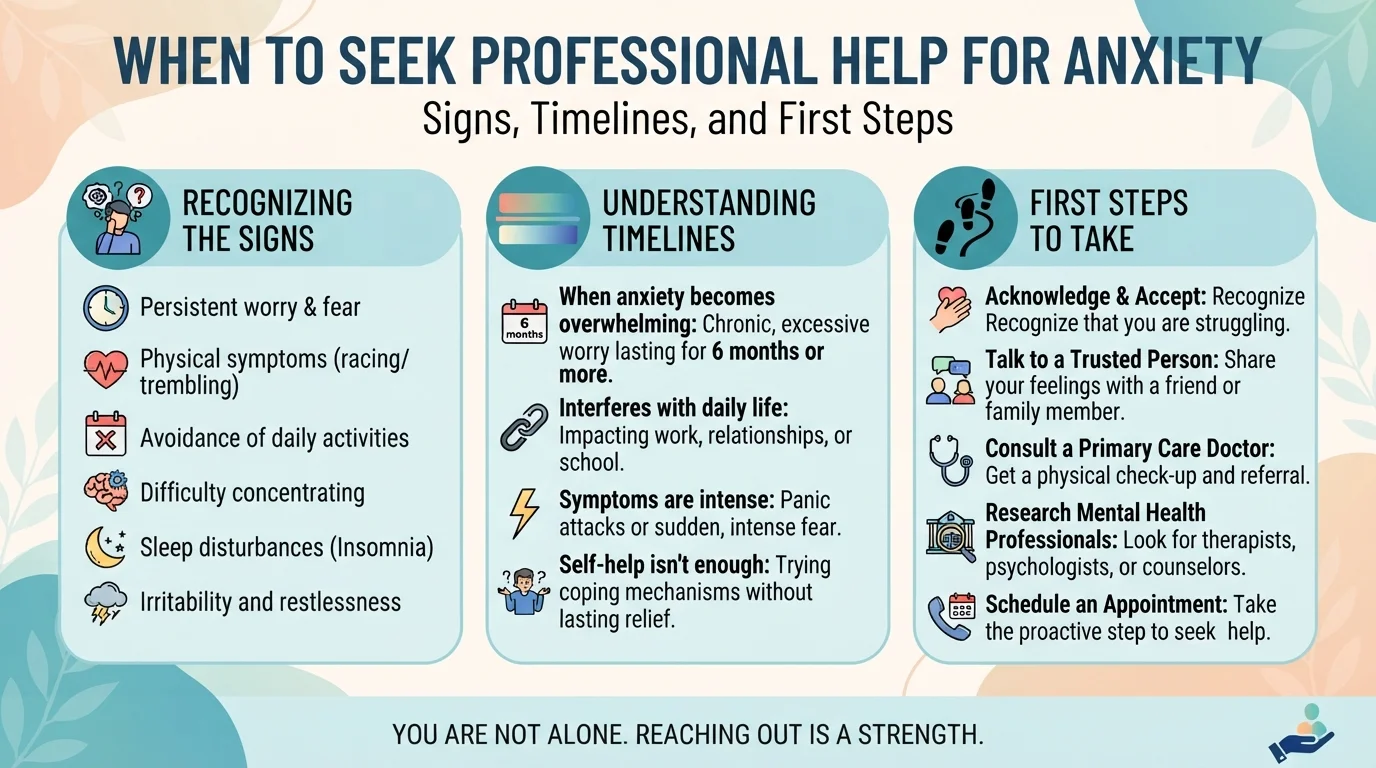
When to Seek Professional Help for Anxiety: Signs, Timelines, and First Steps
Anxiety (anxious distress) is the body's alarm response to a perceived threat, marked by worry, muscle tension, and a faster...