IGotU Corp

How Your Nervous System Stores Stress (and How DBT Helps Regulate It)

How Your Nervous System Stores Stress & How DBT Helps

February 12, 2026

You’re sitting in a meeting, and someone’s tone of voice suddenly makes your heart race. You’re watching a movie, and a specific scene makes your chest tighten for reasons you can’t quite explain. You walk into a room that smells like your childhood home, and suddenly you’re flooded with anxiety—or maybe you feel inexplicably safe.

What’s happening in these moments isn’t random, and it’s not all in your head. Your body is speaking a language you might not fully understand yet—the language of stored stress.

Have you ever wondered why your body remembers a traumatic event even when your mind has moved on? Or why certain situations trigger physical reactions—racing heart, sweaty palms, muscle tension—before you even consciously register what’s happening? Maybe you’ve noticed that no matter how much you try to “think positively” or “just relax,” your body seems stuck in a loop of tension, anxiety, or emotional overwhelm.

Here’s the truth that changes everything: Your nervous system isn’t broken. It’s actually doing exactly what it was designed to do—protect you based on everything you’ve experienced. The problem is, it sometimes keeps protecting you from threats that no longer exist, running an outdated security program that exhausts you and limits your life.

The good news? Understanding how your nervous system stores stress isn’t just fascinating neuroscience—it’s the roadmap to genuine healing and freedom. And that’s exactly where Dialectical Behavior Therapy (DBT) comes in, offering practical, body-based tools to work with your nervous system rather than against it.

At IGOTU CORP, we’ve seen countless individuals transform their relationship with stress, anxiety, and overwhelming emotions by learning to work with their nervous system instead of fighting it. This article will walk you through the science of how stress gets stored in your body and, more importantly, how you can release it and reclaim your sense of safety and calm.

Let’s dive into what’s really happening beneath the surface—and how you can start your journey toward regulation and healing today.

How your Nervous System Stores Stress?

Think of your nervous system as your body’s personal security team, constantly scanning for threats and deciding how to respond. But unlike a simple on-off switch, your nervous system operates more like a sophisticated three-tier response system.

The Three-State System

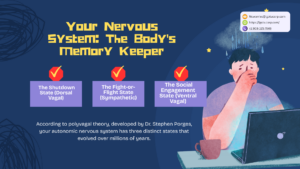
According to polyvagal theory, developed by Dr. Stephen Porges, your autonomic nervous system has three distinct states that evolved over millions of years:

  1. The Social Engagement State (Ventral Vagal) This is your “safe and connected” mode. When you’re in this state, your body hums along smoothly—your heart rate is steady, digestion works properly, and you can connect with others easily. Your face is expressive, your voice has natural intonation, and you’re able to think clearly and creatively. This is where healing happens.
  2. The Fight-or-Flight State (Sympathetic) When your nervous system detects danger, it shifts into this mobilization mode. Your heart races, breathing quickens, muscles tense, and blood flow increases to your limbs. You’re ready to either confront the threat or run from it. While this response is essential for survival, it’s not meant to be a permanent state.
  3. The Shutdown State (Dorsal Vagal) If the threat feels overwhelming or inescapable, your nervous system may shift into this most primitive response—shutdown or freeze. Heart rate drops, you feel numb or disconnected, energy plummets, and you might dissociate from the present moment. This is your body’s last-ditch survival strategy.
how your nervous system stores stress

The problem? Your nervous system doesn’t always distinguish between a genuine threat (like a car about to hit you) and a perceived threat (like a difficult conversation with your boss). And when you’ve experienced trauma or chronic stress, your system can get stuck in these defensive states, constantly perceiving danger even when you’re safe.

How Stress Gets “Stuck” in Your Body

Here’s where things get really interesting—and a bit unsettling. Stress isn’t just something you experience emotionally; it’s physically encoded in your nervous system and body tissues.

Somatic Memory: When Your Body Remembers

Research has shown that traumatic experiences are stored not just as narrative memories in your brain, but as what’s called “somatic memories” or “body memories.” These are implicit memories—you can’t consciously recall them like you would remember what you had for breakfast, but your body responds to them automatically.

For example, someone who experienced a car accident might feel their chest tighten and heart race when they hear a car horn, even years later. A person who experienced childhood trauma might feel nausea or muscle tension in certain social situations without understanding why. The body is responding to stored patterns from the past, treating the present moment as if the original threat is still happening.

This happens because during a traumatic or highly stressful event, your nervous system goes into overdrive. Stress hormones flood your system, your muscles brace for impact, and your breathing changes. If you can’t complete the natural defensive response—if you can’t fight, flee, or the threat just goes on too long—that activated energy can remain stored in your body.

Think of it like this: your nervous system pressed the gas pedal hard, but never got to hit the brakes. The engine is still revving.

The Neuroception Problem

Dr. Porges introduced the concept of “neuroception”—your nervous system’s unconscious ability to detect safety or danger. This happens below the level of conscious awareness, which means your body might be reacting to cues you don’t even consciously notice.

When chronic stress or trauma has dysregulated your nervous system, your neuroception can become overly sensitive. Your alarm system develops a hair trigger. Neutral facial expressions might be interpreted as threatening. Low-frequency sounds might trigger anxiety. A perfectly safe situation might activate a full-blown stress response.

This isn’t a character flaw or something you’re doing wrong—it’s your nervous system trying to protect you based on past experiences. But it can make daily life exhausting and overwhelming.

How DBT Helps?

This is where Dialectical Behavior Therapy becomes a game-changer. Developed by Dr. Marsha Linehan in the 1980s, DBT was originally designed to help people experiencing intense emotions and self-destructive behaviors, particularly those with borderline personality disorder. But its effectiveness extends far beyond that.

DBT recognizes something crucial: you can’t just “think” your way out of a dysregulated nervous system. You need body-based strategies that work at the physiological level.

The DBT Approach to Nervous System Regulation

At its core, DBT helps you develop four key skill sets, several of which directly target nervous system regulation:

  1. Mindfulness: Tuning Into Your Body Mindfulness in DBT isn’t just about meditation (though that can help). It’s about developing awareness of what’s happening in your body right now. When you can notice “my chest is tight” or “my jaw is clenched” without judgment, you’re developing the interoceptive awareness needed to catch stress responses early.

This matters because you can’t regulate what you can’t detect. Mindfulness helps you recognize when you’re shifting out of that safe, social engagement state before you’re completely overwhelmed.

  1. Distress Tolerance: Immediate Nervous System Relief These are your crisis tools—techniques to rapidly shift your nervous system when emotions become overwhelming. The most well-known is the TIPP skill:
  • Temperature: Cold water or ice on your face activates the “dive reflex,” which slows your heart rate and activates your parasympathetic (calming) nervous system. It’s like hitting a reset button.

  • Intense Exercise: A burst of physical activity (jumping jacks, running in place, dancing) helps discharge the mobilized energy that builds up during stress. Remember, your body prepared for action—giving it that action helps complete the cycle.

  • Paced Breathing: Slow, deliberate breathing, especially with longer exhales, directly signals your nervous system to calm down. When you breathe in for 4, hold for 6, and exhale for 8, you’re manually engaging the parasympathetic brake.

  • Paired Muscle Relaxation: Tensing and releasing muscle groups helps release stored tension and brings awareness to where you’re holding stress.

These aren’t just feel-good exercises—they’re physiological interventions that work with your body’s built-in regulation systems.

  1. Emotion Regulation: Understanding the Body-Emotion Connection DBT teaches you to recognize how emotions show up in your body. Anger might feel like heat rising in your chest. Anxiety might manifest as butterflies in your stomach or tension in your shoulders. Shame might feel like heaviness or the urge to make yourself small.

By identifying these physical signatures, you can:

  • Catch emotions early before they escalate
  • Choose appropriate regulation strategies
  • Reduce your vulnerability to emotional overwhelm through lifestyle choices (sleep, nutrition, exercise)

The emotion regulation module also teaches you to work with emotions rather than trying to suppress them, which often backfires and keeps your nervous system in a state of tension.

  1. Interpersonal Effectiveness: Safe Connection Remember that social engagement state we talked about? One of the best ways to regulate your nervous system is through safe, positive connection with others. DBT’s interpersonal skills help you communicate effectively, maintain relationships, and set boundaries—all of which contribute to feeling safer and more regulated.

When you can express your needs clearly and maintain your self-respect while relating to others, your nervous system receives the message: “It’s safe here. We can connect.”

What is the Neuroscience Behind DBT

Research has shown that DBT actually changes your brain. Regular practice of DBT skills creates new neural pathways, particularly in areas responsible for emotional regulation. Studies have found alterations in the prefrontal cortex (involved in decision-making and emotional control), the amygdala (your threat detection center), and the insula (involved in interoceptive awareness).

Essentially, DBT helps rewire the neural circuitry that keeps you stuck in defensive states, making it easier to access that calm, connected state where healing happens.

The Dialectic: Acceptance AND Change

One of DBT’s most powerful elements is right there in the name: dialectical. This means holding two seemingly opposite things as true at the same time.

You need to accept yourself and your nervous system exactly as they are right now—recognizing that your responses make sense given your history. Your body isn’t broken; it’s doing what it learned to do to survive.

AND you can change. You can develop new patterns, teach your nervous system new responses, and create more flexibility in how you navigate the world.

This both/and approach prevents the shame spiral that often comes with mental health struggles. You’re not being told you’re wrong or bad for how your nervous system responds. Instead, you’re learning new skills while honoring the protective strategies that got you this far.

Practical Integration: Daily Nervous System Care

The beauty of DBT is that these skills aren’t just for crisis moments—they’re preventative maintenance for your nervous system. Here’s how you might integrate them into daily life:

Morning: Start with a brief body scan. Notice where you’re holding tension without trying to change it. Take three slow breaths. This sets the tone for nervous system awareness throughout the day.

Throughout the day: Check in with your body periodically. Are you in that safe, social engagement state? If you notice activation building, use a quick regulation skill before you tip into overwhelm.

When triggered: Use TIPP or another distress tolerance skill. The goal isn’t to never feel stressed—it’s to have tools to navigate stress when it arises.

Evening: Process your day. What situations felt safe? Which activated your nervous system? This isn’t about judgment—it’s about gathering data to understand your patterns.

Building safety: Actively cultivate experiences that activate your social engagement system. This might be time with supportive friends, petting a dog, listening to calming music, or spending time in nature.

The Path Forward

Understanding how your nervous system stores stress doesn’t erase past experiences, but it does offer something powerful: a roadmap for healing. When you recognize that your body’s responses are adaptive survival strategies rather than personal failings, shame loses its grip.

DBT provides the practical tools to work with your nervous system’s natural capacity for regulation and healing. It’s not about never experiencing stress—that’s neither possible nor desirable. It’s about developing the flexibility to move through stress responses and return to a regulated state.

Your nervous system has an incredible capacity for change and healing. With the right understanding and tools, those old patterns of stored stress can gradually shift. The alarm system can learn to distinguish between real threats and false alarms. The body can learn that it’s okay to let down its guard.

It takes practice, patience, and often support from a trained therapist. But it is possible. Your body’s wisdom, combined with these evidence-based skills, can help you move from survival mode to a life where you’re not just surviving but truly thriving.

Ready to Start Your Healing Journey with IGOTU CORP?

Understanding how your nervous system stores stress is the first step—but you don’t have to walk the path to regulation alone. At IGOTU CORP, we specialize in evidence-based approaches that honor both the science of nervous system healing and the uniqueness of your personal journey.

Our trained professionals understand that healing isn’t linear, and they’re equipped with the tools and compassion to meet you exactly where you are. Whether you’re dealing with past trauma, chronic stress, overwhelming emotions, or simply want to develop better regulation skills, we offer comprehensive support tailored to your specific needs.

What sets IGOTU CORP apart:

  • Therapists trained in DBT and trauma-informed care
  • Holistic approaches that integrate mind-body healing
  • Individualized treatment plans that respect your pace
  • A safe, non-judgmental space to explore and heal
  • Practical skills you can use immediately in your daily life

Your nervous system has been working overtime to protect you. It’s time to give it—and yourself—the support needed to truly thrive. Taking the first step toward regulation and healing is an act of courage, and we’re here to support you every step of the way.

Contact IGOTU CORP today to learn more about our DBT programs and how we can help you work with your nervous system, not against it.

Frequently Asked Questions

1. How long does it take for DBT to help regulate a dysregulated nervous system?

The timeline varies significantly from person to person, but many people notice some improvement within the first few months of consistent DBT practice. Research shows that standard DBT programs typically run for about a year, and studies have documented meaningful improvements in controlling self-harmful behaviors and regulating emotions within this timeframe.

However, it’s important to understand that nervous system regulation isn’t a destination—it’s an ongoing practice. You might notice immediate relief from using distress tolerance skills like the TIPP technique during a crisis, while deeper changes in how your nervous system responds to stress develop gradually over months and years of practice.

Some factors that influence the timeline include:

  • The severity and duration of past trauma or chronic stress
  • How consistently you practice the skills
  • Whether you’re working with a trained DBT therapist
  • Your support system and living environment
  • Other treatments or therapies you’re using alongside DBT

Think of it like building muscle at the gym—you might feel stronger after your first workout, but developing real strength takes consistent practice over time. The neural pathways that support nervous system regulation grow stronger with repetition.

2. Can I practice DBT skills on my own, or do I need a therapist?

Both approaches have value, though they serve different purposes. Many people benefit from learning DBT skills through self-study using workbooks, online courses, or apps. The skills themselves—mindfulness, distress tolerance techniques, emotion regulation strategies—can be learned and practiced independently, and even self-directed practice can provide meaningful relief.

However, the full DBT treatment package offers several components that are difficult to replicate alone:

  • Individual therapy sessions where you work one-on-one with a therapist to apply skills to your specific situations and receive personalized guidance
  • Skills training groups where you learn alongside others and practice skills in a supportive environment
  • Phone coaching where you can reach out to your therapist during difficult moments in real life
  • Therapist consultation teams that help ensure your therapist is providing the best possible care

If you’re dealing with complex trauma, severe emotional dysregulation, self-harm behaviors, or conditions like PTSD or borderline personality disorder, working with a trained DBT therapist is strongly recommended. They can help you navigate intense emotions safely and tailor interventions to your specific nervous system needs.

That said, self-study can be a great starting point or supplement to therapy. Many people use DBT skills they’ve learned independently between therapy sessions, or they start with self-study to see if DBT resonates with them before committing to formal treatment.

3. Is DBT only for people with borderline personality disorder, or can it help with other conditions?

While DBT was originally developed to treat borderline personality disorder (BPD), its applications have expanded dramatically. The reason DBT works for such a wide range of conditions is that many mental health challenges stem from difficulty regulating intense emotions and a dysregulated nervous system.

DBT has been proven effective for:

  • Post-traumatic stress disorder (PTSD) and complex PTSD
  • Depression, particularly treatment-resistant depression
  • Anxiety disorders
  • Substance use disorders
  • Eating disorders, especially binge-eating disorder and bulimia
  • Self-harm and suicidal behaviors
  • Chronic pain conditions with emotional components
  • Mood disorders

Beyond diagnosed conditions, DBT skills are valuable for anyone who:

  • Experiences emotions very intensely
  • Struggles with impulsive behaviors
  • Has difficulty maintaining relationships
  • Feels overwhelmed by stress frequently
  • Wants to improve their emotional regulation

The nervous system regulation techniques in DBT work because they’re based on how the human nervous system functions—not on any specific diagnosis. Whether your nervous system dysregulation stems from trauma, chronic stress, genetics, or a combination of factors, the skills can help you develop greater flexibility and resilience.

Even people without diagnosed mental health conditions use DBT skills for personal growth, improving relationships, and managing everyday stress more effectively. The mindfulness practices, communication skills, and emotion regulation strategies are universally applicable tools for navigating life’s challenges.

The key is that DBT addresses a fundamental human need: learning to manage difficult emotions and stress in healthy ways while building a life that feels meaningful and worth living.

Related Posts

California ESA Laws Explained: The 30-Day Rule for Valid Landlord Letters Meta Description: California's AB 468 changed everything about how ESA letters work for landlords and tenants. Here's the complete, legally accurate breakdown of the 30-day rule, what makes a letter valid in 2025, and how to protect your housing rights. The Law Changed. Most People Don't Know It Yet. If you have been researching Emotional Support Animals in California — whether you are a tenant trying to secure housing for your ESA, a landlord trying to understand your obligations, or someone who purchased an ESA letter online and is now wondering if it will hold up — there is a good chance the information you have found is outdated, incomplete, or written by a service with a financial interest in obscuring the legal reality. California's ESA landscape shifted significantly with the passage of Assembly Bill 468, which took effect on January 1, 2022 and remains the governing law in 2025. This legislation introduced requirements that fundamentally changed what makes an ESA letter valid in California — and the most important of those requirements is one that most online ESA services either don't mention or actively obscure: the 30-day rule. Understanding this rule — what it requires, why it exists, how landlords can verify compliance, and what happens when letters don't meet the standard — is not optional information for anyone navigating ESA housing situations in California. It is the foundation of whether your documentation will actually protect you when it matters most. This article provides the complete, legally accurate, plainly written explanation of California's ESA laws — with specific attention to the 30-day rule, landlord rights and obligations, tenant protections, and how to ensure your documentation is built to withstand scrutiny. What AB 468 Actually Says: The Foundation of California ESA Law Before the specifics of the 30-day rule, it is worth understanding what AB 468 actually does — because it is the single most important piece of California-specific legislation governing ESA letters, and its requirements go significantly beyond what federal law mandates. AB 468, codified in California Health and Safety Code Section 122318, regulates the conduct of mental health professionals who provide ESA documentation in California. It does not change the Fair Housing Act protections that ESA owners have — those remain intact. What it changes is the standard of conduct required of the professionals who provide the letters and the circumstances under which those letters are considered legitimate. The core requirements AB 468 imposes on mental health professionals issuing ESA letters in California: Licensure requirement. The professional must hold a valid California license in a qualifying mental health profession — LCSW, LMFT, LPCC, Licensed Psychologist, or Psychiatrist. Out-of-state licensure is insufficient for California ESA letters. Scope of practice requirement. The professional must be providing services within their authorized scope of practice — they cannot issue ESA letters for conditions outside their clinical expertise or licensure. The 30-day relationship requirement. The professional must have provided mental health services to the client for at least 30 days before issuing the ESA recommendation — with limited exceptions for acute crisis situations. No fraudulent representation. The professional cannot misrepresent the existence of a professional relationship or the nature of the client's condition. Prohibition on commercial ESA letter mills. Professionals are prohibited from operating in ways that essentially function as commercial document mills — providing ESA letters as a product rather than as a clinical recommendation emerging from genuine treatment. Violations of AB 468 can result in disciplinary action by the professional's licensing board — up to and including license revocation. This means that legitimate California clinicians take these requirements seriously, and it means that services providing instant letters without genuine clinical relationships are operating outside the law. The 30-Day Rule Explained: What It Requires and Why It Matters The 30-day rule is the provision of AB 468 that most directly affects people seeking ESA letters in California — and it is the provision most frequently violated by online ESA services that continue to offer instant or same-day letters. What the Rule Actually Requires Section 122318 specifies that a mental health professional providing an ESA recommendation must have provided mental health services to the individual for no less than 30 days before issuing the recommendation. This is not a 30-day waiting period from the date of application. It is a requirement that a genuine professional relationship — involving actual mental health services — has been established and maintained for at least 30 days prior to the letter being issued. The distinction matters enormously. A single consultation, however thorough, does not satisfy the 30-day requirement. An intake session followed by a letter issued the same week does not satisfy the 30-day requirement. An online questionnaire followed by an automated letter issued within hours does not come close to satisfying the requirement — and letters produced this way are not legally compliant with California law regardless of how official they look. Why the Rule Exists The 30-day requirement was not arbitrary. It was a legislative response to a specific and documented problem: the proliferation of commercial ESA letter mills that were issuing documentation to anyone willing to pay a fee, with no genuine clinical assessment and no actual therapeutic relationship. The consequences of this proliferation were significant. Landlords — particularly smaller independent landlords — were receiving waves of ESA accommodation requests accompanied by letters from online services with no verifiable clinical basis. The frequency and obvious fraudulence of many of these requests was creating significant resistance to legitimate ESA accommodation requests from tenants with genuine mental health needs and genuine clinical relationships. AB 468's 30-day requirement was designed to create a meaningful distinction between genuine clinical ESA recommendations — which emerge from real therapeutic relationships with real licensed professionals — and commercial document products with no clinical basis. By requiring a 30-day professional relationship, the law ensures that the professional issuing the letter actually knows the client, has assessed their condition over time, and is making a genuine clinical judgment rather than completing a commercial transaction. The Exceptions to the 30-Day Requirement AB 468 includes limited exceptions to the 30-day rule — circumstances in which an ESA recommendation may be issued without the full 30-day relationship period. These exceptions are narrow and specific: Acute crisis situations. If a client is in acute mental health crisis and housing stability is immediately necessary for their safety and wellbeing, a professional may issue a recommendation with less than 30 days of established relationship. This exception is designed for genuine emergencies, not for people who simply want a letter quickly. Referral from an established provider. If a professional receives a referral from another mental health professional who has an established relationship with the client, and that referral includes relevant clinical history, the 30-day requirement may be satisfied through the combined relationship rather than requiring an entirely new 30-day period. These exceptions are not a mechanism for circumventing the 30-day requirement. They are narrow carve-outs for genuinely exceptional circumstances, and a landlord presented with an ESA letter invoking these exceptions is entitled to seek verification of the circumstances. What Makes a Valid ESA Letter in California Under Current Law The 30-day relationship requirement is the most significant California-specific requirement, but it is not the only element of a valid ESA letter. A letter that is legally defensible in California in 2025 must contain all of the following: Complete Professional Identification The letter must identify the issuing professional with sufficient specificity to allow verification — their full name, license type (LCSW, LMFT, LPCC, Psychologist, Psychiatrist), California license number, and contact information. The license number is not optional — it is the mechanism by which a landlord (or, if necessary, a court) can verify that the professional is genuinely licensed in California and that their license is in good standing. Confirmation of the Professional Relationship A California-compliant ESA letter should confirm that the professional has provided mental health services to the client — ideally with language that references the 30-day relationship requirement of AB 468. Letters that are vague about the professional relationship, that use language suggesting a one-time consultation, or that cannot be linked to an actual ongoing therapeutic relationship are legally vulnerable. Disability Acknowledgment Without Diagnosis Disclosure The letter must confirm that the client has a condition that qualifies as a disability under the Fair Housing Act — defined as a physical or mental impairment that substantially limits one or more major life activities. Crucially, the letter does not need to — and generally should not — specify the exact diagnosis. Landlords are not entitled to your diagnosis. They are entitled to confirmation that a disability exists and that an ESA is recommended as part of treatment. The ESA Recommendation The letter must clearly state that an Emotional Support Animal is recommended as part of the client's treatment plan for their qualifying condition. This recommendation must be a genuine clinical judgment — not a commercial service delivered to anyone who pays — and it must be one that the issuing professional can stand behind if contacted for verification. Date and Signature The letter must be dated and signed by the licensed professional. ESA letters are generally considered valid for one year from the date of issue, after which landlords may request updated documentation. Landlord Rights Under California ESA Law: What They Can and Cannot Do One of the most practically important aspects of California's ESA framework is the specific delineation of what landlords can and cannot do in response to an ESA accommodation request. What California Landlords Can Legitimately Do Request ESA documentation. Landlords can require a tenant to provide an ESA letter from a licensed mental health professional before granting an accommodation. They cannot require a specific format, a specific service, or documentation from a specific provider — but they can require documentation. Verify the professional's California license. This is entirely legitimate and increasingly common among landlords who have become sophisticated about ESA documentation. The California Department of Consumer Affairs maintains the BreEZe online verification system at breeze.dca.ca.gov, where anyone can verify whether a named professional holds a current, active California license. A landlord who looks up the license number on an ESA letter and finds it invalid, expired, or belonging to someone licensed in a different state has legitimate grounds to question the documentation. Contact the professional to verify authenticity. A landlord may contact the issuing professional to confirm that they issued the letter and that they have an established professional relationship with the tenant. A professional who issued a genuine letter will confirm this. A commercial ESA service that issued a letter without genuine clinical contact typically cannot provide meaningful verification. Request updated documentation annually. ESA letters are generally considered valid for one year. After that period, landlords may request a new letter. This is a reasonable and legitimate request. Deny accommodation for specific, documented reasons. A landlord may deny an ESA accommodation if the specific animal poses a direct threat to the health or safety of others that cannot be mitigated by reasonable accommodation, or if the accommodation would impose undue financial or administrative burden. These are high bars and must be based on specific, documented circumstances — not breed assumptions, species preferences, or general discomfort with animals. What California Landlords Cannot Do Apply a no-pets policy to an ESA. Under the Fair Housing Act, no-pets policies do not apply to Emotional Support Animals. The FHA's reasonable accommodation requirement supersedes lease provisions restricting pets. Charge a pet deposit or pet fee for an ESA. This is one of the most frequently violated tenant rights in ESA situations. An ESA is not a pet under the FHA — pet deposits and pet fees do not apply. The tenant remains responsible for actual damages caused by the animal, but cannot be charged in advance as a condition of the accommodation. Demand your specific diagnosis or medical records. A landlord is entitled to confirmation that you have a disability and that an ESA is recommended. They are not entitled to your diagnosis, your treatment history, your medication, or any other medical information beyond what is contained in the ESA letter. Apply breed or weight restrictions to ESAs. Landlord policies restricting specific dog breeds or imposing weight limits do not apply to ESAs — these restrictions cannot override a valid FHA accommodation request based on general policy alone. If a specific animal poses a direct threat, that determination must be individualized and documented. Retaliate for an ESA accommodation request. California tenant protection law prohibits retaliation against tenants for exercising their legal rights — including the right to request an ESA accommodation. Get Your Legitimate ESA Letter Through IGOTU Corp — Built to Meet California's 30-Day Standard Here is the practical reality: most of the ESA letters available online today do not meet California's AB 468 requirements. They are issued without the 30-day professional relationship. They come from professionals not licensed in California. They are produced by commercial services explicitly prohibited by the legislation. And they fail — sometimes immediately, sometimes when a legally informed landlord looks up the license number — at the exact moment they are supposed to protect you. IGOTU Corp does it differently. IGOTU Corp connects California residents with genuinely licensed California mental health professionals who conduct real clinical assessments, establish real therapeutic relationships, and issue ESA letters that are fully compliant with AB 468 — including the 30-day requirement. Their process is not a five-minute questionnaire followed by an automated certificate. It is a clinical pathway that takes the law seriously because the people going through it deserve documentation that will actually hold up. If you are a California tenant who needs an ESA letter that a landlord cannot legitimately challenge, IGOTU Corp is where that process starts. Not because they make it easy in the way that mill services make it easy — but because they make it right, which is the only kind of easy that matters when you are in a housing dispute and your documentation is being scrutinized. Start your legitimate ESA evaluation at IGOTU Corp today. The 30-day relationship requirement exists because you deserve a clinician who actually knows you — and IGOTU Corp's licensed therapist network is built to provide exactly that. Common ESA Letter Scams to Avoid in California California's AB 468 was specifically designed to address the proliferation of fraudulent ESA services — but those services continue to operate, often with increasingly sophisticated websites and official-looking documentation. Knowing what to avoid protects both your money and your housing security. Instant or same-day letters. Any service offering an ESA letter within hours of an online questionnaire is, by definition, not compliant with AB 468's 30-day requirement. The letter may look legitimate. It will not hold up to a landlord who knows the law. ESA registration and certification services. No official ESA registry exists in California or at the federal level. Services charging fees to "register" your ESA or issue certification documents are selling products with no legal value. A registered ESA certificate from a commercial service carries exactly the same legal weight as a piece of paper you printed yourself. Out-of-state practitioners issuing California ESA letters. AB 468 requires California licensure. An ESA letter from a licensed psychologist in Texas, or a therapist licensed in Florida, does not satisfy California's requirements and is legally vulnerable in California housing disputes. Services that guarantee approval. A legitimate clinical assessment may or may not result in an ESA recommendation — the clinician must make a genuine professional judgment. A service guaranteeing a letter before conducting any assessment is confirming, by the guarantee itself, that it is not conducting a genuine assessment. What to Do If Your Landlord Challenges Your ESA Letter Even with a legitimate, AB 468-compliant ESA letter, some landlords will push back. Knowing your options in that situation is important. Respond in writing. Any communication about an ESA accommodation should be documented in writing. If your landlord raises objections verbally, follow up with a written summary of the conversation and your response. Provide verification. Offer to have your issuing professional confirm the letter's authenticity and the existence of the professional relationship. A legitimate professional will do this. This offer itself often resolves disputes with landlords who suspected a fraudulent letter. File a complaint with HUD. The U.S. Department of Housing and Urban Development investigates FHA violations including unjustified denial of ESA accommodation requests. Filing a HUD complaint is free and can be done online. File a complaint with the California Civil Rights Department (CRD). Formerly the DFEH, the CRD investigates housing discrimination complaints under California's Fair Employment and Housing Act, which provides additional protections beyond the federal FHA. Consult a tenant rights attorney. California has robust tenant protection laws and a network of legal aid organizations that provide free or low-cost legal assistance to tenants facing housing discrimination. A single consultation with a tenant rights attorney can clarify your options and, in many cases, resolve a landlord dispute without litigation. Frequently Asked Questions (FAQs) About California ESA Laws and the 30-Day Rule Q: Does the 30-day rule mean I have to wait 30 days after starting therapy to get my ESA letter? Yes — under AB 468, the mental health professional must have provided services to you for at least 30 days before issuing an ESA recommendation, except in limited acute crisis circumstances. This means the process takes a minimum of 30 days from the start of a new professional relationship. If you already have an established therapist, the 30-day requirement may already be satisfied. Q: Can my existing therapist write my ESA letter? Yes — and this is often the most straightforward path. If you have been working with a California-licensed therapist for more than 30 days, they can potentially issue your ESA letter based on the existing relationship. Discuss it with them directly. Q: What if my landlord refuses to accept my ESA letter? Document everything in writing. Provide verification from your issuing professional. File complaints with HUD and/or the California Civil Rights Department if the refusal appears to violate the FHA. Consult a tenant rights attorney. IGOTU Corp's letters are built to withstand landlord scrutiny — but if a dispute arises, you have legal options. Q: Does AB 468 apply to all housing in California? AB 468 regulates mental health professionals issuing ESA letters — it applies statewide. The Fair Housing Act protections for ESA tenants apply to most California housing, with limited exceptions for certain owner-occupied small buildings and single-family homes rented without a broker. Q: How do I verify that a California therapist is legitimately licensed? Use the California Department of Consumer Affairs BreEZe online system at breeze.dca.ca.gov. Enter the professional's name or license number to confirm their license type, license number, issue date, expiration date, and any disciplinary history. Q: Can my landlord ask how long I have been seeing my therapist? A landlord can ask questions designed to assess whether an ESA letter is legitimate — including whether you have an established professional relationship with the issuing clinician. They cannot demand access to your therapy records or specific details about your treatment. A letter that references AB 468 compliance and confirms the existence of the professional relationship is typically sufficient. Q: Is IGOTU Corp's ESA letter process AB 468 compliant? Yes. IGOTU Corp's process is specifically designed around California's AB 468 requirements — connecting clients with genuinely licensed California professionals who establish real therapeutic relationships and issue letters that satisfy the 30-day rule and all other AB 468 standards. Visit IGOTU Corp to learn more about how the process works and to begin your evaluation. The Bottom Line: In California, Legitimate Means Legal — and Legal Means Protected The 30-day rule exists for a reason. It exists because your housing security is too important to rest on a document produced by a commercial service in five minutes, signed by someone who has never met you, and issued by a professional who may not even be licensed in California. It exists because landlords who have been flooded with fraudulent ESA letters deserve a meaningful standard by which to distinguish genuine clinical recommendations from commercial products. And it exists because tenants with genuine mental health needs and genuine therapeutic relationships deserve documentation that will hold up — in a landlord conversation, in a HUD complaint, in a housing court — when it matters most. The right ESA letter in California is not the fastest one or the cheapest one. It is the one that comes from a real licensed professional who actually knows you, has provided real services to you for at least 30 days, and is making a genuine clinical judgment that an ESA is part of your treatment. That letter protects you. Everything else is a risk. IGOTU Corp builds that letter, through that process, with those professionals. If you are ready to start the legitimate pathway to a California-compliant ESA letter, visit IGOTU Corp today — because the only documentation worth having is the kind that actually works.

California ESA Laws Explained: 30-Day Rule for Valid

  California ESA Laws Changed. Most People Don't Know It Yet. If you have been researching Emotional Support Animals in...

Why Do I Feel Lonely and Depressed? Understanding the Connection

Why Do I Feel Lonely and Depressed? Understanding the Connection

  Quick answer: Why do I feel lonely and depressed? Learn the real neurological connection between loneliness and depression, what...

Why I Feel Stressed

Why I Feel Stressed All the Time? Causes and Treatment

QUICK ANSWER: Feeling stressed all the time is not just a personality trait or a busy life — it is...

Understanding Functional Depression: The Silent Struggle

Understanding Functional Depression: The Silent Struggle

  The Depression Nobody Notices — Including Sometimes You You got up this morning. You made coffee. You answered your...

what is social anxiety

What Is Social Anxiety Disorder? 5 Steps to Handle it

You are standing outside the door of a room full of people. From the outside, nothing looks wrong. But inside...