
What Every Patient Needs to Know About How 8 minute rule therapy Time Is Billed?
Picture this: your therapist helps you make real progress in a session. You leave feeling good. Then the Explanation of Benefits lands in your inbox — and suddenly you are staring at CPT codes, unit counts, and numbers that mean absolutely nothing. You paid for care. You received care. Why is figuring out whether you were billed correctly feel like solving a puzzle without the box?
The answer, more often than not, comes down to one thing most patients have never been told about: the 8 minute therapy rule. This single billing guideline determines how every minute of timed therapy you receive gets translated into what your insurer is charged. It is precise. It is verifiable. And once you understand it, your Explanation of Benefits goes from baffling to readable in about two minutes.
This guide is written for patients — not billing managers, not compliance officers. We are going to walk through the 8 minute therapy rule the way it should have been explained to you on day one: clearly, completely, and with real-world context. At I Got U Corp, this is the kind of information we believe every person receiving care deserves to have access to.
“Therapy billing should not be a mystery. The 8-minute rule therapy is the key that makes it readable — and this guide puts that key in your hands.”
Where This Rule Comes From — and Why It Exists
The 8 minute therapy rule did not appear out of nowhere. It was created by the Centers for Medicare and Medicaid Services — CMS — as part of a broader effort to bring consistency and auditability to outpatient therapy billing across the United States. Before the rule existed, timed therapy services were billed inconsistently across providers, making it nearly impossible for insurers to verify whether the units charged reflected the time actually spent.
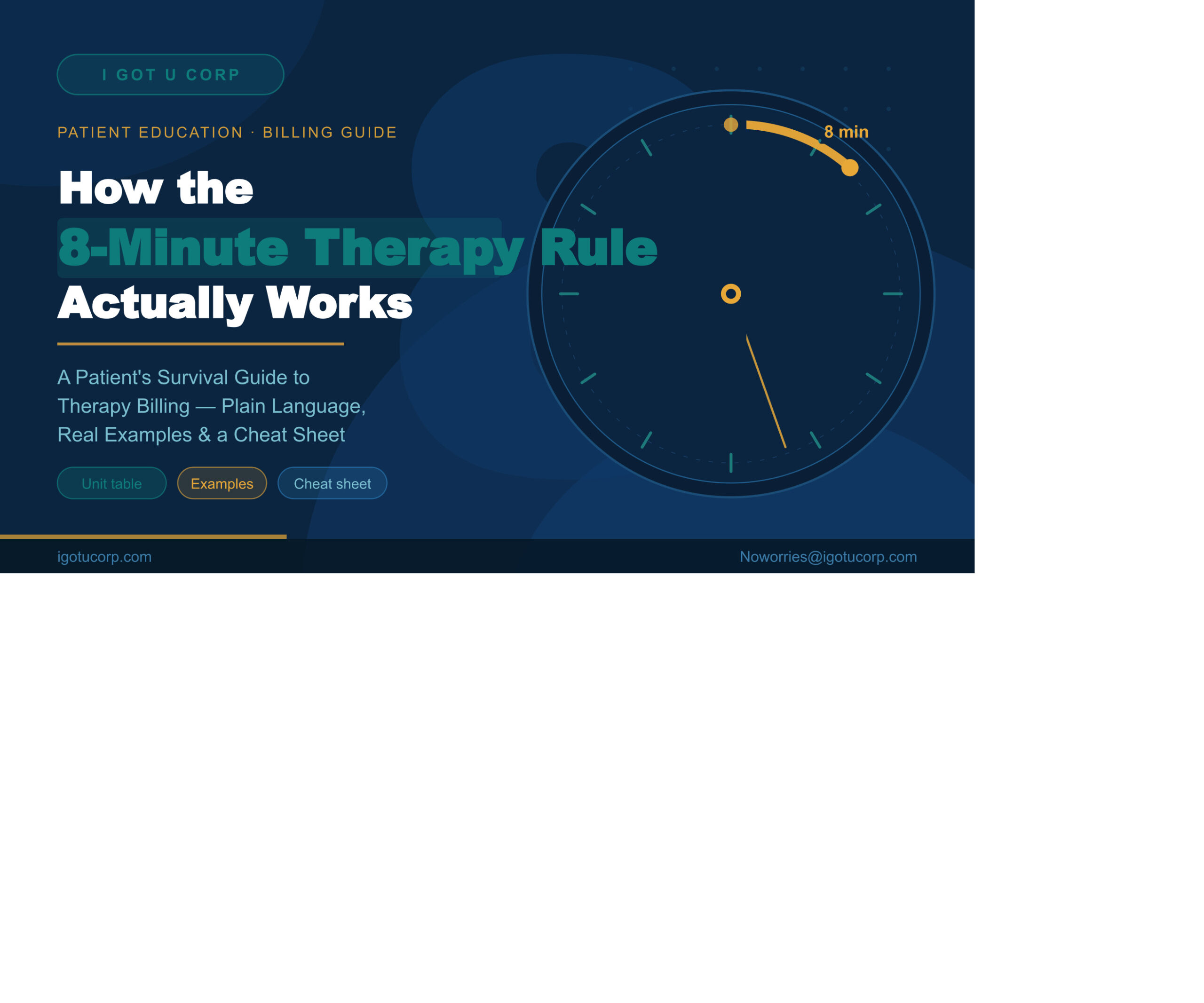
CMS solved this by anchoring billing to a 15-minute unit system with a clear midpoint threshold. One unit of a timed therapy service represents 15 minutes of skilled, direct therapeutic contact. The 8-minute figure represents the halfway point of that 15-minute block — the minimum amount of remaining time that qualifies to be counted as an additional unit. Fall below 8 minutes of remainder and no extra unit can be claimed. Reach 8 minutes and one more unit is earned.
Although the rule was written for Medicare Part B — covering physical therapy, occupational therapy, and speech-language pathology — it has since been adopted as a billing standard by Medicaid and virtually all major private insurers. Understanding where the 8 minute therapy rule comes from helps explain why it is structured the way it is: not arbitrary, but engineered for consistency, fairness, and verifiability on both sides of the billing relationship.
Why it matters to you: Every timed therapy service you receive is billed according to this rule. Knowing its origin helps you understand why the math works the way it does — and why deviating from it is a compliance issue, not a judgment call.
The Unit Arithmetic: Turning Minutes into Billable Charges
Let us work through the arithmetic so it becomes second nature. The system has two moving parts: complete 15-minute blocks, and the 8-minute remainder threshold. Every complete block of 15 minutes earns exactly one billable unit. After all complete blocks are counted, whatever time remains is subject to the threshold — 8 minutes or more earns one additional unit; 7 minutes or fewer earns nothing extra.
Here is the complete minute-to-unit reference for any outpatient therapy session:
| Total Timed Minutes in Session | Units Your Provider Can Bill |
| 1 to 7 minutes | 0 — does not reach the minimum threshold |
| 8 to 22 minutes | 1 unit |
| 23 to 37 minutes | 2 units |
| 38 to 52 minutes | 3 units |
| 53 to 67 minutes | 4 units |
| 68 to 82 minutes | 5 units |
| 83 to 97 minutes | 6 units |
| 98 to 112 minutes | 7 units |
| 113 to 127 minutes | 8 units |
Two numbers in this table deserve your attention above all others. First: 7 minutes earns zero units. No matter how close it is to the threshold, it does not qualify. Second: 8 minutes earns one full unit. A single additional minute of timed service crosses the line from zero to one. This is the threshold that governs every partially completed block in any therapy session — and it is the number that makes the most difference in everyday billing situations.
There is one more arithmetic rule that applies when a session involves more than one timed service. All timed minutes from all services must be pooled into a single total before units are calculated. You do not calculate units for each service separately and then add them. You add all the minutes together, find the total in the table, and that number is the session ceiling — the maximum units that can be billed across all timed services combined, regardless of how many different codes were used.
Common error to watch for: If a provider calculates units per service independently and then adds them, the result almost always overstates the billable total. Pool first. Calculate second. That is the correct sequence under the 8 minute therapy rule.
8-Minute Rule Cheat Sheet: 13 Things Worth Knowing Before You Read Your Bill
This 8-minute rule cheat sheet is designed as a quick-access reference — the kind of thing worth saving on your phone or keeping in a folder with your insurance documents. Each row answers a question that comes up regularly when patients review their statements.
| Question | Quick Answer |
| How many minutes trigger a first unit? | 8 minutes of direct timed therapeutic contact |
| How long is one full unit? | 15 minutes of skilled care |
| What triggers a second, third, or fourth unit? | Each new complete 15-min block, plus 8+ min remainder |
| Do evaluations follow this rule? | No — initial and follow-up evals are billed flat per visit |
| Does it apply to every CPT code? | No — timed codes only, not flat-rate untimed codes |
| Which government body wrote this rule? | CMS — Centers for Medicare & Medicaid Services |
| Do commercial insurers use the same rule? | Most do — it is the de facto national billing standard |
| What qualifies as a timed minute? | One-on-one, skilled, direct therapist-patient contact |
| What does not count toward timed minutes? | Rest periods, equipment setup, passive unsupervised time |
| Highest possible units in a 60-min session? | 4 units — one per complete 15-minute block |
| How should multiple services be calculated? | Pool all timed minutes first; never add units per code |
| What must appear in session documentation? | Minutes per timed code, or start and end times per service |
| Can patients see that documentation? | Yes — HIPAA guarantees access to your own records |
How to use this: When your EOB arrives, pull up this cheat sheet alongside the unit table from the previous section. Cross-reference the timed minutes in your session notes against what was billed. If the numbers match, great. If they do not, you have the basis for a clear, specific conversation with your provider.
Four Real-World Scenarios: Seeing the 8-Minute Therapy Rule in Action
Reading about a rule is one thing. Watching it play out in realistic session scenarios is another. The following four 8-minute rule therapy examples use patient-perspective language — not clinical shorthand — so you can see exactly how the calculation applies to sessions you might actually experience.
Scenario A: A Single-Service Session with Clean Numbers
You receive 45 minutes of therapeutic exercise — one timed service, measured precisely. Forty-five minutes contains three complete 15-minute blocks with no time remaining. Three blocks, three units. Your provider bills 3 units of therapeutic exercise. No threshold question, no remainder calculation needed. This is the clearest possible 8 minute rule therapy example, and it represents the simplest billing situation: time divides cleanly, units reflect that exactly.
Scenario B: The Remainder That Does Not Qualify
Your therapist delivers 29 minutes of a timed service. One complete 15-minute block equals one unit. The remaining 14 minutes — well above the 8-minute threshold — earns a second unit. Total: 2 units billed. Now imagine a different session where the same service runs 21 minutes. One block of 15 minutes, 6 minutes remaining. Six minutes is below the threshold. Result: 1 unit only. The difference between 21 minutes and 23 minutes is the difference between 1 unit and 2. That gap is where most billing disputes begin — and where knowing the 8 minute therapy rule gives you the clearest advantage as a patient.
Scenario C: Three Services, One Pooled Calculation
Your session covers three timed services: 16 minutes of gait training, 13 minutes of therapeutic activities, and 8 minutes of balance training. Do not calculate units for each individually. Add them: 16 + 13 + 8 = 37 minutes total. From the unit table, 37 minutes falls in the 23-to-37-minute range — 2 billable units. Those 2 units are then distributed across the three services based on relative time. Gait training, having the longest duration, would receive 1 unit; one of the remaining services — whichever had more time — receives the second. If your bill showed 3 units for this session, the physical therapy 8 minute rule has been misapplied.
Scenario D: A High-Volume Session at the Unit Ceiling
Your therapist delivers a comprehensive 68-minute session across four timed services. From the unit table, 68 minutes sits in the 68-to-82-minute range — 5 billable units. The 5 units are distributed proportionally across the four services based on time each received. Any bill reflecting more than 5 units for a 68-minute session of timed services would exceed the allowable ceiling under the 8 minute therapy rule, regardless of how many individual CPT codes were used.
“Add up the timed minutes. Find the number in the table. That is your session’s unit ceiling. Any bill above that ceiling deserves a question.”
Timed Services vs. Untimed Services: A Distinction That Changes Everything
One of the most common sources of patient confusion is not the 8-minute calculation itself — it is not knowing which services the rule applies to in the first place. The answer depends on whether a service uses a timed or untimed CPT code.
Timed CPT Codes — Subject to the 8-Minute Rule
Timed codes are billed in 15-minute units based on the duration of skilled, direct therapist contact. Common timed services include therapeutic exercise, manual therapy techniques, neuromuscular reeducation, therapeutic activities, gait training, and self-care management training. If you receive any of these — or similar interventions billed by duration — the 8 minute therapy rule governs how those minutes become units on your statement.
Untimed CPT Codes — Not Subject to the 8-Minute Rule
Untimed codes are billed as a flat charge per visit, regardless of how much time is spent. Your initial evaluation falls into this category, as do most re-evaluations, certain modality codes, and some other per-visit services. These appear on your bill as a single line item per session — no unit count, no threshold calculation. Knowing which category each line item on your bill belongs to tells you immediately whether the 8-minute rule applies to it.
Quick check: If a line on your Explanation of Benefits shows a unit count, the 8-minute rule applies to it. If it shows a single flat charge per session with no unit count, it is an untimed code and the rule does not.
Something Does Not Add Up on Your Bill — Here Is Exactly What to Do
Discovering a discrepancy between your session time and your billed units is not a reason to panic — and it is not automatically an accusation of wrongdoing. Billing errors are more common than most people realise, and they often stem from documentation oversights rather than intentional overbilling. The important thing is knowing the steps to take.
- Request your itemised bill. Ask your provider for a statement that lists every CPT code, the number of units billed per code, and the service date. This is your starting point.
- Pull your session notes. You are legally entitled to your medical records under HIPAA. For timed codes, those notes should show either start and stop times or total minutes per timed service. These are the numbers you will use to verify the bill.
- Run the calculation yourself. Add all timed minutes together. Find the total in the unit table in this guide. Compare the result to the unit count on your bill. If the bill exceeds the ceiling, you have a specific, documentable discrepancy.
- Raise it with your provider first. Bring the specific numbers — the timed minutes from your notes, the units from your bill, and the expected ceiling from the table. Most discrepancies are resolved at this stage without escalation.
- Contact your insurer if necessary. If your provider cannot explain the discrepancy satisfactorily, your insurance company’s member services team can request documentation directly and conduct their own review.
Important: Keep every piece of paperwork — your session notes, itemised bills, EOBs, and any written communication with your provider. Documentation is your strongest asset if a billing dispute escalates.
Billing Accuracy at I Got U Corp: What We Do Differently
There are providers who view billing as an administrative back-end function — something handled separately from the clinical relationship. At I Got U Corp, we see it differently. How we document your sessions and how we calculate your units is part of the care we give you. It is an expression of the same values that shape your treatment: accuracy, accountability, and genuine respect for the person sitting across from us.
Every session at I Got U Corp is documented with precise time entries for each timed intervention. Before any claim is submitted, our billing review process cross-references the unit calculation against the session record. This is not a quality-check that happens when something goes wrong. It is how we do things every time, for every patient, without exception.
We also made a deliberate decision to produce guides like this one — because we believe that a patient who understands the 8 minute therapy rule is better equipped to be a partner in their own care, not just a recipient of it. When you know what accurate billing looks like, you can recognise it. And when you can recognise it, trust becomes something earned and verifiable rather than simply assumed.
If you ever have a question about a bill, a session record, or anything in this guide — we are a phone call or an email away. That is not a customer service line response. It is a commitment we stand behind.
Your Questions Answered: The 8-Minute Therapy Rule FAQ
Q. Is the 8-minute therapy rule the same for all types of therapy?
The 8 minute therapy rule was originally written for Medicare Part B outpatient therapy — physical, occupational, and speech therapy. It applies to the timed CPT codes used in those disciplines. For 8 minute rule mental therapy, most sessions are billed using per-session psychotherapy codes that are not time-based in the same way. However, certain add-on codes in mental health billing do follow a time-based structure, and in those cases the same midpoint-threshold logic applies. When in doubt, ask your provider which codes are being used and whether they are timed or untimed.
Q. What happens if my therapist goes over 60 minutes of timed service?
The unit table continues beyond 60 minutes — up to 127 minutes and 8 units in the reference above. There is no hard session ceiling imposed by the 8 minute therapy rule itself. However, most insurers impose their own limits on the number of units reimbursable per session, per diagnosis, or per year. If your session runs long, the unit calculation still follows the same pooled-minute arithmetic — add all timed minutes together, find the total in the table, and that is the maximum billable unit count regardless of what the insurer will actually reimburse.
Q. Can a therapist bill a unit for time spent writing notes after my session?
No. Only direct, skilled therapeutic contact counts toward timed minutes under the 8 minute therapy rule. Documentation time, phone calls, care coordination, equipment preparation, and any time spent when the therapist is not in direct skilled contact with the patient do not count. If a provider is including administrative time in timed minute totals, that is a compliance violation — not a billing preference.
Q. What is a physical therapy 8-minute rule violation, and who investigates it?
A physical therapy 8 minute rule violation occurs when timed units are billed in excess of what the documented minutes support. This can include billing a unit for less than 8 minutes of remaining time, failing to pool minutes across services before calculating units, or billing timed units without adequate time documentation in the session notes. CMS, Medicaid, and private insurers all have audit mechanisms for detecting billing discrepancies. Patients can also report concerns through their insurer’s member services line or, for Medicare, through the Office of Inspector General.
Q. How do I use the 8-minute rule cheat sheet to check my own bill?
Start with your session notes — either request them from your provider or access them through your patient portal. Identify every timed service and the minutes recorded for each. Add those minutes together to get your session total. Find that total in the unit table earlier in this guide — the corresponding unit count is your billing ceiling. Then compare that ceiling to the total timed units on your itemised bill. If they match, the billing is arithmetically correct. If the bill exceeds the ceiling, you have a specific discrepancy to raise with your provider using the steps outlined in the previous section.
Q. Does the 8-minute therapy rule protect me from being undercharged?
The rule sets a floor as well as a ceiling. Just as overbilling violates the standard, underbilling — failing to claim units that the documented time clearly supports — is also inaccurate. For patients, underbilling is less of a direct financial concern, but it affects provider reimbursement and the long-term sustainability of care access. For the system to work properly, billing should reflect documented time accurately in both directions. A provider who consistently underbills may have documentation problems that create audit risk or affect care quality over time.
Q. Why does I Got U Corp take the time to educate patients about billing rules?
Because we believe that informed patients receive better care — not in theory, but in practice. When you understand the 8 minute therapy rule, you can read your bill, ask specific questions, and hold your provider to a clear and verifiable standard. That kind of engagement improves the quality of the care relationship. It also reflects what I Got U Corp is about: being genuinely transparent with the people we serve, not just clinically skilled. No worries means we have done the work — in the treatment room and in the paperwork.
Your Therapy Time Has Value — Make Sure It Is Being Counted Correctly
Every minute you spend in therapy is time invested in your own wellbeing. The 8 minute rule therapy exists to ensure that time is translated into billing accurately — not estimated, not approximated, but calculated against a consistent, verifiable standard. When you understand how that calculation works, you gain something more than billing literacy. You gain the confidence to engage with your care as an active participant rather than a passive recipient.
If this guide has answered questions you did not know you had — or raised new ones specific to your situation — I Got U Corp is here to help. Bring us your bill, your EOB, your session notes, or simply your questions. We will work through them with you in plain language, and we will not stop until things make sense. That is the I Got U Corp commitment. The 8 minute therapy rule is just one of the ways we put it into practice — one session, one unit, one patient at a time.
READY TO TALK? WE ARE LISTENING.
No Worries. We Got You. That Is Not a Slogan — It Is a Promise.
Questions about a specific bill? Confused by a line on your EOB? Looking for a therapy provider that actually communicates clearly? Reach out to I Got U Corp today. Our team responds within 24 hours. Every conversation is completely confidential.
Get in Touch with I Got U Corp — We Respond Within 24 Hours
CONTACT I GOT U CORP
9431 Haven Ave Suite 100-151, Rancho Cucamonga, CA 91730, United States
+1 909-325-7949
All inquiries are completely confidential · Response within 24 hours · Monday through Saturday
Recent Posts
Related Posts

What to Expect During Your First 7 Days at a Depression Center
The night before you start treatment can feel strange. Part of you is relieved that help is finally coming. Another...

How to Protect Your Mental Health Without Sacrificing Your Career
It is Sunday evening and your stomach is already tight. You are replying to emails you will see again in...

How to Find a Licensed Male Therapist in California
Plenty of people know the moment they decide they want therapy. Fewer people know what to type into the search...

How to Do the 5-4-3-2-1 Technique Silently in Class
Learn how to manage anxiety discreetly during class using the simple and effective 5-4-3-2-1 grounding technique in this article. Exclusive...

How to Set Boundaries Without Guilt: Stop People Pleasing
You said yes again. You knew while the words were leaving your mouth that you did not want to say...