
The 8-Minute Rule in Mental Therapy: Complete Guide | I Got U Corp
You sit down in your therapist’s office. You talk, you reflect, you do the work. But have you ever wondered how the minutes of that session translate into the care that gets billed to your insurance? Or why some sessions feel complete at 45 minutes while others run longer? Behind the scenes of every therapy appointment — mental health, physical, or otherwise — is a framework that governs how timed services are counted, documented, and reimbursed.
The 8-minute rule in therapy is one of the most important and least understood billing standards in the mental health care system. Originally established by the Centers for Medicare and Medicaid Services (CMS) for physical therapy, its principles have been adapted across the broader therapy landscape, including mental health services billed under timed CPT codes. Understanding this rule helps patients make sense of their bills, helps caregivers advocate effectively for their loved ones, and helps mental health professionals ensure accurate, ethical documentation.
This guide covers everything you need to know: what the 8-minute rule mental health standard means, how it applies to therapy sessions, real-world examples of how time translates into billable units, a practical cheat sheet for quick reference, and what it means for you as someone receiving or supporting mental health care.
“In therapy, every minute counts — not just emotionally, but clinically. The 8-minute rule determines how your time in session is measured, recorded, and reimbursed.”
What Is the 8-Minute Rule in Mental Therapy?
The 8-minute rule therapy standard is a Medicare billing guideline that determines how many billable service units a provider can claim based on the direct time spent delivering a timed therapeutic service. Under this rule, a provider must spend a minimum of 8 minutes on a specific timed service in order to bill even a single unit for that service.
One unit represents 15 minutes of direct, skilled therapeutic time. To bill more than one unit, the total timed service minutes must reach the midpoint threshold of the next 15-minute interval — which is 8 minutes (half of 15, rounded up). This is the origin of the name: the 8-minute rule.
In the context of mental health therapy, the 8-minute rule applies to timed CPT codes — the procedure codes used for specific types of therapeutic intervention that are billed by time rather than by visit. Common mental health CPT codes that operate on timed billing include psychotherapy add-on codes, crisis psychotherapy, interactive complexity, and certain evaluation and management codes when combined with psychotherapy. Not all mental health services are timed — the standard 45-minute and 60-minute psychotherapy codes (90834, 90837) are billed as untimed, per-session codes. The 8-minute rule most critically affects sessions where timed add-on codes are used alongside the primary session.
Important Distinction: The standard 45-minute and 60-minute psychotherapy codes are untimed — they are billed per session regardless of exact minutes. The 8-minute rule in mental therapy applies specifically to timed codes used alongside or in addition to the primary session code.
How the 8-Minute Rule Works: Time, Units, and Thresholds
Whether applied in physical or mental health therapy, the core mechanics of the 8-minute rule operate the same way. Each 15-minute block of direct timed service equals one billable unit. To add a unit beyond a complete block, the remaining time must reach or exceed 8 minutes — the midpoint threshold.
Here is the standard time-to-unit conversion table that governs timed therapy billing:
| Minutes of Timed Service | Billable Units |
| 1 to 7 minutes | 0 units — not billable as a timed unit |
| 8 to 22 minutes | 1 unit |
| 23 to 37 minutes | 2 units |
| 38 to 52 minutes | 3 units |
| 53 to 67 minutes | 4 units |
| 68 to 82 minutes | 5 units |
| 83 to 97 minutes | 6 units |
| 98 to 112 minutes | 7 units |
| 113 to 127 minutes | 8 units |
The most common misunderstanding is assuming that any time remaining after a complete 15-minute block automatically earns another unit. It does not. Seven minutes of remaining time — even after 15, 30, or 45 complete minutes — is not sufficient for an additional unit. The threshold is always 8 minutes minimum.
8-Minute Rule Cheat Sheet for Mental Health Therapy
This quick-reference cheat sheet summarises the core principles of the 8-minute rule as it applies in mental health and therapy billing contexts. Use it to review session documentation, understand your Explanation of Benefits, or support accurate record-keeping.
| Concept | What You Need to Know |
| Minimum time for 1 unit | 8 minutes of direct timed therapeutic service |
| One unit equals | 15 minutes of skilled direct service time |
| Threshold for each added unit | Remaining time must reach the 8-minute midpoint of the next interval |
| Applies to | Timed CPT codes only — not standard per-session psychotherapy codes |
| Standard psych codes (90834, 90837) | Untimed — billed per session, not affected by the 8-minute rule |
| Documentation required | Session start/end times, or total timed minutes per code |
| Multiple timed codes | Total minutes across ALL timed codes combined before calculating units |
| Governs | Medicare Part B; widely adopted by Medicaid and private insurers |
| 8-minute rule mental health | Applies to timed add-on codes, crisis codes, and interactive complexity |
| Underbilling risk | Failing to reach 8 minutes loses a legitimate unit of covered care |
Quick Reference: Save this cheat sheet to your records. Patients can use it to review billing statements; mental health professionals can use it to verify session documentation before submission.
8-Minute Rule Therapy Examples in Mental Health Contexts
Seeing the 8-minute rule applied to real mental health therapy scenarios removes the ambiguity. Here are four practical examples drawn from common outpatient mental health billing situations:
Example 1: Standard Psychotherapy Session — No Timed Codes
A patient receives a 45-minute psychotherapy session using CPT code 90834. This is an untimed code billed per session. The 8-minute rule does not apply. The provider bills one unit of 90834 regardless of whether the session ran 43 or 47 minutes. This is the most common mental health billing scenario and the one least affected by the 8-minute rule.
Example 2: Psychotherapy With a Timed Add-On Code
A patient receives 38-minute psychotherapy (CPT 90837) combined with 12 minutes of interactive complexity (CPT 99202 add-on). The primary psychotherapy code is untimed — billed per session. The interactive complexity add-on is timed. Twelve minutes exceeds the 8-minute threshold, so 1 unit of the timed add-on can be billed. Total billing: 1 unit of 90837 + 1 unit of the timed add-on code.
Example 3: Crisis Psychotherapy — Fully Timed
Crisis psychotherapy services (CPT 90839 and 90840) are timed codes. A provider delivers 52 minutes of crisis psychotherapy. Using the unit table: 52 minutes falls in the 38-to-52-minute range, which equals 3 billable units. If the crisis session continued for an additional 10 minutes (total: 62 minutes), that falls in the 53-to-67-minute range — 4 billable units. The additional 10 minutes crossed the 8-minute threshold of the next interval and earned an additional unit.
Example 4: Where the 8-Minute Rule Prevents a Unit
A mental health provider delivers 22 minutes of a timed therapeutic service. That is 1 complete 15-minute unit (15 minutes) plus 7 remaining minutes. Seven minutes does not reach the 8-minute threshold. Only 1 unit can be billed — not 2. This is the most instructive 8-minute rule therapy example because it illustrates the precise boundary. Had the session continued for just one more minute (23 minutes total), a second unit would have been billable.
“One minute can be the difference between one and two billable units. Accurate time tracking in mental health therapy is not administrative overhead — it is clinical and financial precision.”
The 8-Minute Rule and Mental Health: What Makes It Different
While the 8-minute rule originated in physical therapy billing, its application to mental health therapy has its own nuances that patients and providers should understand clearly.
Most Standard Psychotherapy Is Untimed
The majority of outpatient mental health sessions use untimed CPT codes. The standard 30-minute (90832), 45-minute (90834), and 60-minute (90837) psychotherapy codes are billed per session, not per unit. This means that for most patients receiving standard talk therapy, the 8-minute rule does not directly affect how their session is billed. Where it matters most is when timed add-on codes, crisis codes, or evaluation and management codes are combined with psychotherapy.
Interactive Complexity and Timed Add-Ons
Interactive complexity (CPT 99202-99215 range add-ons) is one of the most commonly used timed codes in mental health billing. It applies when the therapeutic work involves specific complications such as non-verbal communication techniques, managing the emotional responses of third parties in the room, or the presence of a legally authorised representative. When this code is added to a psychotherapy session, the time spent on interactive complexity is subject to the 8-minute rule.
Crisis Psychotherapy — Fully Governed by the 8-Minute Rule
Crisis psychotherapy services are among the most significant timed mental health codes. CPT 90839 covers the first 30-74 minutes of crisis intervention, and CPT 90840 covers each additional 30 minutes. These codes are time-defined and require meticulous documentation. Providers delivering crisis services must track time precisely and apply the 8-minute rule accurately when calculating billable units for sessions that extend beyond standard time thresholds.
Documentation Is Everything
For timed mental health codes, documentation must support the billed time. This means recording the start and stop time of each timed service, or the total minutes spent on each timed intervention, within the session note. Inadequate documentation is one of the most common reasons mental health claims are denied or flagged during audits. The 8-minute rule is only as useful as the documentation that supports it.
Why the 8-Minute Rule Matters for Mental Health Patients
For patients, the 8-minute rule in mental therapy may feel distant from the experience of therapy itself — but it has direct, practical implications for how your care is billed and how your insurance coverage is used.
When timed codes are billed correctly under the 8-minute rule, your insurance is charged accurately for the care you received — no more, no less. If timed units are overbilled (claiming units for time that did not meet the threshold), that is a compliance violation that can result in audits, repayment demands, and in serious cases, fraud investigations. If timed units are underbilled, the provider loses legitimate reimbursement — which over time can affect the sustainability of the services available to you.
As a patient, you have the right to request an itemised bill and an Explanation of Benefits from your insurer. If you see units billed for timed services and want to understand how they were calculated, asking your provider to walk you through the session documentation is entirely appropriate. At I Got U Corp, we welcome that conversation. Transparency in how your care is documented and billed is a standard we hold ourselves to — not a concession we make reluctantly.
QUESTIONS ABOUT YOUR MENTAL HEALTH CARE OR BILLING?
I Got U Corp Is Here — No Worries, We Got You.
Whether you are a patient trying to understand how your therapy sessions are billed, a caregiver supporting someone through mental health treatment, or a professional seeking clarity on timed code documentation — the team at I Got U Corp is ready to help. We provide compassionate, expert mental health support and always take the time to make sure you understand your care completely.
[ Reach Out to I Got U Corp Today ]
CONTACT INFORMATION
9431 Haven Ave Suite 100-151, Rancho Cucamonga, CA 91730, United States
+1 909-325-7949
Noworries@igotucorp.com
All inquiries are confidential. We respond within 24 hours.
Recent Posts
Related Posts

How to Protect Your Mental Health Without Sacrificing Your Career
It is Sunday evening and your stomach is already tight. You are replying to emails you will see again in...

How to Find a Licensed Male Therapist in California
Plenty of people know the moment they decide they want therapy. Fewer people know what to type into the search...

How to Do the 5-4-3-2-1 Technique Silently in Class
Learn how to manage anxiety discreetly during class using the simple and effective 5-4-3-2-1 grounding technique in this article. Exclusive...

How to Set Boundaries Without Guilt: Stop People Pleasing
You said yes again. You knew while the words were leaving your mouth that you did not want to say...
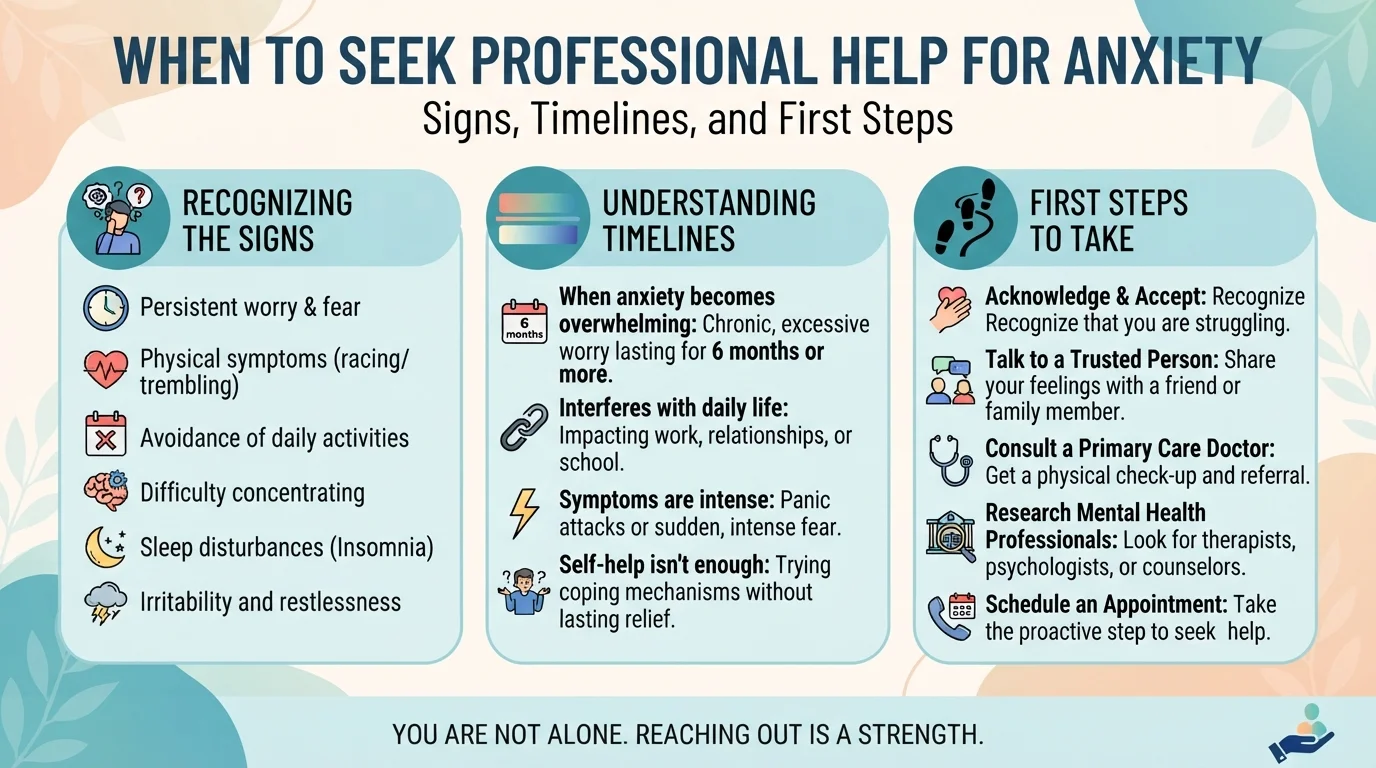
When to Seek Professional Help for Anxiety: Signs, Timelines, and First Steps
Anxiety (anxious distress) is the body's alarm response to a perceived threat, marked by worry, muscle tension, and a faster...