
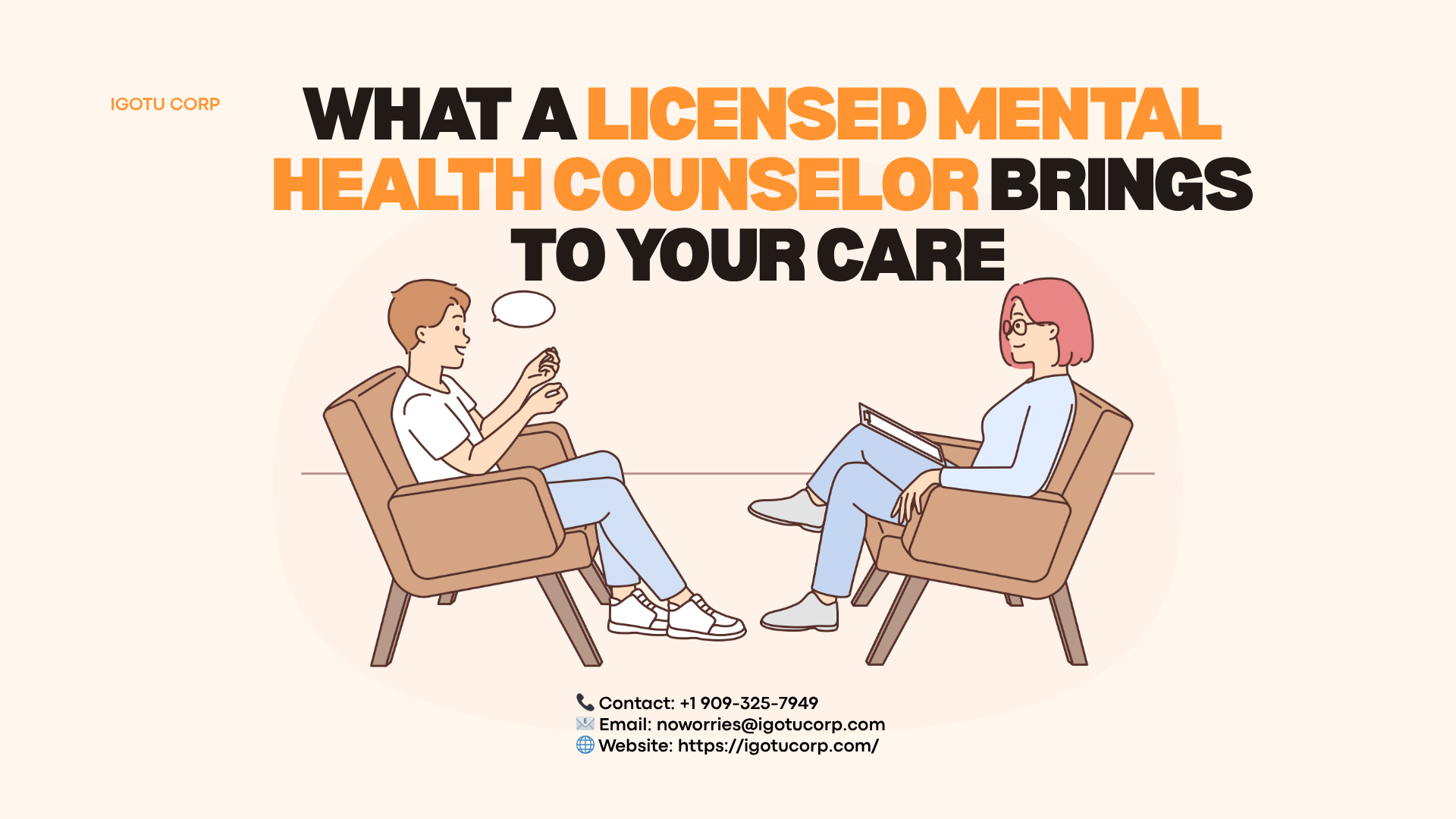
What a Licensed Mental Health Counselor Brings to Your Care
California holds some of the highest mental health care standards in the United States — and the professionals who meet those standards do not do so easily. When you work with a licensed mental health counselor in California, you are not simply talking to someone with good listening skills. You are working with a clinically trained professional who has completed hundreds of supervised hours, passed rigorous state examinations, and earned the legal authority to assess and treat a wide range of psychological conditions. Understanding what that credential means — and what it delivers for your care — is the first step toward making a confident, informed decision about your mental health.
At IGotU Corp, our team brings over 15 years of experience providing compassionate, evidence-based counseling to adults across California — both in person and online. This article breaks down exactly what California expects from its licensed counselors, and what you can expect from your sessions.
What Does a Licensed Mental Health Counselor in California Actually Mean?
In California, the term ‘licensed mental health counselor’ covers several professional designations — including Licensed Clinical Social Workers (LCSW), Licensed Marriage and Family Therapists (LMFT), and Licensed Professional Clinical Counselors (LPCC). Each of these titles represents a practitioner who has satisfied California therapist license requirements set by the Board of Behavioral Sciences (BBS).
These requirements are not symbolic. California therapist license requirements include completion of an accredited graduate-level degree in counseling, psychology, or social work, followed by a minimum of 3,000 hours of supervised clinical experience. Candidates must then pass written licensing examinations that test diagnostic knowledge, treatment planning, and ethical practice. Only after clearing every stage does the state grant the license that authorises a practitioner to provide independent mental health services.
The result is a professional who understands not just how to listen — but how to assess, diagnose, and apply structured therapeutic interventions that produce measurable, lasting change.
“A license is not a formality. In California, it represents thousands of hours of clinical training and an ethical commitment to your wellbeing.” — IGotU Corp
What a Licensed Mental Health Counselor in California Brings to Every Session?
The difference between speaking to an unlicensed coach and working with a licensed mental health counselor in California is significant — and measurable. Here is what licensed practitioners bring to your care that others cannot:
Clinical Assessment & Accurate Diagnosis
Licensed counselors are trained in evidence-based diagnostic frameworks including the DSM-5. They assess presenting symptoms holistically — considering trauma history, biological factors, social environment, and behavioural patterns — before developing a personalised treatment plan. This prevents misidentified conditions and ensures your therapy targets the actual root of your distress.
Evidence-Based Therapeutic Approaches
IGotU Corp’s licensed counselors are trained in proven modalities including Cognitive Behavioral Therapy (CBT), Dialectical Behavior Therapy (DBT), and trauma-informed care. These are not general conversation techniques — they are structured, research-validated methods that have demonstrated effectiveness across anxiety disorders, depression, trauma, and emotional dysregulation. Your sessions have a therapeutic direction, not just a listening ear.
Legal & Ethical Accountability
Licensed mental health counselors in California operate under strict BBS ethical guidelines and HIPAA privacy protections. Their license is tied directly to their conduct — meaning they are professionally and legally accountable for the quality and integrity of the care they provide. This accountability structure exists to protect you.
Continuity of Care & Treatment Planning
Unlike one-off consultations, a licensed counselor builds a structured, evolving treatment plan across sessions. Progress is tracked, approaches are adjusted, and your growth is documented. This continuity of care is what transforms individual sessions into lasting psychological change.

Licensed Mental Health Counselor California Online: Accessible Care Without Compromise
California’s telehealth regulations are among the most robust in the country, and licensed mental health counselor California online services have expanded dramatically — giving Californians access to high-quality care without geographic or logistical barriers. Whether you live in a rural area, have a demanding work schedule, or simply prefer the comfort and privacy of your own home, online therapy with a licensed counselor delivers the same clinical standard as in-person sessions.
IGotU Corp provides fully HIPAA-compliant online therapy sessions across California. Our licensed counselors conduct secure video consultations that mirror the depth and structure of face-to-face care — covering anxiety treatment, depression support, trauma therapy, CBT, DBT, and emotional support animal letter evaluations. For clients in Rancho Cucamonga and the wider Inland Empire, we also offer in-person appointments.
Licensed Mental Health Counselor California Requirements: What Sets the Bar So High?
Understanding licensed mental health counselor California requirements helps explain why California-licensed practitioners command a high level of trust. The pathway to licensure includes:
- Graduate-level education: A Master’s or Doctoral degree in counseling, clinical psychology, social work, or marriage and family therapy from an accredited institution
- 3,000+ supervised clinical hours: Direct client contact hours accumulated under a board-approved licensed supervisor — typically over 2–3 years post-graduation
- Written licensing examinations: Standardised tests assessing clinical knowledge, ethics, treatment modalities, and California-specific law and professional standards
- Background check and BBS application: Criminal background clearance and formal application review by the California Board of Behavioral Sciences
- Continuing education: Active licensees must complete ongoing professional development hours to maintain licensure — ensuring clinical knowledge stays current
This structure means that every licensed mental health counselor in California has not just studied mental health — they have practiced it under rigorous supervision, been tested on it, and committed to ongoing learning throughout their career.
Why Choose IGotU Corp for Licensed Mental Health Counseling in California?
IGotU Corp was built on a single principle: that every adult deserves access to compassionate, high-quality mental health support delivered by qualified professionals who genuinely care. Led by Vincente Mozell, LCSW — a licensed clinical social worker with over 15 years of experience — our team provides personalised therapy for anxiety, depression, trauma, life transitions, and more.
We offer flexible appointment options including online therapy available to all California residents and in-person sessions in Rancho Cucamonga. Our practice maintains full HIPAA compliance, accepts insurance (contact us to verify your plan), and offers a free initial consultation so you can feel confident before committing. There is no pressure, no clinical jargon, and no judgment — just a compassionate, licensed space where your wellbeing comes first.
California’s mental health standards are high for good reason — they protect you. Working with a licensed mental health counselor in California means your care is backed by clinical training, ethical accountability, and a genuine commitment to your long-term wellbeing. If you are ready to take the first step, IGotU Corp is here.
Frequently Asked Questions: Licensed Mental Health Counselor California
What are the requirements to become a licensed mental health counselor in California?
Licensed mental health counselor California requirements include completing an accredited graduate degree, accumulating 3,000+ supervised clinical hours, passing BBS-administered licensing examinations, clearing a background check, and maintaining ongoing continuing education. The full pathway typically takes 3–5 years post-graduation.
Can I see a licensed mental health counselor in California online?
Yes. Licensed mental health counselor California online services are widely available and fully regulated under California telehealth law. IGotU Corp offers secure, HIPAA-compliant virtual sessions for adults across all of California, with the same clinical depth and licensed oversight as in-person appointments.
What is the difference between a licensed counselor and a therapist in California?
In California, ‘therapist’ and ‘counselor’ are often used interchangeably for licensed practitioners. Specific license types include LCSW, LMFT, and LPCC — each with distinct training focus but all meeting California therapist license requirements set by the Board of Behavioral Sciences. All are qualified to provide independent mental health treatment.
How do I know if a mental health counselor is genuinely licensed in California?
You can verify any practitioner’s license status through the California Board of Behavioral Sciences (BBS) online license lookup tool at bbs.ca.gov. This free database shows active license status, license type, expiration date, and any disciplinary history. Always verify before beginning treatment.
Does IGotU Corp accept insurance for mental health counseling in California?
IGotU Corp works with select insurance plans. Contact the team directly at 909-325-7949 or via the website to verify whether your specific plan is accepted. A free initial consultation is available to all new clients before any financial commitment is made.
What conditions does a licensed mental health counselor in California treat?
Licensed counselors in California treat a broad range of conditions including generalised anxiety disorder, depression, PTSD and complex trauma, adjustment disorders, emotional dysregulation, grief, life transitions, and relationship difficulties. IGotU Corp specialises in anxiety, depression, trauma therapy, CBT, and DBT for adults.
How long does it take to see results from mental health counseling?
Many clients report meaningful relief within 4–8 sessions when working with a licensed mental health counselor in California using evidence-based methods. More complex presentations — including trauma or long-term depression — benefit from extended treatment. IGotU Corp creates personalised treatment plans that track your progress and adjust the approach as you grow.
Take the First Step Toward Better Mental Health Today
You do not have to navigate anxiety, depression, or emotional pain alone. IGotU Corp’s licensed mental health counselors are here — online and in person — ready to provide the compassionate, evidence-based care you deserve. Book your free consultation today and take the first step toward lasting clarity and wellbeing.
✦ Request a Free Consultation at IGotUCorp.com ✦
Call or Text: 909-325-7949 | Available Online Across California
Contact IGotU Corp
- 9431 Haven Ave suite 100-151, Rancho Cucamonga, CA 91730, United States
- +1 909-325-7949
- Noworries@igotucorp.com
IGotU Corp — Licensed Mental Health Counseling for Adults in California | Online & In-Person
Recent Posts
Related Posts

What to Expect During Your First 7 Days at a Depression Center
The night before you start treatment can feel strange. Part of you is relieved that help is finally coming. Another...
How to Protect Your Mental Health Without Sacrificing Your Career
It is Sunday evening and your stomach is already tight. You are replying to emails you will see again in...
How to Find a Licensed Male Therapist in California
Plenty of people know the moment they decide they want therapy. Fewer people know what to type into the search...

How to Do the 5-4-3-2-1 Technique Silently in Class
Learn how to manage anxiety discreetly during class using the simple and effective 5-4-3-2-1 grounding technique in this article. Exclusive...
How to Set Boundaries Without Guilt: Stop People Pleasing
You said yes again. You knew while the words were leaving your mouth that you did not want to say...