
By Vincente Mozell, LCSW, MSHM – I Got U Corp
When people come into session and say, “I feel anxious all the time and I do not know why,” I usually start with, “Give me two words to ground us today.”
Those two words tell me how your mind and body have been moving through the week. Words like restless, tense, on edge, or wired but tired are common when anxiety has been running the show for a while.
Anxiety is not always loud. Sometimes it is quiet. It shows up as overthinking, overdoing, not sleeping, or trying to hold everything together for everybody else.
Anxiety is the body’s way of saying, “I do not feel safe.”
The goal is not to shame yourself for feeling that way. The goal is to build tools so your system can come out of survival mode.
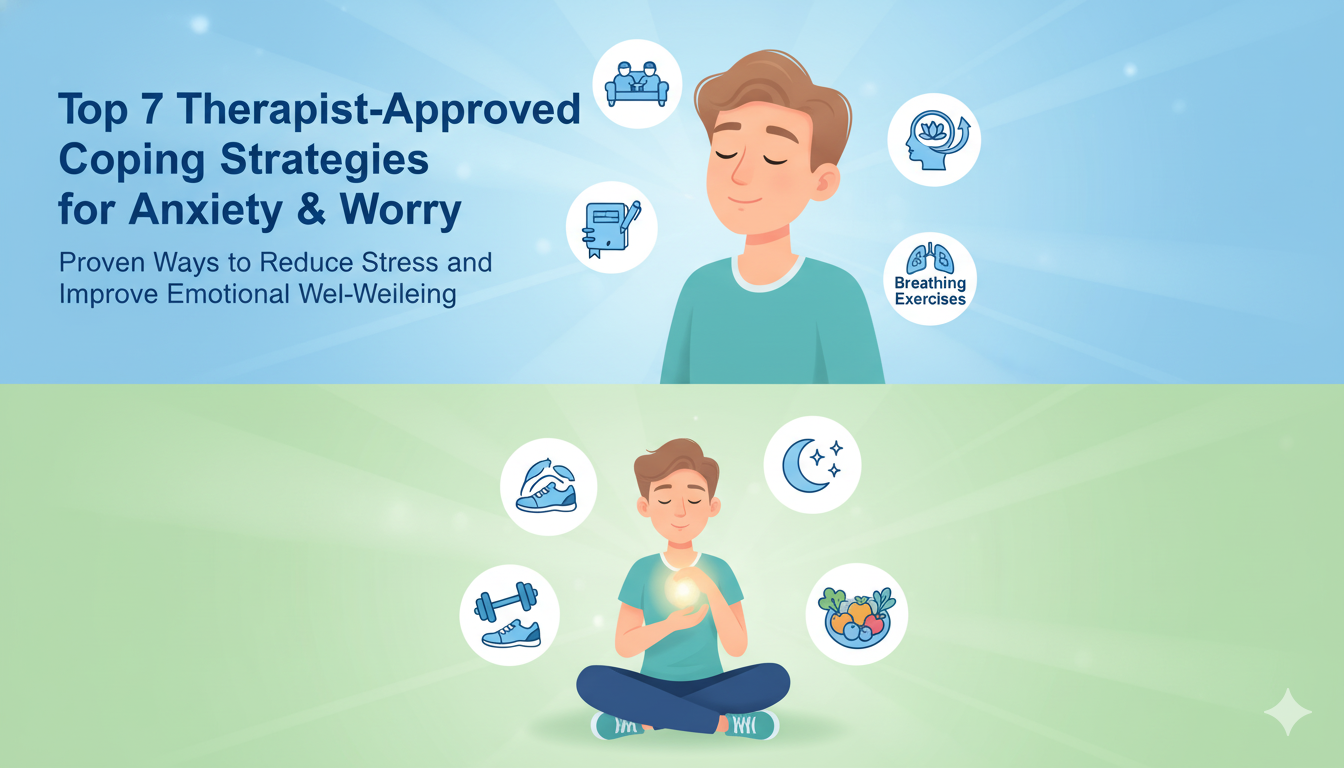
Below are seven therapist-approved strategies I use with clients to help manage anxiety and worry. As you read them, notice what lands for you and what your inner child might be asking for.
-
Notice the Story You Are Telling Yourself:
I tell clients often, “Your feelings are valid, but they are not facts.”
When anxiety hits, your mind often fills in the blanks with the worst-case scenario. You might hear thoughts like:
- “If I mess this up, it is over.”
- “Something bad is going to happen.”
- “Everyone is judging me.”
These thoughts usually come from old stories your inner child learned a long time ago. Maybe you had to anticipate danger or chaos growing up, so your mind still looks for what might go wrong.
A simple practice:
- Write down one anxious thought when it shows up.
- Ask, “What is the evidence for this and what is the evidence against it?”
- Ask, “Is this my adult self-talking or my inner child trying to protect me?”
You are not arguing with your feelings. You are just not letting anxiety decide what the facts are.
-
Ground Your Body So Your Mind Can Catch Up:
Anxiety lives in the body. Tight shoulders, racing heart, shallow breathing, lump in the throat.
Your body is often anxious before your mind can put words to it.
Grounding is how you remind your nervous system, “Right now, I am here. I am not in the past. I am not in the future. I am in this moment.”
Try this when anxiety spikes:
- Name five things you can see.
- Name four things you can touch.
- Name three things you can hear.
- Name two things you can smell.
- Name one thing you can taste.
You can also:
- Hold something cool in your hand.
- Put your feet flat on the floor and feel the support underneath.
- Gently stretch your neck, shoulders, and hands.
Grounding is you telling your inner child, “I am with you. I am not going to ignore you, and I am not going to let this feeling run me.”
-
Use Your Breath as a Brake Pedal:
When anxiety shows up, breathing often becomes short and fast. That sends a signal to your brain that you are in danger, even when you are not.
You can flip that signal by using intentional breathing.
Think of your breath as a brake pedal for your nervous system.
Try this:
- Inhale gently through your nose for a slow count of four.
- Hold for a count of four.
- Exhale slowly through your mouth for a count of six.
- Repeat for a few minutes.
You are not forcing calm. You are creating conditions where calm is possible.
-
Check How Much of Your “Pizza” You Are Giving Away:
In session I sometimes use the pizza analogy. Imagine your energy and time are one pizza cut into eight slices. Anxiety often increases when you give all eight slices away.
You may be:
- Working
- Taking care of family
- Showing up for friends
- Handling crises
- Answering everyone’s questions
At the end of the day, there is nothing left for you.
Anxiety loves a schedule where you are last.
Your inner child notices that too.
Try this:
- Draw a circle and divide it into eight slices.
- Label how you spent your time and emotional energy this week.
- Ask, “Where is my slice? Where does my inner child get cared for?”
If the answer is nowhere that is information. The coping strategy here is boundaries. Saying no sometimes. Protecting one slice for you. That is not selfish. That is maintenance.
-
Move From Rescuing to Healthy Helping:
Anxiety often rises in people who are the “go-to” person. The one everyone calls. The fixer. The problem solver. The one who “always has it.”
In your language: you are often helping, but sometimes you are enabling.
Helping is:
- Doing what someone genuinely cannot do for themselves.
Enabling is:
- Doing what someone can and should be doing for themselves.
The more you enable, the more you train people to rely on your anxiety instead of their own responsibility.
A coping strategy for anxiety is learning to hold the line. You can say:
- “I care about you, but I cannot do that today.”
- “I hear you. Here is what I can offer and here is what I cannot.”
Pay attention to how people respond when you say no.
If they respect your boundary, that is safe.
If they tantrum, they were benefiting from you having none.
Your anxiety will calm when your nervous system learns you do not have to rescue everyone to be worthy.
-
Create a Small Daily Space That Belongs to You:
Anxiety thrives when every minute of your day belongs to someone else’s urgency.
I often tell clients; you cannot keep giving all your time to what I jokingly call “other people’s mess” and expect your system not to break down.
You do not need a spa day. You need consistent, small spaces where you are not a parent, not a partner, not the fixer, not the employee. Just you.
Ideas:
- Ten minutes of journaling at night asking, “What did I feel today that I did not acknowledge?”
- A short walk with no phone, just you and your thoughts.
- Sitting in the car for five minutes after work before going inside and checking in with your body.
This is you teaching your inner child, “You are not an afterthought. I am saving a slice of time for you.”
-
Let Therapy Help You Sort the Facts from the Feelings:
Sometimes anxiety is so loud that self-help tools are not enough. That does not mean you failed. It means your system has been carrying too much alone for too long.
Therapy gives you a structured space to:
- Slow down and name what is actually going on.
- Separate emotional mind, rational mind, and wise mind.
- Explore how your inner child responds to stress.
- Understand how past experiences are shaping your current reactions.
- Practice coping skills with someone who is not asking you to be “the strong one.”
At I Got U Corp, I use approaches like CBT, DBT, trauma-informed care, and inner child work to help people understand their anxiety instead of fighting it blindly. We look at the patterns, not just the symptoms.
You do not have to figure this out alone.
You are allowed to ask for backup.
When It Might Be Time to Reach Out?
You may benefit from professional support if:
- Anxiety is showing up most days.
- Your sleep or appetite is affected.
- You feel on edge, irritable, or restless often.
- You find yourself avoiding people or situations more and more.
- Your mind feels stuck in “what if” mode and you cannot turn it off.
Reaching out is not a sign that you are weak.
It is a sign that you are done trying to hold everything alone.
Final Thought: Your Anxiety Is Information, Not Your Identity
If anxiety has been taking up space in your life, it does not mean you are broken. It means your system is asking for help.
Anxiety is information.
It is your inner child saying, “I need you to slow down and listen.”
It is your nervous system saying, “I do not feel safe enough yet.”
With the right tools, support, and boundaries, you can teach your mind and body a new way of responding.
No worries. I got you.
IGotU Corp – Contact Information
9431 Haven Ave Suite 100 151
Rancho Cucamonga, CA 91730
Phone: 909 325 7949
Email: noworries@igotucorp.com
Website: www.igotucorp.com
Recent Posts
Related Posts
Live Anywhere with Your Pet: Emotional Support Animal Letter California
Finding pet-friendly housing in California is challenging. With “no pets” policies dominating rental markets from San Francisco to San Diego,...
2026’s Checklist for Choosing the Best Depression Treatment Centers
Finding the right depression treatment center in 2026 feels less like a medical appointment and more like choosing a partner...

Get Your Emotional Support Animal Letter California Today (2026 Process)
If you’re struggling with anxiety, depression, PTSD, or other mental health challenges in California, an Emotional Support Animal (ESA) can provide invaluable...
Finding the Licensed Therapists in California and Online Options
Introduction: Why Finding the Right Therapist Matters Mental health is just as important as physical health, and more people in...
Evolution of the 8 Minute Rule Therapy: What’s Different Now
The 8 minute rule therapy has fundamentally shaped how physical therapists, occupational therapists, and speech-language pathologists bill for time-based services...