
IGotU Corp

online psychological self care consultation

Online Psychological Self-Care Consultation : Common Mental Health Problems And Their Solutions

June 29, 2021

Mental and physical health are thoroughly linked. Online psychological self care consultation plays an important role in people’s aptitude to uphold upright overall health. Mental illnesses, such as anxiety and depression, disturb people’s capability to partake in health-promoting behaviors. Sequentially, physical health problems, for example, chronic diseases, can have a thoughtful influence on mental health and cut a person’s capability to contribute to recovery and treatment.

Mental health problems are among the most general reasons for disability among a lot of people all around the world. The resultant illness, the load of mental ailment is among the uppermost of all illnesses. In any assumed year, an appraised 18.1% of U.S. grown-ups ages eighteens years or elder hurt from any mental disease, and 4.2% infected from an extremely devastating mental sickness. Neuropsychiatric conditions are the important reason for disability in the US, accounting for 18.7% of altogether years of life gone to ailment and early death. Furthermore, self-destruction is the 10th foremost reason for expiry in the US, accounting for the deceases of about 43,000 Americans.

Common Mental Health Problems:

Mental health problem is a universal term for a collection of ailments that might comprise symptoms that can disturb a person’s behavior, mood, perceptions, or thinking. Mental illness can make it tough for somebody to handle demands, relationships, work, and additional belongings. The connection between mental illness and stress is complicated, but it is identified that stress can deteriorate a chapter of mental disease. Most individuals can accomplish their mental health problems with counseling, medicine, or both. This page includes some of the more communal mental diseases and other mental health issues shared by online psychological self care consultation California experts.

  • Anxiety disorders:

Anxiety disorders are a collection of mental health illnesses that comprises anxiety illnesses, public phobias, detailed phobias (e.g., agoraphobia and claustrophobia), fright disorders, obsessive-compulsive disorder, and post-traumatic strain illness. Unprocessed, anxiety disorders can cause important damage to people’s daily life routine. Must visit psychological consultation center in case of experiencing anxiety.

  • Bipolar effective illness:

Bipolar effective disorder is a kind of temper illness, earlier known as ‘manic depression. A person with bipolar disorder practices occurrences of depression and mania (elation). The individual might or might not practice psychotic indications. The particular reason is unfamiliar, but a hereditary tendency has been conventional. According to online psychological self care consultation experts, Ecological stressors can likewise cause events of this mental disorder.

  • Depression:

Depression is a temperament ailment outlined by dropping of temper, loss of enjoyment and interest, and condensed energy. It is not simply feeling miserable. There are diverse symptoms and types of depression. There are changing levels of harshness and symptoms linked to depression. Indications of depression can cause augmented risk of unhappy behaviors or thoughts. One should seek psychological consultation online ASAP after getting even slight symptoms of depression.

  • Dissociation:

Dissociation and dissociative disorders are a mental procedure where a person detaches from their feelings, memories, thoughts, or sense of individuality. Dissociation includes dissociative amnesia, depersonalize disorder, dissociative identity disorder, and dissociative fugue.

  • Eating Problems:

Some common eating problems comprise anorexia, bulimia nervous, and additional splurge eating problems. Eating problems disturb females and males and can have thoughtful physical and psychological consequences.

  • Obsessive-compulsive disorder:

Obsessive-compulsive disorder (OCD) is an apprehension illness. Fascinations are recurring feelings, images, or instincts that are disturbing and uninvited. Obligations are distressing and time-consuming constant experiences. Treatments comprise cognitive behavior therapy (CBT), medicines, and online psychological self care consultation.

  • Paranoia:

Paranoia is the foolish and illogical feeling that individuals are ‘out to get you’. Paranoia might be an indication of conditions counting paranoid character illness, delusional ailment, and schizophrenia. Cure for paranoia comprises medicines and mental care.

  • Post-traumatic stress disorder:

Post-traumatic stress disorder also known as PTSD is a behavioral health disorder that can progress as a retort to individuals who have practiced any shocking event. This can be a car accident or additional serious coincidence, bodily or sensual attack, torture or war-related events, or natural tragedies such as floods or fires.

  • Psychosis:

Individuals troubled by psychosis can practice confused thinking, delusions, and hallucinations. Psychosis can come to pass in many mental diseases, counting drug-induced hang-ups, schizophrenia, and mood illnesses. Medication, mental support or online psychological consultation can release, or even eradicate psychotic symptoms.

  • Schizophrenia:

Schizophrenia is a complicated psychotic condition symbolized by disturbances to emotions and thinking and a one-sided insight of realism. Indications of schizophrenia differ extensively but might comprise delusions, impaired thinking and memory, hallucinations, lack of motivation, social withdrawal, and, thought illness. Individuals dealing with schizophrenia have a higher risk of self-destruction. Schizophrenia is not a riven character.

Solutions for Mental Health Problems:

  • Ask for support. If you get your arm broken, you try to find medical help. If you’re having a mental health problem, there’s no motive not to do the similar. No matter what your problem might be, there’s somebody accessible with the proficiency to support you. You must think about seeking online psychological self care consultation in case of any behavioral health problem.
  • Habitually challenge yourself. Though having excessive stress in your life is undesirable, having too slight can be just as immoral. All of us want a sure sum of trials, which is a vigorous kind of stress, to flourish and stay shrill. If your life has no challenge, generate some. When you have overwhelmed sure challenges or you have achieved a goal, it will offer you that haste of pleasure and a feel of achievement.
  • Interrelate with others. Having healthy and positive relations with others plays an imperative part in mental health. Interrelating and socializing with people will keep you safe from feeling isolated. If you quarantine yourself, don’t escape from the house except for work and important work, you rapidly can turn out to be isolated and begin feeling unhappy. As an alternative find somewhat to do that gets you out of the household and surrounded by people. If everything fails, visit a psychological consultation center.
  • Keep your body vigorous. Unfortunate bodily health can outcome in complications with psychological health. The improved you feel bodily, the improved you’ll feel mentally, as well. Make it a routine of habitually exercising and it does not inevitably have to be in a gym, you can try for a run or jog your dog. Swimming is likewise an upright method of exercise. Whatsoever it is that gets your body stirring and gets your heartbeat rate too high. Exercising discharges endorphins and endorphins let you sense comfort, calm, and great.
  • Try to find how to handle stress efficiently. Most people have self-calming ways that possibly will seem operative but flop to discourse the source of stress. A few of us cope with stress in habits that make the condition inferior. If you’re economically worried, eating a whole tub of ice cream will still leave you overdrawn, but you’ll similarly turn out in increasing weight. Seek out psychological consultation online and optimistic solutions as an alternative. Healthy activities for example exercising, reading a book, or spending time with a friend can be vigorous possibilities for dropping your stress.
  • Take time for yourself to relax. Stressing about somewhat you have no control over is not well and likewise does not support in resolving the issue or problem. E.g., if you have money problems and your stress and worry about it, it will never resolve the problem this way, only source you to worry even more. As an alternative take a deep sniff and arise with a plan to cut your expenditures in sure areas to have money for additional imperative belongings.

If You don’t want to visit an online psychological self care consultation professional or therapist; you can just go to your family members or close friends, even a priest or anybody keen to listen and to offer you a serving hand. Occasionally we simply can’t do it entirely by ourselves. Requesting for assistance is not a faintness, as an alternative, it indicated a strong point for the reason that you admit that you can’t do it by yourself and you show strength to extend to somebody who can support you.Emotional and mental health, are together imperative to your general well-being. When any factor of your health is suffering, it turns out to be much extra stimulating to be an active employee, friend, parent, or spouse. All facets of your life, particularly your physical well-being, can hurt. Follow these helpful tips to discourse your mental health. If you’re not feeling improved, it’s time to seek online psychological self care consultation.

FAQs:

Q: Where to find Mental Health support?

If you get your arm broken, you try to find medical help. If you’re having a mental health problem, there’s no motive not to do the similar. No matter what your problem might be, there’s somebody accessible with the proficiency to support you. You must think about visiting an online psychological consultation professional in case of any behavioral health problem.

Q: What is Mental Health Problem?

Mental health problem is a universal term for a collection of ailments that might comprise symptoms that can disturb a person’s behavior, mood, perceptions, or thinking. Mental illness can make it tough for somebody to handle demands, relationships, work, and additional belongings. The connection between mental illness and stress is complicated, but it is identified that stress can deteriorate a chapter of mental disease. Most individuals can accomplish their mental health problems with online psychological self care consultation, medicine, or both.

Related Posts

Depression Center

What to Expect During Your First 7 Days at a Depression Center

The night before you start treatment can feel strange. Part of you is relieved that help is finally coming. Another...

How to Protect Your Mental Health Without Sacrificing Your Career

How to Protect Your Mental Health Without Sacrificing Your Career

It is Sunday evening and your stomach is already tight. You are replying to emails you will see again in...

How to Find a Licensed Male Therapist in California (Online & In-Person)

How to Find a Licensed Male Therapist in California

Plenty of people know the moment they decide they want therapy. Fewer people know what to type into the search...
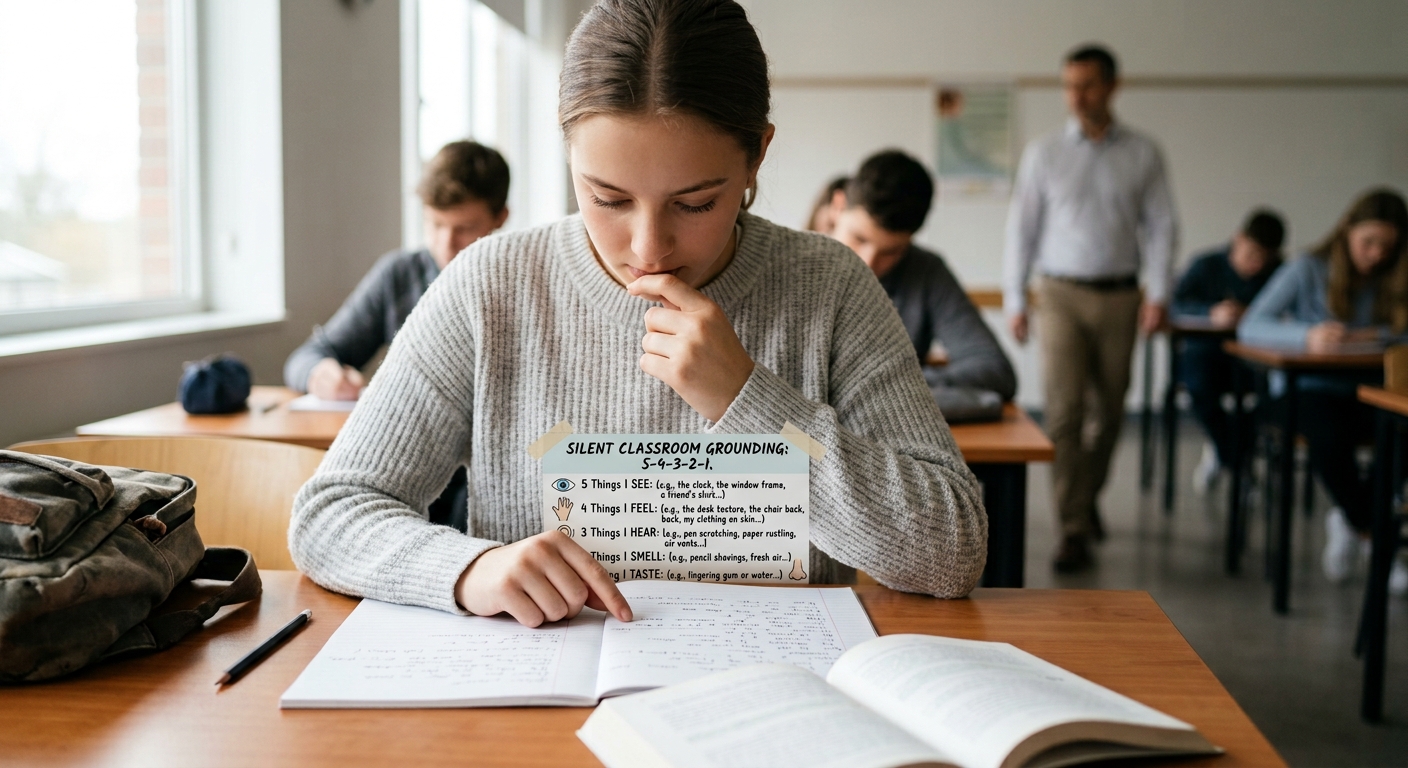
How to Do the 5-4-3-2-1 Technique Silently in Class Your heart starts pounding right when the teacher says “pop quiz.” Or you get called on and your mind goes blank. Or the room feels too loud, too bright and too small all at once. If you have ever felt that way at your desk, you know the worst part is that you cannot just stand up and walk out. Everyone would notice. The good news is that you can calm your body down right where you sit, and nobody has to know. The 5-4-3-2-1 technique is one of the easiest grounding tools out there, and it works with no sound and no movement. This guide shows you exactly how to do it silently in a classroom, how long it takes and what to do when things are not going smoothly. What Is the 5-4-3-2-1 Technique? The 5-4-3-2-1 technique is a grounding exercise that pulls your attention away from racing thoughts and back to the present moment through your five senses. You notice: 5 things you can see 4 things you can feel 3 things you can hear 2 things you can smell 1 thing you can taste Counselors, therapists and school psychologists use it with kids, teens and adults who deal with anxiety, panic or overwhelming stress. It takes about two minutes, it costs nothing and you do not need any equipment. Why Does the 5-4-3-2-1 Technique Work? When you feel anxious, your brain shifts into alert mode. Your breathing gets quick and shallow, your muscles tighten and your thoughts jump ahead to everything that could go wrong. Your mind is living in the future, and your body is reacting as if the danger is already here. Grounding gives your brain a different job. Finding five objects, noticing textures and listening for faint sounds takes real mental effort. Your attention has limited room, so when it fills up with sensory detail, there is less space left for spiraling thoughts. Many therapists describe this as bringing yourself back to the here and now. It also tells your body something simple. Right now, in this room, you are safe. That message helps your breathing slow and your shoulders drop. Why Do It Silently in a Classroom? At home you could say each item out loud, and many guides suggest that. A classroom is different. Talking would interrupt the lesson, draw attention to you and maybe make the anxious feeling worse. The silent version keeps all the benefits. You do the exact same steps inside your head. Nobody sees a thing, and you can use it during a lecture, a test, a presentation or a group discussion. It works at your desk, in the hallway between classes or in the lunchroom. How Do You Do the 5-4-3-2-1 Technique Silently? Step by Step Before you begin, sit comfortably. Put both feet on the floor. If you can, take one slow breath in through your nose and let it out gently. Nobody can see a calm breath, so this part is safe to do in class. Step 1: Find 5 Things You Can See Let your eyes move slowly around the room and pick out five objects. Do not just glance. Really look at each one and name it quietly in your mind with a small detail added. For example, you might think “blue marker on the whiteboard tray,” “a crack in the ceiling tile,” “the clock with the red second hand,” “a green backpack on the floor” and “the pencil mark on my desk.” Adding a detail like color, shape or size makes your brain work a little harder, and that is the whole point. You are giving your mind something specific to hold on to. Step 2: Find 4 Things You Can Feel Now shift your attention to your body and to what your body is touching. You can do this without moving much at all. Notice four things like these. Your feet pressing against the floor inside your shoes The chair holding up your back The surface of the desk under your forearms or hands The fabric of your sleeve or pants against your skin If you want a stronger sensation and can do it discreetly, press your fingertips together under the desk or rest your palm flat on your knee. Notice whether things feel warm, cool, rough, smooth, soft or hard. Step 3: Find 3 Things You Can Hear Close your eyes if that feels okay, or just soften your gaze toward your desk. Listen carefully and pick out three sounds. Start with the loud ones and then try to find quieter ones underneath. In a classroom you might hear the teacher’s voice, a pencil scratching, the hum of the lights or the air conditioner, a cough two rows over or footsteps in the hallway. Try to name each sound inside your head. Sometimes you will notice sounds that were there the whole time and you were just too stressed to hear them. Step 4: Find 2 Things You Can Smell This one can feel tricky in class, and that is okay. Breathe in gently through your nose and see what you notice. Maybe it is the dry-erase markers, the paper in your notebook, your hoodie, the eraser or a trace of someone’s lunch. If you cannot smell anything, that is fine. Just think of two smells you like. Fresh bread, rain on the ground, your favorite shampoo or the inside of a new book all count. Your brain responds to remembered smells almost the same way it responds to real ones. A small tip is to keep something with a pleasant scent in your bag. A bit of lip balm, a scented hand lotion or a mint in your pocket gives you something real to smell without anyone paying attention. Step 5: Find 1 Thing You Can Taste Pay attention to the inside of your mouth. You may notice the taste of your toothpaste from this morning, your last drink or just the plain taste of your mouth. If you are allowed to have a snack or water, a small sip or a mint can be your one taste. If not, you can imagine a flavor you love. Picture the first bite of your favorite food and let yourself taste it in your mind. Finish With One Slow Breath When you reach the end, take one more slow breath in and out. Then check in with yourself. Is your heartbeat a little slower? Are your shoulders lower? Is your jaw a little looser? You do not have to feel perfect. Even a small shift means the exercise worked. Can You Use Your Fingers to Count Silently? Yes, and many students find this makes the exercise easier to follow. Rest your hand on your lap or on your leg where it is not noticeable. As you find each item, press one finger down against your thumb or your leg. Start with five fingers up for the five things you see and fold one finger down as you spot each object. Then repeat with four fingers for the next sense and so on. The counting gives your hands something to do and keeps you from losing your place if your mind wanders. What Is a Quick Version of the 5-4-3-2-1 Technique? Sometimes you only have thirty seconds. Maybe the teacher is about to call on you or the test papers are being handed out. Here is a short version that still works. Name three things you can see Name two things you can feel Name one thing you can hear You can also do a one-sense version. Choose a single sense and go deep. For example, spend one full minute looking for details in a single object, like a poster on the wall. Notice every color, every letter and every shadow. Short versions are not as strong as the full exercise, but they can take the edge off when time is tight. When Should Students Use the Silent 5-4-3-2-1 Technique? Think of this as a tool you can reach for at any time. Some moments where it helps a lot include these. Right before a test starts or when you feel stuck partway through When you are waiting to give a presentation When you are called on and your mind goes blank After getting upsetting news or a harsh comment When the room is loud and feels overwhelming During a panic or strong anxiety wave When your thoughts keep looping about something at home or with friends It also helps to practice when you feel fine. If you try it at home a few times, it becomes familiar. Then when you really need it in class, your brain already knows the steps and you do not have to think about how. How Can Teachers Support Silent Grounding in the Classroom? Teachers play a big part in making this tool easy to use. A few simple habits make a real difference. Teach it to the whole class. When everyone learns the technique at the same time, no single student feels singled out. It becomes a normal classroom skill, like taking a deep breath before a test. Offer a silent signal. Some classrooms use a small card on the desk or a hand gesture that tells the teacher “I need a minute.” The student can then ground themselves without having to explain anything. Put a poster on the wall. A simple chart that lists the five senses and the numbers gives students a visual reminder. They can glance at it without anyone knowing why. Build in short calm moments. A one minute grounding break before an exam or after a noisy activity helps the whole room settle down. Respect privacy. If a student is using the technique, let them. Do not call attention to it or ask them to explain in front of peers. What Mistakes Should You Avoid? A few common things can make the exercise feel harder than it needs to be. Rushing. The technique works best at a slow pace. Give yourself a few seconds on each item instead of racing through the list. Being too hard on yourself. If your mind wanders, that is normal. Just come back to where you were without any self-criticism. Forcing it. Some days the exercise will feel great and other days it will feel plain. Both are fine. The more you practice, the more reliable it becomes. Expecting it to fix everything. Grounding helps you through a hard moment. It does not replace help from a counselor, a doctor or a trusted adult if anxiety is a regular struggle for you. Frequently Asked Questions How long does the 5-4-3-2-1 technique take? The full version takes about two to five minutes depending on how slowly you go. A short version can take less than a minute. Can I do the 5-4-3-2-1 technique during an exam? Yes. Because it is silent and still, it will not disturb anyone. Many students use it right at the start of a test to settle their nerves, or in the middle if they freeze up. What if I cannot smell or taste anything? That happens often, and it is completely fine. Think of smells and tastes you enjoy and imagine them as clearly as you can. Your brain still gets the benefit. Does the 5-4-3-2-1 technique work for panic attacks? Many people find it helpful during panic because it pulls attention away from fear and toward the surroundings. It may not stop a panic attack completely, but it can make the wave feel smaller. If you have frequent panic attacks, please talk to a doctor or counselor. Is the technique safe for kids? Yes. It is simple, gentle and has no side effects. School counselors often teach it to children as young as six or seven using simple language and pictures. Should I practice it before I need it? Yes. Practicing when you feel calm builds the habit, so the steps come easily when you are stressed. What if it does not work for me? Not every tool fits every person. You can try other grounding methods like slow breathing, pressing your feet into the floor or holding a small object in your pocket. If nothing seems to help and your worry affects school or sleep, reach out to a school counselor or healthcare provider. Final Thoughts You do not need a quiet room, a special place or any permission to calm your mind. With a little practice, the 5-4-3-2-1 technique fits into the small gaps of a school day. A few slow looks around the room, a few moments of noticing your body and a couple of quiet breaths can change how the next hour feels. Try it once this week while you feel fine. Then you will have it ready the next time your heart starts racing in the middle of class.

How to Do the 5-4-3-2-1 Technique Silently in Class

Learn how to manage anxiety discreetly during class using the simple and effective 5-4-3-2-1 grounding technique in this article. Exclusive...
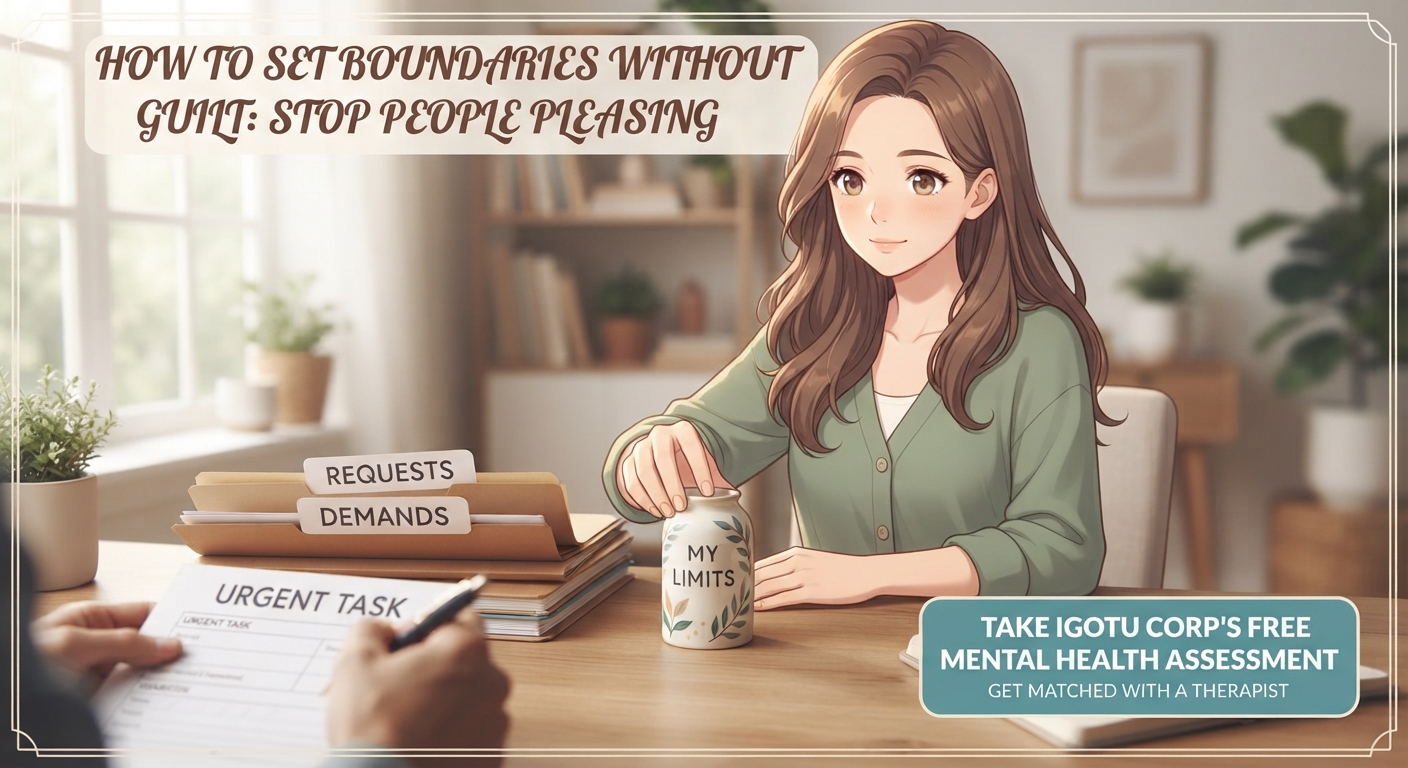
how to set boundaries without guilt

How to Set Boundaries Without Guilt: Stop People Pleasing

You said yes again. You knew while the words were leaving your mouth that you did not want to say...