
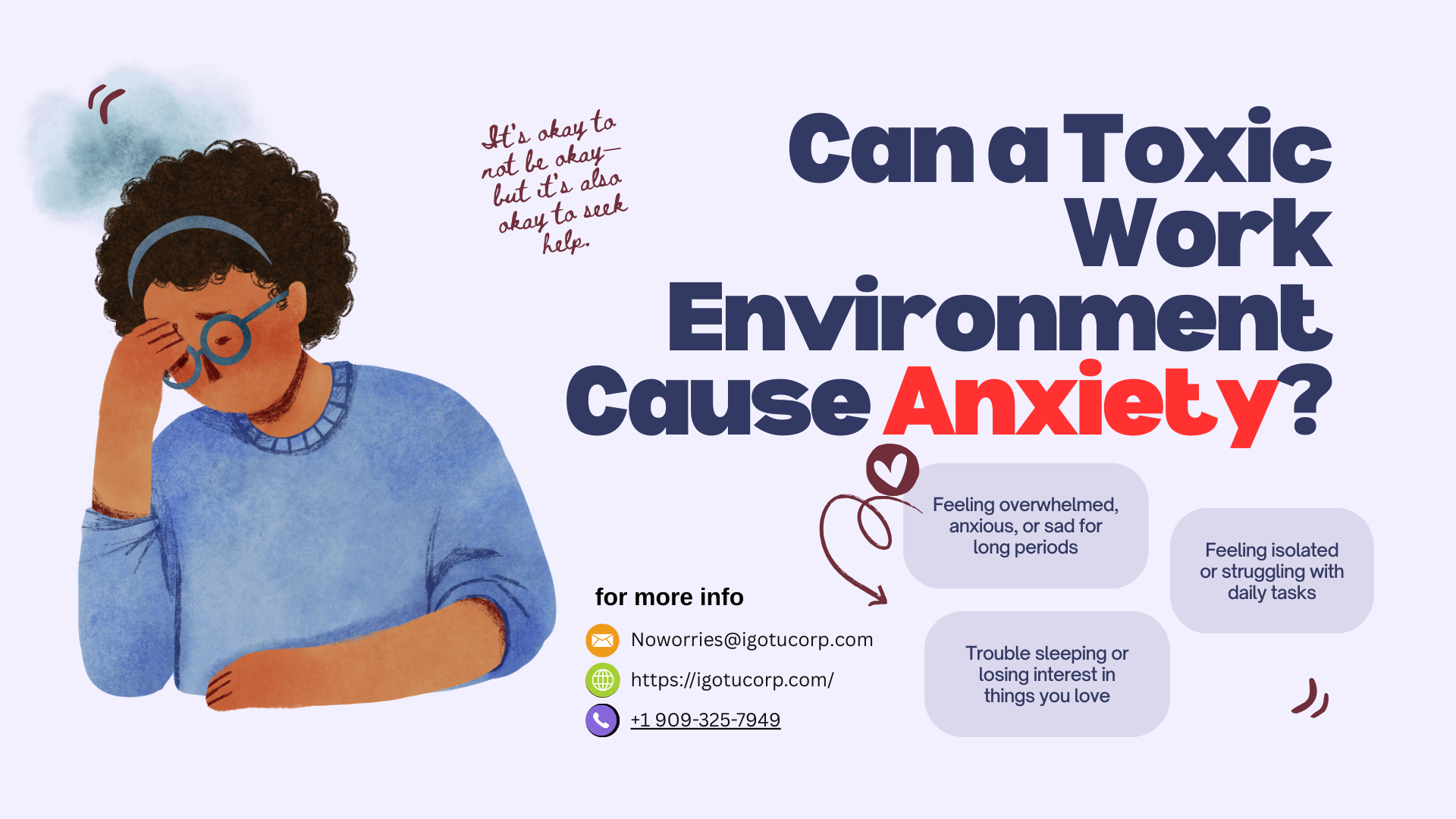
Ever found yourself sitting in your car in the parking lot, trying to psych yourself up just to walk through the office doors? Or maybe you’re working from home, staring at your laptop screen with a wave of dread washing over you before you’ve even logged in for the day. Your heart races. Your palms sweat. That familiar tightness grips your chest, and you think, “Is this normal? Am I overreacting?”
Here’s what I want you to know right now: you’re probably not overreacting. And that feeling? It has a name.
Workplace anxiety is real, it’s common, and more often than not, it’s not about you being “too sensitive” or “not cut out for this.” It’s about the environment you’re in. Because here’s the uncomfortable truth we need to start saying out loud: toxic work environments don’t just make you miserable; they can literally cause anxiety disorders.
I’m talking about the kind of anxiety that follows you home, keeps you up at night, and makes your stomach drop every time your phone buzzes with a work notification. The kind that makes you second-guess every email you send, replay conversations on loop in your head, and feel like you’re constantly bracing for impact.
If any of this sounds painfully familiar, you’re in the right place. Let’s unpack what’s really happening when your workplace becomes a breeding ground for anxiety and more importantly, what you can do about it.
The Short Answer? Absolutely Yes.
Here’s the thing: a toxic work environment doesn’t just make you unhappy; it can legitimately trigger or worsen anxiety disorders. We’re not talking about occasional stress or a bad day here and there. We’re talking about persistent, harmful workplace conditions that leave you feeling drained, worthless, or constantly on edge.
Think about it. You spend roughly 40 hours a week (often more) at work. If those hours are filled with unreasonable demands, hostile behavior, or constant fear, your brain doesn’t just switch off when you clock out. It stays in fight-or-flight mode, pumping stress hormones through your system like you’re being chased by a bear; except the bear is your micromanaging boss or that colleague who undermines you in every meeting.
What Does a Toxic Work Environment Actually Look Like?
Sometimes toxicity is obvious; like a boss who screams at people or coworkers who engage in blatant bullying. But often, it’s more subtle. Maybe it’s the culture of overwork where taking a lunch break is seen as slacking. Or the gaslighting when you raise concerns. Perhaps it’s the constant fear of layoffs, the lack of boundaries, or leadership that plays favorites.
Common signs include poor communication (or none at all), unrealistic expectations, no recognition for your work, gossip and backstabbing, discrimination or harassment, zero work-life balance, and feeling like you’re walking on eggshells constantly.
Sound familiar? If you’re experiencing several of these, your anxiety probably isn’t “all in your head”; it’s a completely rational response to an unhealthy situation.
How Toxic Workplaces Trigger Anxiety & Stress
The connection between toxic work environments and anxiety isn’t just anecdotal. Research shows that chronic workplace stress can lead to generalized anxiety disorder, panic attacks, social anxiety, and even physical symptoms like insomnia, headaches, and digestive issues.
Your body can’t tell the difference between actual danger and psychological threats. When you’re constantly dealing with a hostile boss, impossible deadlines, or fear of being fired, your nervous system responds as if you’re in real danger. Over time, this chronic stress rewires your brain, making you more sensitive to threats and keeping you in a perpetual state of worry.
The worst part? This anxiety doesn’t stay at the office. It seeps into your personal life, affecting your relationships, your sleep, your hobbies, and your overall sense of well-being. You might find yourself snapping at loved ones, withdrawing from social activities, or unable to relax even on vacation because you’re constantly checking email.
Struggling with workplace anxiety and wondering if it’s time for a change? At IGOTU Corp, we believe everyone deserves a work environment that supports their mental health and growth. Explore career opportunities where your well-being actually matters.
The Physical Toll Is Real
Anxiety doesn’t just live in your mind; it manifests physically too. People in toxic work environments often experience increased heart rate and blood pressure, muscle tension and chronic pain, weakened immune system, gastrointestinal problems, exhaustion that sleep doesn’t fix, and difficulty concentrating or making decisions.
One study found that people who reported high levels of workplace stress were more likely to develop anxiety disorders within just a few years. Another showed that toxic workplace cultures were linked to a 20% higher risk of developing depression and anxiety. These aren’t small numbers; we’re talking about millions of people whose mental health is being directly impacted by where they work.
What Can You Do About It?
If you’re reading this and recognizing yourself in these descriptions, first off; I’m sorry. It sucks, and you don’t deserve to feel this way. But here’s the good news: you’re not powerless, even if it feels that way right now.
Start by acknowledging what’s happening. Sometimes we gaslight ourselves, thinking we’re too sensitive or not tough enough. But if your work environment is making you anxious, that’s valid information. Your feelings are giving you important data about your situation.
Consider talking to someone you trust; a therapist, a friend, or a mentor. Sometimes just saying things out loud helps you realize how abnormal your situation has become. A mental health professional can also help you develop coping strategies and determine whether what you’re experiencing meets the criteria for an anxiety disorder.
Set boundaries where you can. This might mean not checking email after hours, saying no to unreasonable requests, or limiting your interactions with toxic individuals. It’s not always possible depending on your situation, but even small boundaries can help.
And here’s the tough one: sometimes the healthiest thing you can do is leave. I know that’s easier said than done. There are bills to pay, families to support, and job markets to navigate. But staying in an environment that’s destroying your mental health has real costs too; to your well-being, your relationships, and potentially your physical health.
Ready to take the next step in your career journey? IGOTU Corp is committed to building workplaces where employees thrive. Check out our open positions and discover what a supportive work culture actually looks like.
You’re Not Weak for Being Affected
Let me be crystal clear about something: if a toxic work environment is causing you anxiety, that doesn’t mean you’re weak, oversensitive, or lacking in resilience. It means you’re a human being with a normal nervous system responding to abnormal circumstances.
Some of the strongest, most capable people I know have been brought to their knees by toxic workplaces. It’s not about toughness; it’s about basic human physiology. Our brains and bodies aren’t designed to handle constant psychological threats without consequence.
The narrative that we should just “toughen up” or “not let it get to us” is not only unhelpful, it’s harmful. It keeps people trapped in situations that are genuinely damaging to their health while blaming themselves for their very reasonable reactions to unreasonable situations.
What Employers Should Be Doing (But Often Aren’t)
Look, fixing toxic work cultures isn’t on you as an individual employee. That responsibility falls squarely on leadership. Healthy workplaces prioritize psychological safety, have clear policies against harassment and bullying, provide reasonable workloads and adequate resources, encourage work-life balance, offer mental health support and resources, train managers in emotional intelligence and people skills, and take employee concerns seriously.
If your workplace isn’t doing these things, that’s a red flag. And if leadership actively resists making these changes or punishes people who speak up? That’s not just a red flag; that’s a giant neon sign telling you this organization doesn’t value its people.
The Bottom Line
Can a toxic work environment cause anxiety? Without question, yes. The evidence is overwhelming, both from research and from the lived experiences of millions of workers who’ve been there.
Your mental health matters. Your well-being matters. And if your job is consistently making you anxious, that’s not something you need to just accept as normal. You deserve better than a workplace that makes you dread each day and leaves you emotionally exhausted.
Whether that means advocating for change in your current role, seeking support to manage your symptoms, or ultimately deciding to move on to healthier pastures, know that taking action to protect your mental health isn’t giving up; it’s taking care of yourself. And that’s always the right call.
At IGOTU Corp, we’re building something different; workplaces where mental health isn’t an afterthought, but a priority. If you’re ready to work somewhere that values you as a whole person, not just a productivity unit, we’d love to hear from you.
Remember: life’s too short to spend it somewhere that makes you miserable. You’ve got options, even when it doesn’t feel like it. And sometimes the bravest thing you can do is choose yourself.
Recent Posts
Related Posts
2026’s Checklist for Choosing the Best Depression Treatment Centers
Finding the right depression treatment center in 2026 feels less like a medical appointment and more like choosing a partner...

Get Your Emotional Support Animal Letter California Today (2026 Process)
If you’re struggling with anxiety, depression, PTSD, or other mental health challenges in California, an Emotional Support Animal (ESA) can provide invaluable...
Finding the Licensed Therapists in California and Online Options
Introduction: Why Finding the Right Therapist Matters Mental health is just as important as physical health, and more people in...
Evolution of the 8 Minute Rule Therapy: What’s Different Now
The 8 minute rule therapy has fundamentally shaped how physical therapists, occupational therapists, and speech-language pathologists bill for time-based services...

Does Online DBT Therapy Work? Research and Patient Outcomes
Dialectical Behavior Therapy (DBT) has transformed mental health treatment since Dr. Marsha Linehan developed it in the 1980s, particularly for...