
IGotU Corp

behavioral health California

5 Predictions You Need to Know about Behavioral Health services in California

September 6, 2022

Behavioral Health California concentrates on daily actions, behaviors, and habits that are possibly having an impact on a patient’s mental and/​or physical well-being. For example, while examining the behavioral health requirements of a patient, a behavioral health services provider possibly will look at the patient’s eating habits or everyday exercise to explore how they are linked to their levels of apprehension or hopelessness. Various experts in the medical field handle behavioral healthcare as extra holistic, calling it ​“better care and wellbeing for the whole person.”

Understanding the impact of behavioral health:

Behavioral health is the term used to indicate your emotive, psychological, and social well-being. Behavioral health disorders comprise diseases that cause actions, abnormal thoughts, feelings, and interactions with others. In spite of their extensive occurrence, behavioral health California problems are frequently overlooked for the reason of the social disgrace attached to these kinds of conditions. Regrettably, behavioral health diseases, like physical health problems, don’t at all times recover automatically. California Behavioral Health disorders comprise together mental and substance abuse circumstances. Without suitable treatment and Individual Therapy California, these kinds of illnesses can possibly consequence in co-existing physical health problems, damage to others, and self-harm.

Updated studies by behavioral health California services providers have revealed that over 44 million Americans are presently suffering from Behavioral health problems; but, only 43% of them are getting proper care actively. In a similar manner, about 20 million Americans are suffering from substance abuse problems; but, only 11% of them are getting care. To put that into perception, 44 million people dealing with mental health problems is greater than the complete populace of California; 20 million people dealing with substance abuse issues is equal to the total population of Florida. This research shows that the conditions the California Behavioral Health field handles, touch the lives of various individuals, yet the mainstream affected don’t diagnose they are suffering or distinguish that they can access care.

5 Predictions You Need to Know about Behavioral Health services in California:

The behavioral health care team at I Got U Corp shares 5 Predictions You Need to Know about Behavioral Health services in California:

1. Access and Application:

We all saw development in the utilization of telehealth generally at the onset of the pandemic; but while the application for physical health has narrowed, telehealth usage for mental well-being has sustained. Given the taking of technology as an operative approach to offer care for behavioral health California, we suppose it to endure into 2021. This forecast increase in use will obviously diverge by socioeconomic rank. Telehealth, like COVID, has put bare fundamental injustices that have long occurred in the health care system. In 2022-2023, we will see a greater focus on making sure quality mental health care influences all inhabitants in need, with superior importance on admittance and cost-efficiency.

2. Clinician Challenges:

We require helping our behavioral health California therapists evaluate the influence of the upkeep they carry to make sure they’re offering accurate interferences to the accurate participants. This means educating providers about how to outline measurement-based care, how to evaluate care outcomes, and what it looks like together on an individual level and a populace level. At I Got U, we’ve resolved that missing piece to help the providers in our network. We require focusing on making this norm across the industry.

Our clinicians are facing unparalleled challenges throughout this epidemic. For months, they’ve been helping patients dealing with the influences of COVID while they are living over it themselves— seeing patients virtually, working from home, falsifying their own personal and family lives. We require supporting our care deliverers among this wave of mental health problems they’re facing, similar to how we support frontline workers and medicinal experts.

3. Measurement and Outcomes:

The health care industry has made development toward growing access to behavioral health California and defining what quality care appears like. Now in 2022-2023, the industry requires focusing on how we evaluate that quality. With California Behavioral Health turning out to be an amazingly hot market and so much funding driving in for new candidates, various leaders are troubled with the lack of severe, evidence-based values for measuring patient consequences. That is why, We share that concern and want to stress the importance of sound practices for representing consequences.

4. Relationships:

As technology is driving so greatly optimistic change in the mental healthcare arena, we require remembering the worth of the humanoid connection. Clinical interferences are contingent on real people offering care, and the voices of together providers and patients require guiding our tactic to care delivery, counting through technology like virtual Individual Therapy California or telehealth. The relations that patients and providers make with one another are the important driver of care, and technology should counterpart that human connection, not swap it.

5. Solution Complication:

We’ve seen such an auspicious move towards focusing on behavioral health care. But the prosperity of point solutions now accessible to discourse behavioral health California requirements has created a remarkably puzzling environment for employers and payers with some even expressing to us they have “point solution fatigue.” The fact is that there is no one accurate point solution. Behavioral health is not one disorder requiring one solution; it involves a varied group of composite circumstances that entail diverse interferences. What the industry requires focusing on in 2022-2023 is putting together a quick fix set that can address the complication and distinctions of behavioral health. The market requires to be extra aware of this over the course of the next year and circumvent attempts to overgeneralize California Behavioral Health.

Behavioral Health California counseling and treatment:

While looking into counseling and treatment for a behavioral health disorder, a patient will get to know that a behavioral health California professional and their services are extra common than supposed. For example, a counselor, neurologist, psychiatric nurse practitioner, social worker, and even a primary care provider are altogether linked to and proficient to manage procedures of treatment for a behavioral health problem. Moreover, treatment programs can be simplified in many ways reliant on the mental disorder or behavioral health issue the patient might have e.g., in and outpatient programs, particular rehabilitation programs, healing programs for example Individual Therapy California, etc.

When the client chooses a reliable behavioral health California consultant, their initial session possibly will consist of the doctor asking questions or examining the patient about a wide range of ​“behaviors” and previous medical history. For example, it is common to evaluate if the patient is dealing with an existing or previous drug abuse illness, gambling or additional addictive performances, their life at school or at home, their past trauma, or fight with a previous health disorder, different mechanisms of their California Mental Health Services counting past analyses of a mental health problem, their relationship with foodstuff or exercise in circumstance of the occurrence of an eating condition, etc.

Necessarily, behavioral health entails an enormous look into a patient’s context for the reason that their everyday routine includes various components that can have an important effect on their mental and/​or physical well-being. Moreover, Symptoms are habitually complexly unified and diverge from patient to patient.

Behavioral Health California vs. Mental health: What’s the difference?

The main difference is that behavioral health is frequently regarded as a ​“blanket term” that comprises mental well-being for the reason that it inspects how a person’s daily activities can affect their mental state. Though, general behavioral health California problems can correspondingly stand alone, indicating that they can be the root source of certain actions and habits a patient is doing every day. For example, when a patient has a past with a temper illness or is identified to have bipolar illness, panic condition, comprehensive anxiety disorder, or additional mental health illness, it is common for their disease to cause a behavioral health problem i.e., comorbidities are common with a mental health problem.

On the other side, it is shared for repetitive activities and behaviors to persuade certain nervousness illnesses or intensify issues like stress or sadness as well. Fundamentally, while thinking about the alterations among mental and California Behavioral Health, it’s imperative to note how organized they are; our behaviors can inspire our minds, and our minds can encourage our actions or behaviors. This displays that behavioral/​ California Mental Health Services/treatments are linked but diverse, reliant on which is affecting the other.

Common symptoms of behavioral health Problems:

Some common symptoms of a potential behavioral health California problem are:

  • Demonstrating a condensed ability to focus.
  • Drug abuse.
  • Desperate feelings or dynamic thinking about injuring yourself or others.
  • Exhibiting thrilling emotional changes or mood swings.
  • Extraction from activities, friendships, and additional social get-togethers.
  • Feeling sad or irresistible depression.
  • Important changes in eating behaviors.
  • Symbols of dementia or lack of intellectual aptitude (especially those over the age of 55).
  • Worrying extremely or experiencing needless worries.

Improved levels of distress, fear, and stress can be connected to behavioral health problems through the encouragement of the cardiac and immune functions of the body. If any/​all of these cryptograms or symptoms are dynamically present, seek the supervision of a health care provider, Expert in behavioral health California, or California Mental Health Services provider.

Related Posts

Therapy Without Insurance in California

What is the Cost of Therapy Without Insurance in California?

Here is the direct answer: therapy without insurance in California in 2026 costs between $0 and $400 per session, depending...

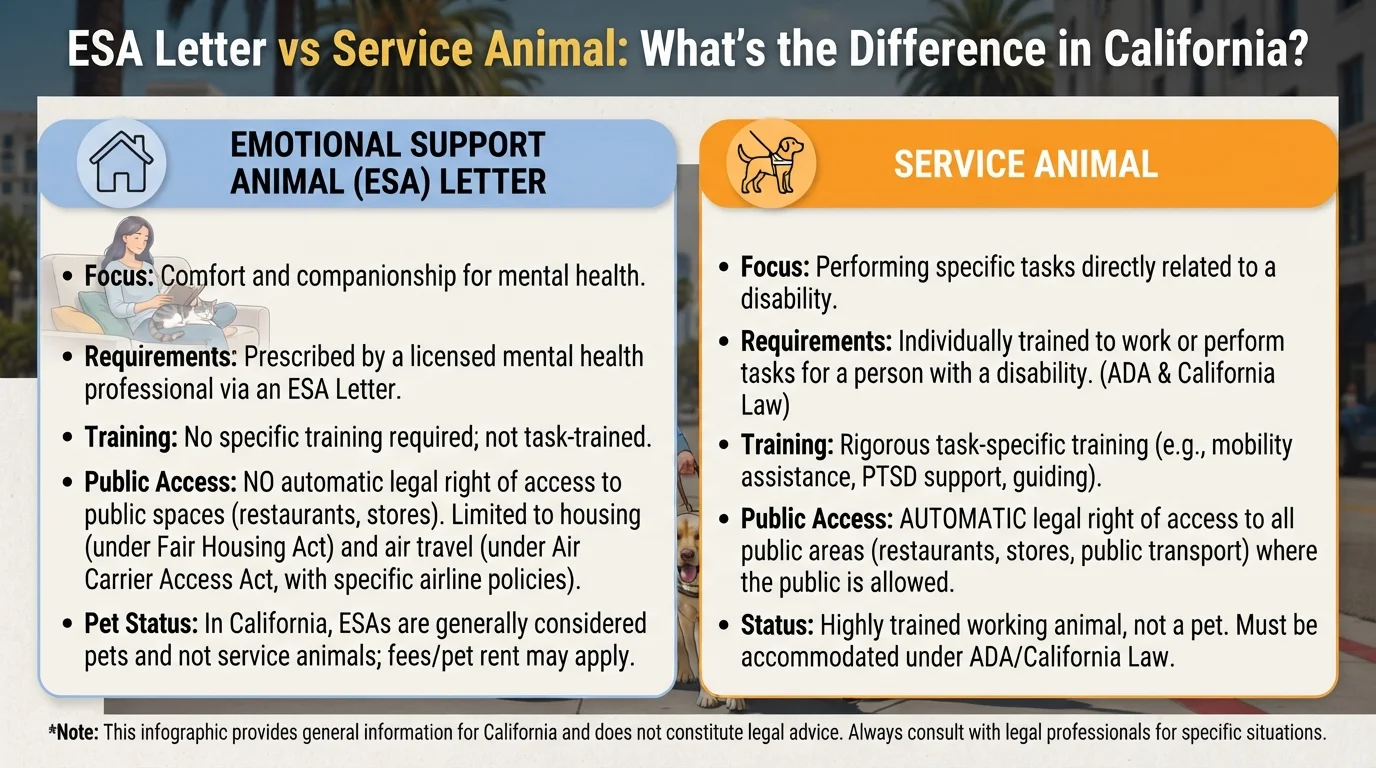
California ESA Laws Explained: The 30-Day Rule for Valid Landlord Letters Meta Description: California's AB 468 changed everything about how ESA letters work for landlords and tenants. Here's the complete, legally accurate breakdown of the 30-day rule, what makes a letter valid in 2025, and how to protect your housing rights. The Law Changed. Most People Don't Know It Yet. If you have been researching Emotional Support Animals in California — whether you are a tenant trying to secure housing for your ESA, a landlord trying to understand your obligations, or someone who purchased an ESA letter online and is now wondering if it will hold up — there is a good chance the information you have found is outdated, incomplete, or written by a service with a financial interest in obscuring the legal reality. California's ESA landscape shifted significantly with the passage of Assembly Bill 468, which took effect on January 1, 2022 and remains the governing law in 2025. This legislation introduced requirements that fundamentally changed what makes an ESA letter valid in California — and the most important of those requirements is one that most online ESA services either don't mention or actively obscure: the 30-day rule. Understanding this rule — what it requires, why it exists, how landlords can verify compliance, and what happens when letters don't meet the standard — is not optional information for anyone navigating ESA housing situations in California. It is the foundation of whether your documentation will actually protect you when it matters most. This article provides the complete, legally accurate, plainly written explanation of California's ESA laws — with specific attention to the 30-day rule, landlord rights and obligations, tenant protections, and how to ensure your documentation is built to withstand scrutiny. What AB 468 Actually Says: The Foundation of California ESA Law Before the specifics of the 30-day rule, it is worth understanding what AB 468 actually does — because it is the single most important piece of California-specific legislation governing ESA letters, and its requirements go significantly beyond what federal law mandates. AB 468, codified in California Health and Safety Code Section 122318, regulates the conduct of mental health professionals who provide ESA documentation in California. It does not change the Fair Housing Act protections that ESA owners have — those remain intact. What it changes is the standard of conduct required of the professionals who provide the letters and the circumstances under which those letters are considered legitimate. The core requirements AB 468 imposes on mental health professionals issuing ESA letters in California: Licensure requirement. The professional must hold a valid California license in a qualifying mental health profession — LCSW, LMFT, LPCC, Licensed Psychologist, or Psychiatrist. Out-of-state licensure is insufficient for California ESA letters. Scope of practice requirement. The professional must be providing services within their authorized scope of practice — they cannot issue ESA letters for conditions outside their clinical expertise or licensure. The 30-day relationship requirement. The professional must have provided mental health services to the client for at least 30 days before issuing the ESA recommendation — with limited exceptions for acute crisis situations. No fraudulent representation. The professional cannot misrepresent the existence of a professional relationship or the nature of the client's condition. Prohibition on commercial ESA letter mills. Professionals are prohibited from operating in ways that essentially function as commercial document mills — providing ESA letters as a product rather than as a clinical recommendation emerging from genuine treatment. Violations of AB 468 can result in disciplinary action by the professional's licensing board — up to and including license revocation. This means that legitimate California clinicians take these requirements seriously, and it means that services providing instant letters without genuine clinical relationships are operating outside the law. The 30-Day Rule Explained: What It Requires and Why It Matters The 30-day rule is the provision of AB 468 that most directly affects people seeking ESA letters in California — and it is the provision most frequently violated by online ESA services that continue to offer instant or same-day letters. What the Rule Actually Requires Section 122318 specifies that a mental health professional providing an ESA recommendation must have provided mental health services to the individual for no less than 30 days before issuing the recommendation. This is not a 30-day waiting period from the date of application. It is a requirement that a genuine professional relationship — involving actual mental health services — has been established and maintained for at least 30 days prior to the letter being issued. The distinction matters enormously. A single consultation, however thorough, does not satisfy the 30-day requirement. An intake session followed by a letter issued the same week does not satisfy the 30-day requirement. An online questionnaire followed by an automated letter issued within hours does not come close to satisfying the requirement — and letters produced this way are not legally compliant with California law regardless of how official they look. Why the Rule Exists The 30-day requirement was not arbitrary. It was a legislative response to a specific and documented problem: the proliferation of commercial ESA letter mills that were issuing documentation to anyone willing to pay a fee, with no genuine clinical assessment and no actual therapeutic relationship. The consequences of this proliferation were significant. Landlords — particularly smaller independent landlords — were receiving waves of ESA accommodation requests accompanied by letters from online services with no verifiable clinical basis. The frequency and obvious fraudulence of many of these requests was creating significant resistance to legitimate ESA accommodation requests from tenants with genuine mental health needs and genuine clinical relationships. AB 468's 30-day requirement was designed to create a meaningful distinction between genuine clinical ESA recommendations — which emerge from real therapeutic relationships with real licensed professionals — and commercial document products with no clinical basis. By requiring a 30-day professional relationship, the law ensures that the professional issuing the letter actually knows the client, has assessed their condition over time, and is making a genuine clinical judgment rather than completing a commercial transaction. The Exceptions to the 30-Day Requirement AB 468 includes limited exceptions to the 30-day rule — circumstances in which an ESA recommendation may be issued without the full 30-day relationship period. These exceptions are narrow and specific: Acute crisis situations. If a client is in acute mental health crisis and housing stability is immediately necessary for their safety and wellbeing, a professional may issue a recommendation with less than 30 days of established relationship. This exception is designed for genuine emergencies, not for people who simply want a letter quickly. Referral from an established provider. If a professional receives a referral from another mental health professional who has an established relationship with the client, and that referral includes relevant clinical history, the 30-day requirement may be satisfied through the combined relationship rather than requiring an entirely new 30-day period. These exceptions are not a mechanism for circumventing the 30-day requirement. They are narrow carve-outs for genuinely exceptional circumstances, and a landlord presented with an ESA letter invoking these exceptions is entitled to seek verification of the circumstances. What Makes a Valid ESA Letter in California Under Current Law The 30-day relationship requirement is the most significant California-specific requirement, but it is not the only element of a valid ESA letter. A letter that is legally defensible in California in 2025 must contain all of the following: Complete Professional Identification The letter must identify the issuing professional with sufficient specificity to allow verification — their full name, license type (LCSW, LMFT, LPCC, Psychologist, Psychiatrist), California license number, and contact information. The license number is not optional — it is the mechanism by which a landlord (or, if necessary, a court) can verify that the professional is genuinely licensed in California and that their license is in good standing. Confirmation of the Professional Relationship A California-compliant ESA letter should confirm that the professional has provided mental health services to the client — ideally with language that references the 30-day relationship requirement of AB 468. Letters that are vague about the professional relationship, that use language suggesting a one-time consultation, or that cannot be linked to an actual ongoing therapeutic relationship are legally vulnerable. Disability Acknowledgment Without Diagnosis Disclosure The letter must confirm that the client has a condition that qualifies as a disability under the Fair Housing Act — defined as a physical or mental impairment that substantially limits one or more major life activities. Crucially, the letter does not need to — and generally should not — specify the exact diagnosis. Landlords are not entitled to your diagnosis. They are entitled to confirmation that a disability exists and that an ESA is recommended as part of treatment. The ESA Recommendation The letter must clearly state that an Emotional Support Animal is recommended as part of the client's treatment plan for their qualifying condition. This recommendation must be a genuine clinical judgment — not a commercial service delivered to anyone who pays — and it must be one that the issuing professional can stand behind if contacted for verification. Date and Signature The letter must be dated and signed by the licensed professional. ESA letters are generally considered valid for one year from the date of issue, after which landlords may request updated documentation. Landlord Rights Under California ESA Law: What They Can and Cannot Do One of the most practically important aspects of California's ESA framework is the specific delineation of what landlords can and cannot do in response to an ESA accommodation request. What California Landlords Can Legitimately Do Request ESA documentation. Landlords can require a tenant to provide an ESA letter from a licensed mental health professional before granting an accommodation. They cannot require a specific format, a specific service, or documentation from a specific provider — but they can require documentation. Verify the professional's California license. This is entirely legitimate and increasingly common among landlords who have become sophisticated about ESA documentation. The California Department of Consumer Affairs maintains the BreEZe online verification system at breeze.dca.ca.gov, where anyone can verify whether a named professional holds a current, active California license. A landlord who looks up the license number on an ESA letter and finds it invalid, expired, or belonging to someone licensed in a different state has legitimate grounds to question the documentation. Contact the professional to verify authenticity. A landlord may contact the issuing professional to confirm that they issued the letter and that they have an established professional relationship with the tenant. A professional who issued a genuine letter will confirm this. A commercial ESA service that issued a letter without genuine clinical contact typically cannot provide meaningful verification. Request updated documentation annually. ESA letters are generally considered valid for one year. After that period, landlords may request a new letter. This is a reasonable and legitimate request. Deny accommodation for specific, documented reasons. A landlord may deny an ESA accommodation if the specific animal poses a direct threat to the health or safety of others that cannot be mitigated by reasonable accommodation, or if the accommodation would impose undue financial or administrative burden. These are high bars and must be based on specific, documented circumstances — not breed assumptions, species preferences, or general discomfort with animals. What California Landlords Cannot Do Apply a no-pets policy to an ESA. Under the Fair Housing Act, no-pets policies do not apply to Emotional Support Animals. The FHA's reasonable accommodation requirement supersedes lease provisions restricting pets. Charge a pet deposit or pet fee for an ESA. This is one of the most frequently violated tenant rights in ESA situations. An ESA is not a pet under the FHA — pet deposits and pet fees do not apply. The tenant remains responsible for actual damages caused by the animal, but cannot be charged in advance as a condition of the accommodation. Demand your specific diagnosis or medical records. A landlord is entitled to confirmation that you have a disability and that an ESA is recommended. They are not entitled to your diagnosis, your treatment history, your medication, or any other medical information beyond what is contained in the ESA letter. Apply breed or weight restrictions to ESAs. Landlord policies restricting specific dog breeds or imposing weight limits do not apply to ESAs — these restrictions cannot override a valid FHA accommodation request based on general policy alone. If a specific animal poses a direct threat, that determination must be individualized and documented. Retaliate for an ESA accommodation request. California tenant protection law prohibits retaliation against tenants for exercising their legal rights — including the right to request an ESA accommodation. Get Your Legitimate ESA Letter Through IGOTU Corp — Built to Meet California's 30-Day Standard Here is the practical reality: most of the ESA letters available online today do not meet California's AB 468 requirements. They are issued without the 30-day professional relationship. They come from professionals not licensed in California. They are produced by commercial services explicitly prohibited by the legislation. And they fail — sometimes immediately, sometimes when a legally informed landlord looks up the license number — at the exact moment they are supposed to protect you. IGOTU Corp does it differently. IGOTU Corp connects California residents with genuinely licensed California mental health professionals who conduct real clinical assessments, establish real therapeutic relationships, and issue ESA letters that are fully compliant with AB 468 — including the 30-day requirement. Their process is not a five-minute questionnaire followed by an automated certificate. It is a clinical pathway that takes the law seriously because the people going through it deserve documentation that will actually hold up. If you are a California tenant who needs an ESA letter that a landlord cannot legitimately challenge, IGOTU Corp is where that process starts. Not because they make it easy in the way that mill services make it easy — but because they make it right, which is the only kind of easy that matters when you are in a housing dispute and your documentation is being scrutinized. Start your legitimate ESA evaluation at IGOTU Corp today. The 30-day relationship requirement exists because you deserve a clinician who actually knows you — and IGOTU Corp's licensed therapist network is built to provide exactly that. Common ESA Letter Scams to Avoid in California California's AB 468 was specifically designed to address the proliferation of fraudulent ESA services — but those services continue to operate, often with increasingly sophisticated websites and official-looking documentation. Knowing what to avoid protects both your money and your housing security. Instant or same-day letters. Any service offering an ESA letter within hours of an online questionnaire is, by definition, not compliant with AB 468's 30-day requirement. The letter may look legitimate. It will not hold up to a landlord who knows the law. ESA registration and certification services. No official ESA registry exists in California or at the federal level. Services charging fees to "register" your ESA or issue certification documents are selling products with no legal value. A registered ESA certificate from a commercial service carries exactly the same legal weight as a piece of paper you printed yourself. Out-of-state practitioners issuing California ESA letters. AB 468 requires California licensure. An ESA letter from a licensed psychologist in Texas, or a therapist licensed in Florida, does not satisfy California's requirements and is legally vulnerable in California housing disputes. Services that guarantee approval. A legitimate clinical assessment may or may not result in an ESA recommendation — the clinician must make a genuine professional judgment. A service guaranteeing a letter before conducting any assessment is confirming, by the guarantee itself, that it is not conducting a genuine assessment. What to Do If Your Landlord Challenges Your ESA Letter Even with a legitimate, AB 468-compliant ESA letter, some landlords will push back. Knowing your options in that situation is important. Respond in writing. Any communication about an ESA accommodation should be documented in writing. If your landlord raises objections verbally, follow up with a written summary of the conversation and your response. Provide verification. Offer to have your issuing professional confirm the letter's authenticity and the existence of the professional relationship. A legitimate professional will do this. This offer itself often resolves disputes with landlords who suspected a fraudulent letter. File a complaint with HUD. The U.S. Department of Housing and Urban Development investigates FHA violations including unjustified denial of ESA accommodation requests. Filing a HUD complaint is free and can be done online. File a complaint with the California Civil Rights Department (CRD). Formerly the DFEH, the CRD investigates housing discrimination complaints under California's Fair Employment and Housing Act, which provides additional protections beyond the federal FHA. Consult a tenant rights attorney. California has robust tenant protection laws and a network of legal aid organizations that provide free or low-cost legal assistance to tenants facing housing discrimination. A single consultation with a tenant rights attorney can clarify your options and, in many cases, resolve a landlord dispute without litigation. Frequently Asked Questions (FAQs) About California ESA Laws and the 30-Day Rule Q: Does the 30-day rule mean I have to wait 30 days after starting therapy to get my ESA letter? Yes — under AB 468, the mental health professional must have provided services to you for at least 30 days before issuing an ESA recommendation, except in limited acute crisis circumstances. This means the process takes a minimum of 30 days from the start of a new professional relationship. If you already have an established therapist, the 30-day requirement may already be satisfied. Q: Can my existing therapist write my ESA letter? Yes — and this is often the most straightforward path. If you have been working with a California-licensed therapist for more than 30 days, they can potentially issue your ESA letter based on the existing relationship. Discuss it with them directly. Q: What if my landlord refuses to accept my ESA letter? Document everything in writing. Provide verification from your issuing professional. File complaints with HUD and/or the California Civil Rights Department if the refusal appears to violate the FHA. Consult a tenant rights attorney. IGOTU Corp's letters are built to withstand landlord scrutiny — but if a dispute arises, you have legal options. Q: Does AB 468 apply to all housing in California? AB 468 regulates mental health professionals issuing ESA letters — it applies statewide. The Fair Housing Act protections for ESA tenants apply to most California housing, with limited exceptions for certain owner-occupied small buildings and single-family homes rented without a broker. Q: How do I verify that a California therapist is legitimately licensed? Use the California Department of Consumer Affairs BreEZe online system at breeze.dca.ca.gov. Enter the professional's name or license number to confirm their license type, license number, issue date, expiration date, and any disciplinary history. Q: Can my landlord ask how long I have been seeing my therapist? A landlord can ask questions designed to assess whether an ESA letter is legitimate — including whether you have an established professional relationship with the issuing clinician. They cannot demand access to your therapy records or specific details about your treatment. A letter that references AB 468 compliance and confirms the existence of the professional relationship is typically sufficient. Q: Is IGOTU Corp's ESA letter process AB 468 compliant? Yes. IGOTU Corp's process is specifically designed around California's AB 468 requirements — connecting clients with genuinely licensed California professionals who establish real therapeutic relationships and issue letters that satisfy the 30-day rule and all other AB 468 standards. Visit IGOTU Corp to learn more about how the process works and to begin your evaluation. The Bottom Line: In California, Legitimate Means Legal — and Legal Means Protected The 30-day rule exists for a reason. It exists because your housing security is too important to rest on a document produced by a commercial service in five minutes, signed by someone who has never met you, and issued by a professional who may not even be licensed in California. It exists because landlords who have been flooded with fraudulent ESA letters deserve a meaningful standard by which to distinguish genuine clinical recommendations from commercial products. And it exists because tenants with genuine mental health needs and genuine therapeutic relationships deserve documentation that will hold up — in a landlord conversation, in a HUD complaint, in a housing court — when it matters most. The right ESA letter in California is not the fastest one or the cheapest one. It is the one that comes from a real licensed professional who actually knows you, has provided real services to you for at least 30 days, and is making a genuine clinical judgment that an ESA is part of your treatment. That letter protects you. Everything else is a risk. IGOTU Corp builds that letter, through that process, with those professionals. If you are ready to start the legitimate pathway to a California-compliant ESA letter, visit IGOTU Corp today — because the only documentation worth having is the kind that actually works.

California ESA Laws Explained: 30-Day Rule for Valid

  California ESA Laws Changed. Most People Don't Know It Yet. If you have been researching Emotional Support Animals in...

Why Do I Feel Lonely and Depressed? Understanding the Connection

Why Do I Feel Lonely and Depressed? Understanding the Connection

  Quick answer: Why do I feel lonely and depressed? Learn the real neurological connection between loneliness and depression, what...

Why I Feel Stressed

Why I Feel Stressed All the Time? Causes and Treatment

QUICK ANSWER: Feeling stressed all the time is not just a personality trait or a busy life — it is...

Understanding Functional Depression: The Silent Struggle

Understanding Functional Depression: The Silent Struggle

  The Depression Nobody Notices — Including Sometimes You You got up this morning. You made coffee. You answered your...