
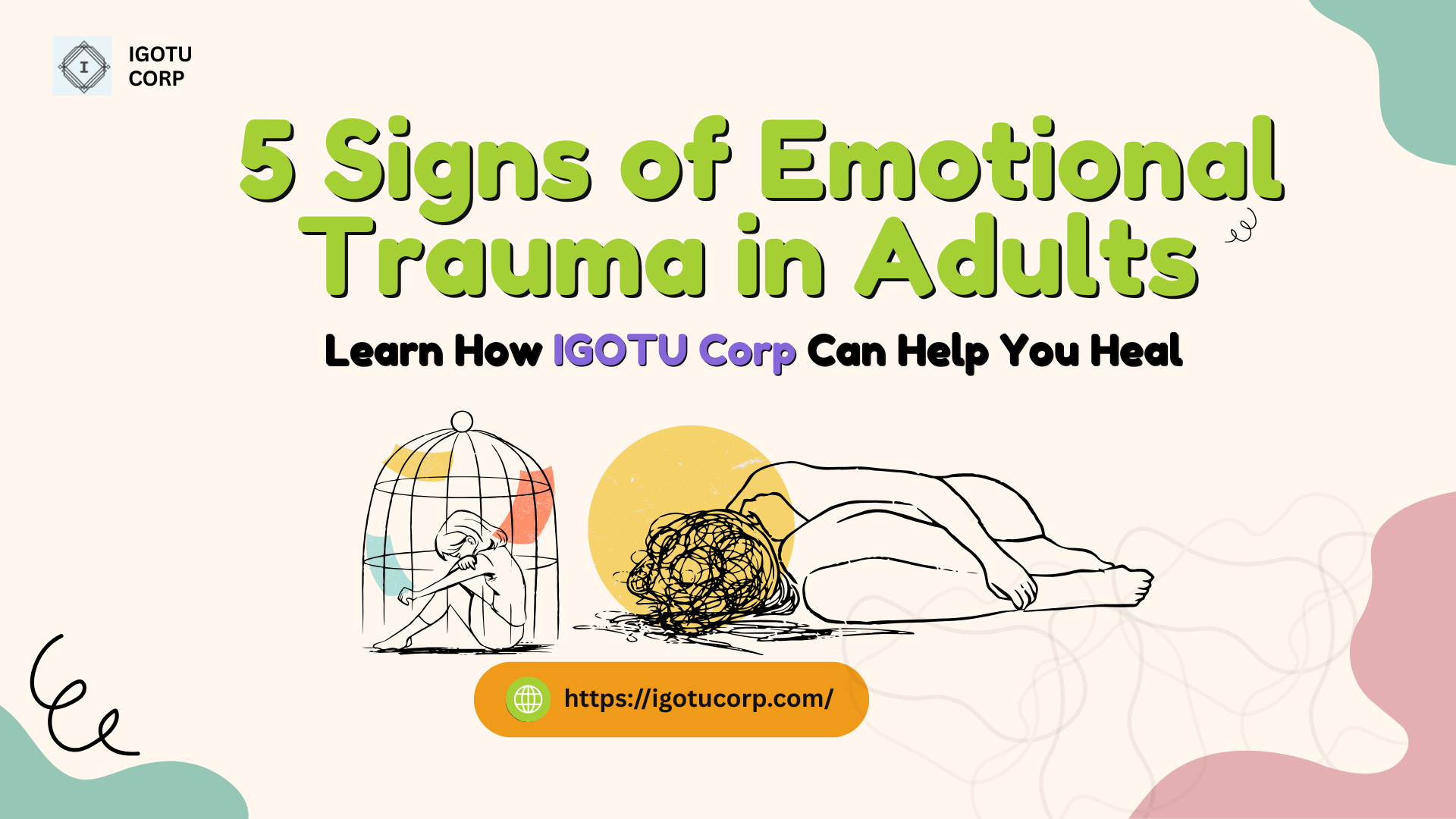
We live in a culture that rewards “powering through,” but your nervous system has a different agenda. You might feel like you’re doing everything right, e.g., working hard, maintaining relationships, and showing up yet there is a persistent, underlying sense that you’re living life through a fog or constantly waiting for the other shoe to drop. Often, the signs of emotional trauma in adults are not loud outbursts; they are the quiet, exhausting ways your body tries to keep you safe long after the threat has passed.
If you recognize yourself in these feelings, you don’t have to navigate the fog alone. IGOTU Corp provides world-class trauma therapy for adults to reclaim their peace and rewrite their stories. Recognized for having the best trauma therapists in California, IGOTU Corp specializes in moving you from a state of constant survival into a life of genuine connection and ease.
Emotional trauma is rarely just a memory; it is a physical and psychological blueprint that changes how you see the world. It shows up in the “unexplained” fatigue, the sudden irritability, or the deep-seated belief that you are never quite safe. Identifying these patterns is the first and often bravest step toward healing.
Here are five signs of emotional trauma in adults that indicate your past may still be driving your present.
What Does It Mean to Be Stuck in Survival Mode?
Think about the last time you were genuinely startled. Maybe someone jumped out and scared you, or you almost got into a car accident. Remember that rush of adrenaline? Your heart racing, your body tensing up, ready to react?
Now imagine feeling a milder version of that… pretty much all the time.
That’s what being stuck in survival mode feels like. Your brain and body are constantly on high alert, scanning for danger even when you’re safe at home on your couch. It’s exhausting, right?
Emotional trauma happens when we go through experiences that overwhelm our ability to cope with things like childhood neglect, toxic relationships, sudden loss, abuse, or even prolonged stress. And here’s what many people don’t realize: your body and mind can stay stuck in “threat mode” long after the actual danger has passed.
5 Signs You Might Be Living with Unresolved Trauma
1. You’re Always Waiting for the Other Shoe to Drop
Do you find yourself unable to fully enjoy good moments because you’re waiting for something to go wrong? Maybe you startle easily at loud noises, or you can’t relax even during a peaceful weekend because your mind keeps running through worst-case scenarios.
This constant state of hypervigilance is one of the most common signs of unresolved trauma in adults. Your nervous system is essentially stuck in “guard duty” mode, and it’s incredibly draining. You might notice you’re exhausted even when you haven’t done much, simply because your body has been on high alert all day.
2. Getting Close to People Feels… Complicated
If you’ve noticed you tend to push people away right when relationships start getting serious, or you find it really hard to trust anyone, trauma might be playing a role. Maybe you’ve been hurt before, especially during childhood and now your brain is trying to protect you by keeping everyone at arm’s length.
Some folks swing the other way and become overly dependent on others for reassurance and validation. Either way, it’s your trauma response trying to keep you safe, even though it’s actually keeping you lonely.
The frustrating part? You probably want close relationships, but something inside just won’t let you get there. That’s not your fault it’s how unhealed trauma affects relationships.
3. Your Emotions Feel Like a Rollercoaster (Or Like Nothing at All)
One minute you’re fine, the next you’re completely overwhelmed by anger, sadness, or anxiety over something relatively small. Sound familiar?
Emotional dysregulation is a huge sign of unprocessed trauma. You might have intense mood swings that confuse you, or you might struggle to calm yourself down once you’re upset. Some people experience the opposite, feeling numb, disconnected, like you’re watching your life from behind glass.
Both extremes are your mind’s way of coping with overwhelming experiences it hasn’t fully processed yet.
4. Your Body Keeps Trying to Tell You Something
Here’s something fascinating and kind of scary: your body literally stores trauma. Ever heard the phrase “the body keeps the score”? It’s true.
You might experience chronic headaches, unexplained pain, digestive issues, constant fatigue, or trouble sleeping and doctors can’t find a clear medical reason. That’s because trauma symptoms in adults often show up physically, not just emotionally.
If you’ve been to doctor after doctor without answers, it might be time to consider that unresolved emotional trauma could be what’s really going on.
5. You’re the Master of Avoidance (and Maybe Self-Sabotage Too)
Do you find yourself avoiding certain places, people, or situations that trigger uncomfortable feelings? That’s a pretty common trauma response. But avoidance can get sneaky. It might look like procrastination, using substances to numb out, or staying so busy you never have to feel anything.
And here’s a tough one: self-sabotage. If you find yourself undermining your own success like quitting right before you achieve something, ruining good relationships, or convincing yourself you don’t deserve good things that often comes from deep-rooted beliefs formed by childhood trauma or other painful experiences.
Why Does Trauma Keep Us Stuck?
When you experience trauma, something changes in your brain. The part that handles fear (your amygdala) goes into overdrive, while the part that helps you think rationally (your prefrontal cortex) gets quieter. It’s like your brain’s smoke alarm is going off constantly, and the part that says “hey, actually we’re safe now” can’t be heard over the noise.
This wasn’t meant to be permanent, it’s supposed to help you survive immediate danger. But when trauma doesn’t get processed, that emergency response becomes your new normal. You’re literally living in fight, flight, or freeze mode, even years after the traumatic experiences ended.
No wonder you’re tired.
How IGOTU Corp Makes Trauma Recovery Actually Accessible
Okay, so here’s where IGOTU Corp comes in and trust me, we get it.
IGOTU Corp specializes in helping adults like you break free from survival mode and heal from emotional trauma. What makes them different? We understand that your trauma healing journey is uniquely yours. There’s no cookie-cutter approach here.
We Create a Plan Just for You
IGOTU Corp doesn’t believe in one-size-fits-all healing. We work with you to create personalized trauma recovery programs based on your specific experiences, symptoms, and goals. Whether you’re dealing with childhood trauma, complex PTSD, relationship trauma, or something else entirely, we meet you where you are.
You’ll Work with People Who Actually Understand Trauma
The team at IGOTU Corp includes trauma-informed professionals who really get how complicated this stuff is. We have seen it all, and more importantly, we know how to create a safe space where you can start unpacking painful experiences without feeling judged or rushed.
We understand that healing isn’t linear. Some days you’ll feel great, other days you’ll feel like you’re back at square one. That’s normal, and we are there for all of it.
We Look at the Whole Picture
IGOTU Corp recognizes that trauma doesn’t just live in your mind it affects your body, your relationships, your sleep, your physical health, everything. That’s why their programs take a holistic approach to healing, addressing both the emotional and physical impacts of trauma.
You’re not just talking about feelings in a chair (though that’s part of it). You’re learning practical tools for managing triggers, regulating your nervous system, and rebuilding your life in a way that actually feels good.
You’re Not Alone in This
One of the hardest parts about living with unresolved trauma? Feeling totally alone with it. IGOTU Corp creates opportunities for community connection where you can meet others who really understand what you’re going through.
Sometimes just knowing other people get it that you’re not broken or crazy can be incredibly healing in itself.
You’ll Leave with Tools You Can Use Forever
IGOTU Corp isn’t just about processing past trauma (though that’s important). We are also about equipping you with practical skills for long-term wellbeing. You’ll learn how to manage triggers when they pop up, how to set healthy boundaries, and how to build the kind of resilience that helps you not just survive, but actually thrive.
Ready to Take the First Step?
Look, recognizing that you might be dealing with unresolved trauma? That takes serious courage. If you’ve read this far and thought “wow, that’s me,” I want you to know something: asking for help isn’t weakness. It’s actually one of the strongest, smartest things you can do.
You don’t have to keep living in survival mode. You don’t have to keep white-knuckling your way through life, waiting for disaster, pushing people away, or feeling disconnected from yourself.
Organizations like IGOTU Corp exist specifically to help people like you break free from the grip of trauma. We provide the support, tools, and guidance to process what you’ve been through safely and effectively so those past experiences stop controlling your present.
From Just Surviving to Actually Thriving
You weren’t put on this earth just to survive. You’re meant for more than constantly bracing for impact, more than keeping everyone at arm’s length, more than feeling disconnected from yourself.
IGOTU Corp understands that getting from “barely surviving” to “actually thriving” takes more than positive thinking or trying harder. It takes understanding what’s really happening in your nervous system, processing what you’ve been through in a safe environment, and learning new ways of being in the world.
Our comprehensive approach to trauma recovery doesn’t just slap a Band-Aid on symptoms, it helps you address the root causes so you can build a genuinely stable foundation for your life.
If you’re tired of living in survival mode or if you’re ready to stop letting past trauma run your present life, reaching out for support is the single most important thing you can do. Your healing journey starts with recognizing you deserve peace, safety, and joy and then taking one brave step toward getting there.
Remember: healing isn’t about becoming who you were before the trauma happened. It’s about integrating your experiences and becoming the strongest, wisest, most authentic version of yourself. With the right support from trauma-informed professionals like the team at IGOTU Corp, you can transform all that pain into growth and purpose.
You’ve survived 100% of your worst days so far. Now it’s time to do more than just survive.
Recent Posts
Related Posts
Live Anywhere with Your Pet: Emotional Support Animal Letter California
Finding pet-friendly housing in California is challenging. With “no pets” policies dominating rental markets from San Francisco to San Diego,...

2026’s Checklist for Choosing the Best Depression Treatment Centers
Finding the right depression treatment center in 2026 feels less like a medical appointment and more like choosing a partner...

Get Your Emotional Support Animal Letter California Today (2026 Process)
If you’re struggling with anxiety, depression, PTSD, or other mental health challenges in California, an Emotional Support Animal (ESA) can provide invaluable...
Finding the Licensed Therapists in California and Online Options
Introduction: Why Finding the Right Therapist Matters Mental health is just as important as physical health, and more people in...

Evolution of the 8 Minute Rule Therapy: What’s Different Now
The 8 minute rule therapy has fundamentally shaped how physical therapists, occupational therapists, and speech-language pathologists bill for time-based services...